Category Archives: FEATURE

Depay or Wijnaldum? Did Manchester United buy the wrong player from PSV?

PSV had perhaps their best team for years last season and clinched the Eredivisie with relative comfort, with Memphis Depay and Gini Wijnaldum taking most of the plaudits. Both managed to secure a move to the Premier League, but they have had differing fortunes in England. The former has struggled and has lost his place in the side to the homegrown Jesse Lingard, which shows how Depay has under-performed this season. Meanwhile, Wijnaldum has been a revelation for Newcastle, despite their struggles as a side. He has stood out as a complete midfielder capable of taking his Eredivisie form into the Premier League, which begs the question, why weren’t there bigger clubs in for him last summer? And did Manchester United buy the wrong player from PSV last summer asks Jake Jackman.

20160130 - Depay vs Wijnaldum

Manchester United wanted to add some attacking talent to their squad over the summer and opted for Depay, who was excellent last season for PSV, scoring 22 goals and getting 5 assists. However, Manchester United don’t play out and out wingers, which has prevented Depay from settling in. Also he is only 21 years old and perhaps Manchester United underestimated how much time the Dutchman needed to reach his best form. He has scored just two goals in 17 league appearances and has looked like a weak link at times, especially against Stoke when the first goal was down to his poor touch.

The one time dominant force of English football haven’t managed to get a balanced partnership in central midfield, with Bastian Schweinsteiger, Michael Carrick and Morgan Schneiderlin being very similar, and none of them offer that attacking impetus from deep, which makes the team one dimensional in attack. This is why I feel Georginio Wijnaldum would have been a better fit for Louis van Gaal’s side this summer, as he can play in central midfield, and he is a forward-thinking player, who would have given their midfield another dimension. It’s odd that the club didn’t at least try to sign Wijnaldum, considering that the manager knows him well from his time as manager of the national side.

Another reason why Wijnaldum would have been a better fit is that he has been involved in transferring clubs before, and he is far more experienced than Depay. This has allowed him to be better prepared for moving to a new league, which is evident in his immediate impact. He has nine goals and three assists for Newcastle, and he still has 16 games to play. The Dutchman has a great chance of securing a big goal tally for the season, which is rare for a midfielder in his debut Premier League season. He has the potential to be one of the most complete midfielders produced in the Netherlands since Wesley Sneijder. Although he would have had less freedom at Manchester United, he would have been a better fit than Memphis Depay and would have been a big improvement on their current midfield options.

It is concerning to see the failures of Depay this season and Manchester United doesn’t look a good fit for him. Hopefully he manages to make an impact in the second half of the season as he has a lot of talent and it would be a shame for his confidence to be hit so soon after his big money move. If he doesn’t do any better before the summer, he should try and look for a move away from Old Trafford, unless van Gaal departs as it doesn’t look like he will ever have sustained success under his former national team manager. In hindsight, Depay should have moved to a smaller club, in order to bridge from PSV to a huge Champions League club, like Wijnaldum has.


Name-JacobJakeman

Click on Jacob’s name above to follow him on Twitter.

TotalDutchFootball.com    WorldFootballWeekly.com

Maikel Kieftenbeld turning out to be a bargain buy for Blues

When 25 year old Dutch midfielder Maikel Kieftenbeld joined Blues from Groningen for a mere £160,000 I don’t think anyone would’ve predicted how crucial he would become to Gary Rowett’s team writes Luke Turner.


To be fair, I had never heard of Maikel prior to him joining the Blues and his early season performances left me thinking. His endeavour was there for all to see but he couldn’t seem to string a pass together. As time has gone on, I have seen more of him and now it can be seen clearly what his strengths and weaknesses are. Kieftenbeld is excellent at committing himself for tackles, breaking the play up and covering ground. However, his weaknesses are that he can needlessly give possession away as well as fouls. Up until Saturday he had also barely been a threat in front of goal.

With Maikel Kieftenbeld in you team, you know what you’re going to get. You can’t expect a pin point 40-yard long pass but what he does give you a fully committed performance and 110% effort right up until the last kick of the game. Only Jonathan Grounds makes more tackles and interceptions on average per game than Kieftenbeld which shows how important he is to the team.

I can’t quite believe that we signed him for such a small transfer fee. Talk about value for money! A midfielder of his ability would cost at least a couple of million pounds if signed from the Premier League or a fellow Championship club. It just shows that there are players out there that can be sought for such little money.

I think the game on Saturday against Brentford was the game where Blues fans really discovered their love for Kieftenbeld. As the game approached 90 minutes, Maikel intercepted a pass in his own half before making a 60-yard lung busting run in support of James Vaughan and then tapped home from a couple of yards to clinch the winner. His first goal for Blues, his first goal in England and in front of the Tilton as well. You could see in his celebration that he was delighted. That goal epitomised Maikel’s style of play and he certainly fits the bill for the type of player Rowett dreams of having.

What a signing he has proved to be so far by Gary Rowett. If he continues to produce performances at the level he has so consistently so far this season then I think we could be seeing a new Blues cult hero in the making. Dutch Maik, I salute you!

Name-LukeTurner

Click on Luke’s name above to follow him on Twitter.

TotalDutchFootball.com    WorldFootballWeekly.com

Could Tonny Vilhena be ready to call Sunderland, Bournemouth or Southampton home?

Although the Dutch are not going to be at the European championships this summer, there is still a lot of very talented players coming through and several of them will be targets for European clubs this window. The three big names that I expect to be attracting interest are Anwar El Ghazi, Jetro Willems and Tonny Vilhena. In this article, I’ll be concentrating on Vilhena, who could leave this window, due to his contract wrangle with Feyenoord at the moment. He looks set to leave the club with Giovanni van Bronckhurst admitting that much recently writes Jake Jackman.

The types of clubs that have been linked with Tonny Vilhena aren’t the biggest, despite his undoubted potential. Sunderland, AFC Bournemouth and Southampton have been credited with an interest in the attacking midfielder, but none of these sides are in the greatest health at the moment, which might lead to Vilhena leaving it until the summer to move. Ronald Koeman has spoken out about his interest in the player he managed for a period at Feyenoord and that could be the best fit for him, as it’s unlikely that either Eddie Howe or Sam Allardyce know the midfielder’s game as well as Koeman does. Although the English media believe that Sunderland are the favourites to sign him, Allardyce’s treatment of Jeremain Lens could leave Vilhena with doubts about moving to the North East, especially considering the club’s perilous league position.

Vilhena has hardly had a great contribution to Feyenoord’s season to date, only starting in three Eredivisie matches, but he did manage to score in the club’s last two fixtures before the winter break. The midfielder has two goals and two assists this season, with a goal involvement every 107.8 minutes, which is a very good return and begs the question why he hasn’t been used more. He is best served as a number ten, which is a possible that Feyenoord haven’t always used this season and this may be part of his reason for leaving.

The Feyenoord midfielder is attacking minded, which is why he has struggled to break into the side this season as he can be lazy defensively when used as part of a midfield three. His best position is as a number ten, with his movement being one of the major strengths to his game. He knows when to stay deep and when to make surging runs into the box. He is also an excellent finisher with both his feet and his head. As expected from a Dutch youth international, Vilhena is very good when passing the football, with the ability to play defence-splitting passes.

In a period of precariousness for Dutch football, Vilhena will have a great belief in his ability to be a big part of the future. There remain doubts about his attitude after he was involved in a bust up with team-mate Miquel Nelom in recent times. Feyenoord may be even keener to do a deal for the midfielder this month as he is obviously looking for a move, and that won’t have a good impact on the overall morale of the squad. Feyenoord have a very good chance of achieving something this season as they are only two points off PSV in second and five off Ajax, after a good first half of the season.

I think Vilhena is a very talented individual, who is struggling to push on, which is why he is trying to move to another club. He has the ability to play in the Premier League and he will take a lot of confidence from the way Gini Wijnaldum has settled into the league. Although he is nowhere near as complete as Wijnaldum, they are similar players and that will be the level Vilhena is trying to hit in the next few years. Southampton would be the best fit for him, if that deal can be salvaged. If he goes to Sunderland as is being rumoured by some media outlets, that move could do more damage than good for his career long term as Allardyce isn’t known for being a fan of players like Vilhena.


Name-JacobJakeman

Click on Jacob’s name above to follow him on Twitter.

TotalDutchFootball.com    WorldFootballWeekly.com

Hakim Ziyech now deserving of his big break

In a summer transfer window where the mind boggled at the amount spent – a record £870m in the Premier League – Hakim Ziyech surprisingly remained in the Eredivisie with FC Twente. His stellar performances from last term have only carried through to this term and the decision to pass up on the 22-year-old is proving to be a foolish one writes Alex Blinston.

When Jesus Corona departed Twente for pastures new this summer – The Mexican wide man joined FC Porto for £7 million – Hakim Ziyech may have expected to see bids come in for his services, and rightly so.

His performances for The Tukkers last season were sensational, particularly in a side that largely underwhelmed with financial issues at the heart of their struggles. In the 2014/15 campaign the Moroccan born playmaker recorded 11 goals and 16 assists – Ziyech was the only player in the Eredivisie to register both 11 goals and assists. No player played more key passes last term than Ziyech (83) and only Jetro Willems (75) and Yassin Ayoub (63) played more accurate crosses (60), eye-catching figures by any measure.

Twente are sat in 16th place with only nine points to their name, however, this isn’t due to a lack of effort from their captain. His seven goals and four assists this season is a sterling return and Ziyech is leading the Eredivisie in terms of key passes (43), attempted dribbles (68)  and only Edouard Duplan has completed more accurate crosses than Ziyech.

The 22-year-old fits the bill of a traditional no.10. His technique and vision is first-rate and he combines this with a great ability to carry the ball at a defence with an incredible presence. Predominantly left-footed, Ziyech is equally apt with both feet and he is a menace from set-pieces – nobody completed more assists from corners last term (5).

So why did nobody make a serious bid? While there are niggling issues with his strength: although he is 5’11” he still has a very slender frame, as well as his occasional carelessness with the ball, highlighted by his pass completion this season (73.3%), neither should detract from his undoubted talent.

The Netherlands-Morocco tug-of-war took an interesting step in October as Ziyech opted to represent his country of birth, after pulling out of a Netherlands side due to injury back in June. With Wesley Sneijder’s talents undoubtedly waning, Danny Blind’s side are yearning for the architect to lead their side forward post-Sneijder; Hakim Ziyech would have been the perfect fit. After representing the Oranje at U21 level, it will be a bitter pill to swallow. With the 22-year-old yet to represent Morocco in an international fixture, nothing is concrete but all the signs are leading to North Africa with Ziyech saying, “As it looks now, I go to Morocco. I just want to play.”

A player with seemingly unbounded potential, Ziyech needs to continue his progression and inevitably a move will materialise. Great credit needs to be given to the player who didn’t ‘throw his toys out of the pram’ and attempt to force his way out of Twente. While hyperbole can often surround young players, it certainly isn’t the case for Hakim Ziyech for whom the sky is the limit.

  • All stats via Opta Sports

Name-AlexBlinston

Could El Ghazi be the next player to leave the Eredivisie for the Premier League?

Anwar El Ghazi is perhaps the best player to come out of the famous Ajax academy in a number of years and he has stepped into Memphis Depay’s shoes as the leading player in the Eredivisie. It has not been surprising to see the Dutchman take the next step in his career after a good first full season in the first team. He has emerged as the most important player for Ajax as they lead the table after twelve matches, as Ajax attempt to reclaim the championship at the first attempt writes Jake Jackman.

He has operated on the right of the attack in the majority of matches this season and he has looked threatening in almost every game. The attacker has eight goals in the league to date, with the majority coming at the beginning of the season. Recently, he has not threatened the scorers, but he has still looked dangerous in the final third and his influence on matches has still been huge. The main disappointment for El Ghazi has been his inability to transfer his league form to the Europa League and that will cause interested clubs to have doubts about his ability to perform outside of the Eredivisie.

The Ajax attacker is only 20-years-old and it is obvious to everybody who watches him that he has a big future in the game. He is most dangerous when he is running with the ball as he has the ability to beat players and get into dangerous positions. This season, he has been good at crossing the ball and cutting in to shoot, which makes him unpredictable in the final third. Moreover, he is good in the air, which is unusual for a winger, but it gives him an extra element to his game. His main weakness is his lack of defensive contributions, which will become more of a worry if he leaves the Eredivisie. He can afford to not track back at Ajax, but in bigger leagues that will be a huge problem as Memphis Depay is finding out at Old Trafford.

He has been linked with Manchester United and Newcastle United in recent weeks, with both having Dutch connections. Depay has struggled to settle in at Manchester United and that may cause El Ghazi to have doubts about joining Louis van Gaal’s side. They do need more wingers in their squad though, which is why they will be looking at the Dutch international. It is still early in El Ghazi’s career and he may opt to join a smaller club originally, which is why the Newcastle link is interesting. They have been poor in the last twelve months, but they have a large Dutch contingent in their squad and Georginio Wijnaldum has shown how joining Newcastle may have been the correct move in the long run with his excellent start at St James’ Park. It’s clear that Wijnaldum has settled in better at his new club than Depay and that could have an effect on the way players in Holland view their first move away from the Eredivisie.

There is no doubt that El Ghazi will have a lot of interest in him, especially after his start this season. He is a dynamic attacking player, who is capable of scoring goals and he has the potential to get much better. It’s important that he doesn’t rush a move as Ajax are a huge club and he still has a lot of time to grow in the Eredivisie. Many thought Depay had outgrown the league, but that isn’t the case for El Ghazi yet. The best decision may be for him to stay at the club for at least another twelve months, but it’s difficult for clubs to resist the money that Premier League clubs have in their pockets.

Name-JacobJakeman

Click on Jacob’s name above to follow him on Twitter.

TotalDutchFootball.com    WorldFootballWeekly.com

Is Virgil van Dijk is the man to lead the Dutch defence?

When making the transition south of the border from the SPFL to the Premier League questions will naturally be asked of a player’s credentials; something Virgil van Dijk recognised himself: “The standard is much quicker than in Scotland. The ball is like a pinball machine. You have to concentrate. It took me some time to get used to it but I’m doing all right now.”

However, those who had followed Van Dijk during his time with the Scottish steamroller, Celtic, will know that these questions were gratuitous. The 24-year-old has taken to Premier League life with aplomb and Southampton and the Oranje are the beneficiaries writes Alex Blinston.

While Van Dijk may have flattered to deceive in the recent loss to Czech Republic, it was – as has been well documented – a scandalous showing from the whole Dutch side, so it would be foolish to evaluate Van Dijk’s second cap with a fine-tooth comb.

The departure of Toby Alderweireld from St Mary’s gave Ronald Koeman the task of finding a new partner to club captain Jose Fonte, with the Dutchman eventually opting for his compatriot. The £11.5 million that it took for Celtic to part with Van Dijk represented a sizeable investment – it made him the most The Saints most expensive defender in their history – but so far Koeman’s men are reaping great rewards from their investment.

Last term Southampton conceded just 33 goals – a tally only bettered by eventual champions Chelsea – and back-to-back clean sheets against Bournemouth and Sunderland are showing signs of real defensive steel, something which Van Dijk has been an integral part of.

Hitherto, only six players average more clearances in the Premier League than the 24-year-old (7.9) and Van Dijk making 93% of the tackles he attempts. While you’d expect someone of a 6ft 4in frame to be domineering in the air, Van Dijk posts exceptional aerial duel figures by any measure. Only Sebastian Bassong has won more aerial battles (47) than Van Dijk (46) in the Premier League this term, but to give this context it has taken him 360 minutes more to do so. Furthermore, the Dutchman averages a successful aerial battle every 15.1 minutes of action, a tally only Calum Chambers can boast to better.

While Van Dijk is evidently stellar in his defensive duties, his ability in possession certainly can’t be overlooked. The fact that the centre-back pairing of Fonte and Van Dijk lead Southampton in average passes per game – first and second respectively – epitomises Ronald Koeman’s philosophy of playing out from the back. Southampton’s No.17 averages 47.9 passes per game and does so at an impressive 84.6% pass success rate, with van Dijk still yet to be dispossessed in the Premier League.

None of the centre-back trio that starred at the 2014 World cup – Stefan de Vrij (injury), Ron Vlaar and Bruno Martins Indi – were called up to Danny Blind’s most recent squad; now is the time for Van Dijk. With the Dutch now at rock bottom, expectations have been reset and it could – underline the word could – prove to be a fertile environment for Van Dijk and the fellow inexperienced members of the side. In Van Dijk, Terrence Kongolo, Joel Veltman and Jairo Riedewald, Blind has an abundance of young blood at the heart of defence and although it may not get the pulse racing, building solid defensive foundations to build on could prove to be the best option.

Arguments could certainly be made that Virgil van Dijk has been the standout defender in the Premier League this term – his Whoscored.com average rating (7.80) which ranks top of the pile of all defenders would certainly provide evidence to this. While the Southampton summer exodus has become a formality in recent times, van Dijk is in the perfect place to flourish, particularly with Koeman at the helm. Football is beautifully unpredictable and dynamics can easily change, but it is easy to envisage Virgil van Dijk and Ronald Koeman eventually teaming up with Het Wilhelmus ringing out.

*Stats courtesy of Opta Sports


Name-AlexBlinston

Are Feyenoord finally the real deal?

Feyenoord captain, Dirk Kuyt thumped the ball past the club’s former goalkeeper, Erwin Mulder, to put the Rotterdam giants 5-0 up against a hapless Heerenveen side; in the process, adding another hat trick in an already bountiful goal-scoring career. Just 39 minutes of the first half had elapsed at the Abe Lenstra Stadion on 18 October 2015, as Kuyt wheeled away to receive the congratulations of his jubilant team mates, in front of a disbelieving home crowd writes Steven Davies.

After the match, a resounding 5-2 victory for De Stadionclub, which left Feyenoord lying second behind rivals, Ajax on goal difference after nine matches, the 35-year-old, Kuyt was bullish when questioned by the media about the club’s title chances, telling De Telegraaf, “Of course we want to be successful. We fight hard every week and will see at the end of the journey how real the chance of a prize is.”

“We are in good shape after nine matches, but this is just the beginning. We are joined with Ajax at the top and it is wonderful to see how the team handles it. This is a totally new situation for the club. It’s been quite a long time since Feyenoord was top.”
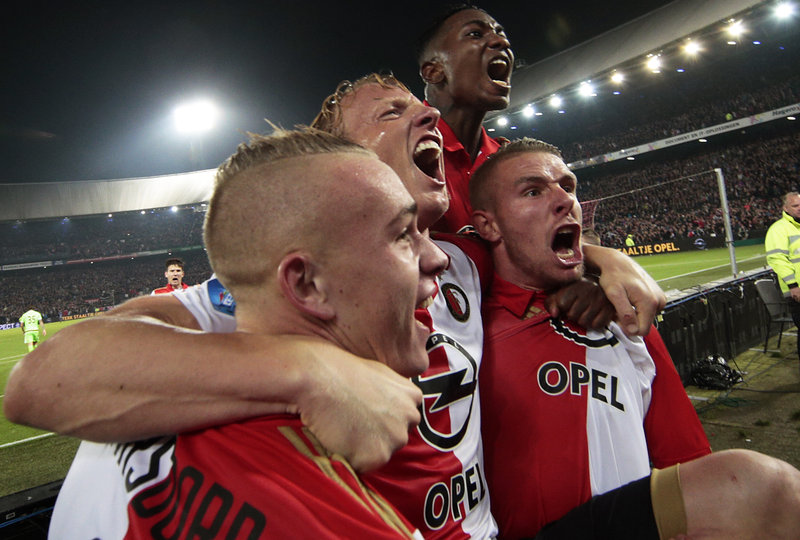
The veteran marksman avoided referencing the burden of expectancy that weighs heavily upon the shoulders of everyone associated with the third most successful club in the Netherlands; Feyenoord having been crowned national champions on fourteen occasions, trailing only PSV (22) and Ajax (33) in this regard. Yet, notwithstanding their illustrious history, 16 years have elapsed since the Rotterdam giants’ last lifted the Eredivisie title in 1999 and, as such, pressure and unrealistic expectations have become a fact of life at De Kuip.

Surprisingly, Feyenoord are actually the last Dutch team to achieve continental success; Bert van Marwijk’s side having secured the UEFA Cup by overcoming Borussia Dortmund on a famous night in De Kuip in 2002. During those heady days around the turn of the century, you would have been hard pressed to find anybody associated with the Rotterdam club who could have envisioned then the remarkable drought (save for a lone KNVB Beker triumph in 2008) that would ensue thereafter.

Yet it was this ‘golden period’ of success that very nearly set the club on the road to ruin.

In 1998, with the club well on their way to securing its’ fourteenth national championship, the FIOD-ECD (Fiscal Information and Investigation Service/Economic Investigation Service) visited Feyenoord because of suspected fraud associated with the signings of Aurelio Vidmar, Christian Gyan and Patrick Allotey. This became an ongoing scandal with Chairman, Jorien van den Herik, the main suspect. Both Feyenoord and van den Herik were found to be not guilty in 2002 and, despite a later appeal, after three years of investigations, the initial ruling was upheld in 2005.

This off-field turmoil would prove to be only the tip of the proverbial iceberg.

The following year, the club’s supporters saw their two star players leave De Kuip for Chelsea (Salomon Kalou) and Liverpool (Dirk Kuyt) respectively. Meanwhile, it was revealed that Feyenoord were teetering on the brink of financial oblivion despite earlier claims to the contrary by van den Herik. Supporters’ unrest quickly turned to anger and, following continued and vociferous protests, van den Herik resigned.

Following the departure of van den Herik, a new board set up Youth Investment Funds which encouraged investors to effectively purchase a stake in the talent being developed at the club. However, initially, most players failed to live up to their early promise and left De Kuip as free agents while others were sold for far less than the club had initially hoped which left the Rotterdam giants owing even greater debts to the investors. The scheme would only bear fruit some years later with the sales of the likes of Stefan de Vrij, Bruno Martins Indi and Luc Castaignos, after all players in the Academy, from U15’s up to the U19’s had become included in the initiative which generated millions of euros in investment in a succession of talented generations of players, from the transfer of which, investors received a cut of 18.33%.

On the field meanwhile, by the summer of 2007, the club, having hired and fired both Ruud Gullit and Erwin Koeman following the departure of Bert van Marwijk to Borussia Dortmund in 2004, had parachuted in legendary coach, Leo Beenhakker, in its time of need towards the end of the 2006-07 campaign. However, despite the efforts of the man who had helmed the club to its fourteenth and last national championship in 1999, it was all for nought as Feyenoord missed out on European qualification for the first time in 16 years following an unthinkable 7th place finish. The club also suffered the ignominy of having been thrown out of the UEFA Cup following hooliganism prior to and during a match with AS Nancy earlier in the year. Would-be last 16 opponents, Tottenham, received a bye after the Court of Arbitration upheld UEFA’s decision to eject Feyenoord from the tournament and fined the club £40,000.

The return of van Marwijk the following season, heralded a renewed optimism at the club as Feyenoord also made a number of high-profile signings, including Dutch internationals, Giovanni van Bronckhorst and Roy Makaay. However, despite keeping pace with eventual champions PSV at the top of the table until a crucial showdown at De Kuip just prior to the winter break went the visitors way, the New Year brought little cheer as Feyenoord’s form dipped alarmingly resulting in an eventual sixth place finish as the 2007-08 campaign proved to be a false dawn.

The pain was mitigated somewhat as the club collected its first prize in six years: 100 years after the foundation of the club, Feyenoord managed to win the KNVB Beker, beating Roda JC 2-0 at a jubilant, De Kuip.

However, any thoughts of continuity were dashed soon after the KNVB Beker triumph when van Marwijk accepted the role of Bondscoach. Forced once more in a new direction, Feyenoord appointed the highly regarded, Gertjan Verbeek as their manager for the following season.

However, following a disastrous first half of the 2008-09 campaign and a mid-season player revolt, the hapless Verbeek was sacked with assistant, Leon Vlemmings, tasked with saving the Rotterdam giant’s season. Although results improved slightly thereafter, the best the club could manage was to secure a spot in the playoffs for the final Dutch Europa League slot in which the team inexplicably fell flat.

The following season saw the club turn to its former assistant manager and player, Mario Been to lead the club out of the doldrums. Been, after achieving minor European successes with NEC Nijmegen, was considered to be the ideal man for the job. Former manager, Leo Beenhakker, at that time manager of the Polish national team, assumed the role of Technical Director.

A fourth place finish secured a crucial Europa League place, meaning that Feyenoord would take part in continental club competition for the first time in two years, while an inspiring run to the final of the KNVB Beker added to an air of renewed self-belief around De Kuip.

In the summer of 2010, some even considered Been’s men dark horses for the Eredivisie crown in 2010-11.

How wrong they were.

After tumbling out of the Europa League in the qualifying rounds to Gent, the club also suffered a humiliating exit in the third round of the KNVB Beker at the hands of Roda JC following a penalty shootout at De Kuip.

However, much worse was to follow.

On 24 October 2010, Been’s charges were humiliated at the hands of a ruthless PSV Eindhoven who hit the Rotterdam giants for ten for no reply.

Prior to that day that many dubbed the worst in the club’s history, the club had opened talks with a group of fans united under the name Varkenoordgroep, after the Academy offices they regularly met in and a group of investors, known as the Vrienden van Feyenoord (“Friends of Feyenoord”). But in the aftermath of the mauling in Eindhoven and with the club on the brink of bankruptcy, talks were stepped up until, following an uplifting 3-0 victory over VVV Venlo at De Kuip in the match immediately after the PSV humiliation which saw fans pack the stands in solidarity holding aloft banners that read ‘Unconditional love, unconditional support’, the club and investors reached an agreement on the huge debt the club owed, calculated somewhere between 35 and 40 million euros, with the investors receiving 49 percent of the stocks of the club for around 30 million euros.

Yet this resolution of the club’s financial issues did not bring an end to the turmoil.

In mid-January 2011, Leo Beenhakker resigned after multiple clashes with the Feyenoord Directors who replaced him with former Feyenoord player, Martin van Geel, previously the Technical Director at Roda JC.

An unacceptable tenth place finish meant that the club would once again have to operate without the added income generated from involvement in European competition in 2011-12. The writing was on the wall for Mario Been and, in July 2011 he stepped down; player power having done for Been as it had previously for Verbeek.

Following Louis van Gaal’s refusal of the managerial role at De Kuip, the club sought out legendary former Barcelona defender Ronald Koeman, who had played for Feyenoord during the late 1990s. Upon acceptance, Koeman became the first man to serve as both player and head coach at each of the so-called “traditional big three” of Dutch football: (AFC Ajax, PSV Eindhoven and Feyenoord).

Following the loss of key players: Leroy Fer, Georginio Wijnaldum and André Bahia to FC Twente, PSV Eindhoven and Samsunspor respectively, the club turned to youth to revive its ailing fortunes, with the likes of: Jordy Clasie, Miquel Nelom, Guyon Fernandez and Kaj Ramsteijn promoted to the first team.

Although compensated financially for their services, the loss of the likes of Fer and especially Wijnaldum, not, as had become progressively commonplace in the modern game and clubs, irrespective of their size or stature in the Eredivisie, to a club from the cashed up leagues of England, Germany, Italy and Spain, but to their own domestic rivals?

Had Feyenoord actually become a feeder club?

Unthinkable.

To little fanfare, two other players were drafted in on loan: Swedish starlet, John Guidetti from Manchester City and Otman Bakkal from PSV. Both would prove influential over the course of the 2011-12 campaign, but it was marksman, Guidetti whose goal-scoring exploits would capture the hearts of Feyenoord’s devoted fan-base with a remarkable 20 goals in 23 appearances as the club emerged as unlikely title contenders, finishing just six points behind eventual champions, Ajax and in the process securing a place in the third qualifying round of the UEFA Champions League.

It wasn’t just on the field that things were showing signs of improvement.

On 16 December 2011, it was revealed that Feyenoord had been placed in the more favourable second category (Category 2), meaning that Feyenoord, in the eyes of the KNVB, were no longer in debt. This was owed, in part, to accumulated transfer revenue but also to a large capital injection made by the organisation VVF (Friends of Feyenoord, Vrienden Van Feyenoord).

On 13 April 2012 Feyenoord’s status was officially confirmed. Club chairman, Eric Gudde stated that the re-categorisation came earlier than anticipated, congratulated the fans and promised to maintain the same policy until Feyenoord was completely healthy, while insisting that the club would never again fall back into the first category.

The policy of frugality continued as the club recruited ahead of the 2012-13 Eredivisie campaign promoting more of its young starlets to the first team while supplementing this youthful injection with a number of experienced heads on free transfers: John Goossens, Ruud Vormer and Daryl Janmaat. The only expenditure came in the form of ADO Den Haag’s Lex Immers and Vålerenga’s Harmeet Singh.

Despite an early exit from European competition and losing both Karim El Ahmadi and captain, Ron Vlaar to Aston Villa in July 2012, Koeman’s charges were once more back in the title picture as the 2012-13 Eredivisie campaign reached its climax.

In the absence of Vlaar and El Ahmadi, it fell to Dutch youngsters, Stefan de Vrij (who assumed the captaincy) and Jordy Clasie (who became vice-captain) to take up leadership roles within what became an increasingly youthful line-up.

An eventual third place finish secured UEFA Europa League football for 2013-14 while the successful loan of Parma’s, Graziano Pelle (who netted a remarkable 27 goals in 29 appearances) resulted in the Italian striker’s move becoming a permanent one.

Despite enduring the club’s worst start in its illustrious history, in spite of maintaining all of its key men the following season, (Feyenoord opening with loses to: PEC Zwolle, FC Twente and Ajax respectively), the Rotterdam giants recovered and capitalised on the inconsistency of those at the top of the table to eventually feature in the race for the title, finishing just 4 points behind eventual champions, Ajax, who collected their fourth successive title.

Although having secured a place in the third qualifying round of the UEFA Champions League for the second time in three years, the club and its supporters’ optimism was mitigated somewhat by the announcement in February 2014 that coach, Ronald Koeman would be leaving the club at the end of the 2013-14 campaign.

Fred Rutten was revealed as Koeman’s successor on 3 March 2014 but the new man at the helm would endure a turbulent summer where Feyenoord lost four of its best players, not to mention most of its defence: Daryl Janmaat to Newcastle United, Stefan de Vrij to Lazio, Bruno Martins Indi to FC Porto, and Graziano Pelle to Southampton – Koeman’s new club.

In spite of its recent seasons of frugality in the transfer market Feyenoord appeared to revert to type in the wake of this exodus of high profile names. The club suffered elimination from the UEFA Champions League at the third qualifying round stage at the hands of Besiktas, 5-2 on aggregate, but did, at long last, manage to reach the lucrative group stages of the UEFA Europa League (defeating FC Zorya Luhansk in the final qualifying round 5-4 on aggregate) as its hectic recruitment drive continued throughout August 2014 with experienced Aussie, Luke Wilkshire arriving from Dynamo Moscow, veteran Dutch international, Khalid Boulahrouz from Brøndby IF, Bilal Başaçıkoğlu from SC Heerenveen, the much travelled, Colin Kazim-Richards on loan from Bursaspor, Jens Toornstra from FC Utrecht, Kenneth Vermeer, controversially from Ajax while Karim El Ahmadi also returned to De Kuip from Aston Villa.

Unsurprisingly, with a substantial influx of new players as well as a new coach, Feyenoord endured a disappointing start to the season taking just 5 points from 4 matches.

However, the club would surprise everyone with their exploits on the continent, opening with a 2-1 victory against Standard Liège in their first home match in Group G of the UEFA Europa League (the club’s first victory in the competition’s group stage in 8 years). Feyenoord also beat HNK Rijeka (2-0) and defending champion Sevilla FC (2-0) at De Kuip to reach the knock-out stage for the first time in 10 years before eventually being eliminated at the hands of AS Roma, 3-2 on aggregate despite having drawn the away leg impressively at the Stadio Olympico in Rome, 1-1.

After their European elimination, Feyenoord didn’t recover. Even though a spot for next season’s Europa League qualification rounds was almost secure, the team failed to win any of their last 5 games, ending in the season in a disappointing fourth place, behind AZ Alkmaar on the last day of the season.

Giovanni van Bronckhorst presided over the final few weeks of the campaign in the Feyenoord hot-seat having stepped up from his previous role as assistant manager earlier than planned to replace Fred Rutten who was fired on 17 May 2015 following a 3-0 loss at PEC Zwolle. Previously, on 2 March 2015, the club had announced that Rutten had decided not to extend his 1-year contract and would leave the club at the end of the season. But the club’s hierarchy believed that, following the costly defeat against Zwolle which left Feyenoord 4th in the Eredivisie and consequently out of the automatic UEFA Europa League qualification place that came with 3rd, they had to act to somehow save their season.

However, their efforts were in vein as, during the end-of-season play-offs to gain a ticket for the UEFA Europa League, Feyenoord were surprisingly eliminated at the hands of Heerenveen, leaving the club devoid of European competition and its associated revenue for 2015-16.

A dispiriting summer followed in which the inevitable departure of young captain and talisman, Jordy Clasie to ex-coach, Ronald Koeman’s Southampton, became a reality. Meanwhile, the recruitment of an aging Dirk Kuyt, the permanent signing of Colin Kazim-Richards, Groningen’s defensive lynchpin, Eric Botteghin, unheralded Swede, Simon Gustafson, Vitesse Arnhem’s midfield maestro, Marko Vejinovic, the much travelled Dutch international who had seemingly fallen off everybody’s radar, Eljero Elia, free agent, Jan-Arie van der Heijden and ADO’s gangly, goal-machine, Michiel Kramer continued throughout a disrupted and calamitous pre-season in which the Rotterdam giants were humiliated 3-0 at the hands of Koeman’s Southampton side in front of their own fans at De Kuip, while also suffering embarrassing reversals at the hands of both Olympiakos and VVV Venlo.

One could have forgiven even the staunchest of Feyenoord supporter for harbouring some grave reservations about their club’s chances as the 2015-16 Eredivisie campaign dawned.

Yet, Giovanni van Bronckhorst’s charges surprised all as they raced to three successive victories from the opening three games, dispatching both Cambuur away and Vitesse at home after an opening day win over Utrecht at De Kuip.

Despite notching nine pints from a possible nine, many believed that these victories had been both unconvincing and undeserved. Those same naysayers, feeling subsequently vindicated after seeing Feyenoord swept aside by a clinical PSV on 30 August 2015, believed the Rotterdam outfit would now reset their expectations to the previously anticipated quest for third place.

Unwilling to be consigned to another season of mediocrity, the club won five of their next six fixtures off the back of not only the 35-year-old, Kuyt, who rolled back the years with 6 goals in as many matches, but Elia, who notched three goals and put in a number of sparkling displays which recalled his early years at FC Twente, while new arrival, Kramer, having wrestled the central striking role away from Kazim-Richards, had hit three goals of his own.

Meanwhile, Vejinovic was beginning to pull the strings in the heart of the Feyenoord midfield alongside the previously unknown Gustafson, who not only helped himself to a goal at Heerenveen but also set up three of the other four Feyenoord goals at the Abe Lenstra Stadion on 18 October 2015.

A week removed from hitting Heerenveen for five and having bagged a treble of his own, Kuyt was at it again scoring his second hat-trick in a week during Feyenoord’s 3-1 win over AZ Alkmaar at De Kuip putting the Rotterdam club level on points with leaders Ajax once again.

The former Liverpool forward opened the scoring on 13 minutes before AZ equalised through Joris van Overeem, who slotted home from close range.

But Kuyt was on hand again just before the hour to get the final touch on Bart Nieuwkoop’s shot and deflect the ball past Gino Coutinho to put Feyenoord back in the ascendancy before sealing the win in the 77th minute when Coutinho cut down Gustafson in the area, prompting the referee to award the home side a penalty, which Kuyt duly slammed home.

With the victory came a defiant cry from 47,500 jubilant Rotterdammers. Even with the looming inevitability of a mid-season collapse and concession of a thirty fourth title to their fierce rivals from Amsterdam following the departure (for a second time) of their inspirational captain, (As Kuyt, basking in an unexpected Indian summer of his career with 12 goals in 11 appearances in all competitions in 2015-16, was suddenly linked with a shock switch to Barcelona as a short term fix for the Catalan club’s coach, Luis Enrique in the January transfer window), at the back of their minds.

All this, of course, is typical Feyenoord.

Many have attempted to pinpoint the reason for the enigma that Feyenoord as a club have become over the course of the last 16 years.

  • Those in charge of the club.
  • An aging line-up.
  • Operating with a ridiculously inflated wage bill to pay for the aforementioned aging line-up in an attempt to ‘keep up with the Jones’s’.
  • An inexperienced line-up (As a result of aforementioned over-spending, lack of involvement in lucrative European club competition, nose-dive into financial black hole and resultant near bankruptcy). ‘You’ll win nothing with kids…’
  • A lack of experienced leaders on the field when it comes to the crunch.
  • A lack of money.
  • A tendency to waste what little money is available to spend.
  • A lack of consistency.
  • The propensity to inexplicably lose their collective ‘heads’ in a pressure situation.
  • The predilection to metaphorically ‘shoot themselves in the foot’ when things seem to be going well.
  • ‘Player power’ in the dressing room.
  • The revolving door to the manager’s office at De Kuip (Often as a result of the aforementioned ‘player power’).
  • Selling key players (A necessity in terms of pulling the club out of the aforementioned financial black hole).
  • A resultant lack of any sort of clear vision or plan for the future (Both on and off the field).
  • The history of the club, the expectancy of the fans and the overwhelming pressure that comes with this.

Bearing all this mind and while factoring in a poor performance in the club’s only true test of its title credentials (a 3-1 defeat to PSV in Eindhoven on 30 August 2015), few truly envisioned Feyenoord being crowned national champions for the fifteenth time in the club’s illustrious history in May 2016.

In addition, a home tie against arch rivals Ajax in the 3rd round of the KNVB Beker on 28 October 2015 appeared just the sort of fixture which would have, in previous years, comprehensively dashed any delusions of grandeur harboured by the Rotterdam giants’ passionate and vociferous fan-base.

Yet, with the game locked at nil-nil and deep into injury time it was Kuyt, or more precisely, the veteran Dutch marksman’s presence that proved to be the difference once more, as Ajax’s Joel Veltman, with his hands full marking Kuyt as a Feyenoord free kick was lofted towards Jasper Cillessen’s far post, miscued his attempted clearance past the unsuspecting goalkeeper and into the back of his own net.

The emotional outpouring of joy and adulation that ensued thereafter on that Wednesday night at De Kuip not only acclaimed a victory over Feyenoord’s despised rivals from Amsterdam, progression in a cup competition at a fellow contender’s expense as well as the late and dramatic nature of the game-winning goal itself, but also reiterated the club’s defiance in the face of the doubters and proclaimed, at long last, it’s belief.

Name-StevenDavies

Click on Steven’s name above to follow him on Twitter

Bas Dost is now fully deserving of Oranje starting berth

He may not be the most dynamic, fluid or exhilarating striker, but the goals of Bas Dost can no longer be ignored. Dost’s second half of the Bundesliga season was seen as a flash in the pan by many, however, the Wolfsburg man has started where he left off this term and is showing few signs of letting up. As the Oranje crashed out of Euro qualifying in an embarrassing fashion, they did so without a leading marksman, so is Dost now the answer asks Alex Blinston.

Go back twelve months and any talk of Bas Dost being deserving of an Oranje call-up would have been first laughed at, and then duly dismissed with good reason. The Netherlands were coming off a 3rd place at the World Cup; an overachievement by any means, and Dost was keeping the bench toasty at Wolfsburg.

Well, what a difference twelve months can make. 2015 has seen Dost flourish in to the striker that many were expecting when he made the switch to Lower Saxony in 2012 after a 32 goal season with Heerenveen. In the last six months Dost has scored four in a game against Bayer Leverkusen, got on the scoresheet in the DFB Pokal final and be part of a Wolfsburg side that came 2nd behind the untouchable Bayern Munich; however, he is still yet to make his impact with the Dutch Lion on his chest.

There is only one reason for this: he hasn’t been awarded the chance. The football purists will point to his technical flaws; that he doesn’t fit the Totaal Voetbal theory that is deeply embedded in to Dutch football. However, neither does Klaas-Jan Huntelaar, the man with 76 caps and 42 goals to his name for country and his career with the national side, on an individual basis if nothing else, has been a success.

Guus Hiddink and Danny Blind persisted with the duo of Robin Van Persie and Huntelaar, whose powers are both waning; leaving Dost had to watch from the side-lines as he made just two substitute appearances in Euro qualifying.

This is not to take away from the prestige of Van Persie and Huntelaar – after all they are first and second respectively in the Netherlands’ all-time leading scorers list – but the mistake of picking stature over form may have been a costly one. Of course hindsight is a beautiful thing, but Dost has scored 25 club goals in 2015 – the aforementioned duo have only accrued 17 between them in the same time.

Unlike Wolfsburg’s backers, Volkswagen, Bas Dost’s reputation is only growing, and the sceptics who described his form last season as fleeting period of success, are quickly diminishing. The 26-year-old has averaged a Bundesliga goal every 96 minutes in the Bundesliga last term, compared to a goal every 120 minutes this season but it would have been ludicrous to expect Dost to maintain his pace from last term. Dost epitomizes the traditional no.9: dominating in the air and clinical in front of goal – his conversion rate (37.2%) was the best of all players in Europe’s top five leagues last term.

While Wolfsburg boss Dieter Hecking has slammed Dost for being ‘egotistical’, a common problem with Dutch front men, his showings this season will have gone some way to get him back in to Hecking’s good books.

Johan Cruyff – who I would like to wish support to in his battle with lung cancer – famously said, “It’s better to go down with your own vision than with someone else’s.” His vision, and the Dutch vision will always be Totaal Voetbal, something Bas Dost will never fit in to. However, Cruyff also said, “Every disadvantage has its advantage” and bare this in mind with Bas Dost and the direction the Netherlands should take. Dost isn’t aesthetically pleasing, like many of his predecessors have been; however, he has a lot to offer an Oranje side that needs to stray away from Totaal Voetbal.

Name-AlexBlinston

What can Reading FC fans expect from Ola John?

On deadline day over in England, Sky Bet Championship side Reading FC pulled off quite a coup by the loan signing of Dutch winger Ola John from Portuguese giants Benfica. Fin Crebolder is here to inform the Reading fanbase what they are about to witness…

BACKGROUND

After being born in Liberia, Ola John moved to the Netherlands at a young age, and joined the youth academy of Dutch giants FC Twente at the age of ten after spending two years at minnows DES Nijverdal. He made his professional debut for the club in November 2010, at the age of 18, coming off the bench against AZ Alkmaar. This set the tone for the rest of the season for John, as he came off the bench in nine more games, and even started in three games, managing to get one goal and one assist in 13 appearances overall.

The 2011/12 season was John’s true breakthrough season, as he established himself as one of the nation’s biggest talents. He came on as a late substitute in the first game of the season, but due to an injury to Nacer Chadli, he made the left midfield spot his own from the second game, where he got his first assist of the season. He notched his first league goal for the club in October, in a 2-2 draw with Excelsior, and this sparked a truly remarkable run of form for the 19-year-old, where he got either a goal or an assist in six consecutive games.

John continued this form throughout the season, putting in some very impressive performances, including a game against where he got two goals, one assist and inspired his team to a 6-2 victory. He also impressed in the Europa League, and in the group stages particularly, where he got six assists in six games. He ended the 11/12 campaign with nine goals and an incredible 22 assists in all competitions. This earned him a place in the preliminary Netherlands squad for Euro 2012, an impressive achievement for such a young player.

After it became clear that John was a huge talent, it was inevitable that bigger clubs would come sniffing, and in May 2012, he signed a five-year-deal with Benfica. His first season at the club was relatively successful. After initially struggling to make an impact, being behind Eduardo Salvio and Nicolás Gaitán in the pecking order, he eventually managed to get himself a place in the starting line-up, and enjoyed a good run of form across league, cup and European matches, finishing the season with a respectable four goals and eight assists.

After a solid but unremarkable first season for the Portuguese giants, John was expected to kick on in his second season, but things did not go to plan. At the start of the season, the club signed promising winger Lazar Markovic from the Serbian league, and he impressed straight away, making the Dutch winger the fourth choice. In order to get first team football, John left for German Bundesliga side Hamburger SV on loan in January, hoping to help keep them in the German top flight whilst showing his talents. Again, this did not go to plan, as he failed to impress in eight games for the club, although they did stay up, and this capped off a very disappointing season for John.

He returned to Benfica at the start of the 14/15 season expecting to leave the club in the summer transfer window. However, after Liverpool signed Lazar Markovic from the club, John ended up staying, moving up the pecking order and enjoyed a better season than the previous. Although he continued to struggle to get in the starting line-up, he managed to make an impact off the bench throughout the season, notching up four goals and seven assists. His final action for Benfica was scoring the winning goal in the Portuguese League Cup final.

Overall, his time at Benfica was disappointing considering the huge potential that he arrived with. He never managed to nail down a place in the first team and play his best football, and the fans never really warmed to him either, often complaining about his lack of footballing intelligence, an attribute that was seen as very important by both the fans and coaches of the club.

STYLE OF PLAY

John is a player that will truly excite fans with his blistering pace and quick feet, as well as his dangerous long shots. He is capable of playing on either wing, but is most comfortable playing on the left and cutting inside onto his stronger right foot where he will look for an opportunity to release a shot or play in one of his team-mates. In terms of comparison, his style is similar to that of his compatriot, Memphis Depay.

Alongside his very impressive pace and dribbling, John also has excellent passing ability, and these attributes mean that he can unlock almost any defence on his day. It would be unfair not to mention his weaknesses, and as already mentioned, his footballing intelligence is not the best, and he was often tactically in the wrong during his time at Benfica, something that Jorge Jesus felt was important, hence his lack of starts. Like many players of his style, John’s work rate is also not the best, and he can often leave his full back exposed.

THE FUTURE

That brings us up to present day, where he has just signed for English Championship side Reading. Now, as a half-Dutch (his nationality) Reading (his current club) fan, I am undoubtedly (more than…) slightly biased, but Ola John still has the huge talent that he showed throughout his time at FC Twente, and in brief glimpses at Benfica, and this loan move seems like the ideal opportunity for him to reignite his career. He was scintillating in the Eredivisie and it’s fair to say that the English Championship is a slightly weaker league, so Ola John could find it easier to impress again.

In Reading, he has a club on the up with ambitious owners and a transfer window that has given them a club capable of challenging for promotion. As the club has an option to sign John permanently at the end of the season, he could find himself playing in the best league in the world this time next year, if he can rediscover the incredible form that earned him a move to one of Europe’s biggest clubs, and at the age of 23, there’s no reason why he can’t.

Name-FinCrebolder

Click on Fin’s name above to follow him on Twitter.

PSV’s Champions League fate

Phillip Cocu’s PSV Eindhoven are all set for their bow in this seasons’ UEFA Champions League. The Dutch champions, who were the first club from the Netherlands to participate in the competition in 1992, were drawn against Manchester United, Wolfsburg and CSKA Moscow in Thursday’s draw in Monaco. They will be looking to secure a place in the last sixteen writes Sam May.

Having played in the competition 149 times to date and winning the tournament in 1988 beating Benfica 6-5 on penalties, PSV come with a wealth of experience and will be looking to emulate the success they have had in recent years. Their most recent success was reaching the play-off round when they played AC Milan in what would be a great achievement for the club, the first leg of the tie finished 1-1 at the Phillips Stadion but the return leg differed with Milan being out-right 3-0 winners.

PSV, who have won the Eredivisie title 22 times, play their opening match at home on the 15th September 2015 against Louis Van Gaal’s new look Manchester United side. The former Oranje head coach will return to his homeland hoping to spoil to the party. The first matchday will also see former PSV player Memphis Depay play against his former employers, the 21-year old pacey winger, who has made eight appearances in the competition, scoring three goals, will be looking to add to his tally when he returns to the Phillips Stadion. It comes just after he won the Eredivisie championship a few months before with Cocu’s men. It will also be a return for Daley Blind; the former Ajax player will receive a tasty reception on his arrival.

Memphis didn’t take long to spice up the occasion after taking to Twitter straight after the draw was announced stating: “well, well, we meet again”. However, the Dutch club didn’t take long to respond stating: “Were always happy to have you here. Keep in mind were unbeaten at home against Manchester United so don’t expect too much”.

Albert Stuivenberg one of Van Gaal’s trusted lieutenants will also return to his fellow country as will goalkeeping coach Frans Hoek, performance analyst Mex Reckers, chief fitness coach Jos Van Dijk and chief scout Marcel Bout.

PSV’s key to progression…

Jeroen Zoet – Recently linked with Crystal Palace, the young 24-year shot stopper, who came through the youth academy, helped clinch the title in 2014-15 with a number of outstanding displays. The goalkeeper is good in the air and also with the ball at his feet.

Hector Moreno – Signed from Espanyol this summer, the 6ft centre back comes with a wealth of experience having played for Mexico in the 2014 World Cup in Brazil. His physical prowess means he has the ability to lead from the back, command and organise the defence.

Jetro Willems – He represented the Netherlands at Euro 2012 becoming the youngest ever player at a European Championship. Now in the Netherlands first team, the 21-year old was once a target for Sir Alex Ferguson when the Scotsman was looking for ‘the New Evra’ but the move didn’t materialise.

Adam Maher – Signed on a five-year contract from AZ in 2013 for €6.5m, he is a skillful 22-year-old defensive and attacking midfielder, who is the youngest player ever playing at a Dutch club to score a goal in the Europa League and UEFA Cup.

Andres Guardado – The Mexican 28 years of age, was named Eredivisie player of the season for the 2014-15, he was formerly of Valencia and is a fast left-winger who has an eye for goal cutting in on his left foot.

Luciano Narsingh – The 24-year old, is a versatile attacking midfield player who can play through the middle and on both wings. He scored the final goal as PSV defeated Heerenveen 4-1 to help win the Eredivisie title this season.

Luuk De Jong – Remember him? He will probably want to forget his short spell in England with Newcastle United. On 2nd August 2015 he scored a double to help PSV clinch the Dutch Supercup. The number 9 will be hoping to get off the mark in season Champions League.

Another Dutch Compatriot

Bas Dost will also return to the Netherlands when his Wolfsburg side take on the Eindhoven side on Tuesday 3rd November 2015. The 26-year-old Dutch International, who is currently Wolfsburg’s third-choice striker, had a decent spell with the Bundesliga side last season. He came through the ranks at FC Emmen and Heracles Almelo before moving to Heerenveen in 2010 and then on to the Bundesliga club in 2012.

Name-SamMay

Click on Sam’s name above to follow him on Twitter.

Ajax look to fit to be champions again

Ajax are on a mission to reclaim the Eredivisie title at first attempt from PSV Eindhoven. Last season’s champions have been weakened over the summer and Frank de Boer will believe his side are favourites going into the 2015/16 campaign. In their opening three matches, Ajax have looked like a side capable of winning the title, but their elimination in the Champions League highlights that there are still weaknesses in the side. The club can’t compete at the very top of the game, mainly due to the lack of finances in the Dutch game. However their academy is as strong as ever and a number of young players have displayed that in the opening three Eredivisie fixtures writes Jake Jackman.

The Dutch giants have a very young squad, which has advantages and disadvantages. Their Champions League defeat against Rapid Wien showed their lack of experience, particularly regarding game management which is crucial in a two legged cup tie. They should have been able to beat the Polish outfit and concerns grew among the supporters when they were knocked out. However, three convincing consecutive league victories without a goal being conceded has showed that Ajax should be considered favourites to regain the Eredivisie title.

Frank de Boer opted to sign Nemanja Gudelj and Mitchell Dijks this summer, which could be some great business. Neither are huge names, but they both have plenty of experience in the Dutch top flight and they have slotted in seamlessly into the Ajax side. The former has been really impressive, grabbing a goal and an assist already, while also dominating games in the middle of the park. Meanwhile, former Ajax youth team player Dijks has two assists to his name so far, highlighting the attacking qualities that he brings to the club. It would have been easy for Ajax to panic after being outclassed in all departments by PSV last season, but they stuck to their principles and these two signings show that the club were right to do so.

The club’s attacking play has been excellent in their opening three games as would be expected from Ajax. The club are averaging 16.3 shots per game this season, which highlights the creative quality in the side. Their average possession (56%*) and average passing success (81%*) shows that the side will dominate games in the Eredivisie. After the disappointment of losing their Eredivisie crown, Ajax’s early season form shows that they are determined to reclaim the title this season and they could even surpass the achievements of the dominant PSV side of last year.

Every side needs a star player to look to for inspiration and Anwar El Ghazi could be developing into that player for Ajax. The forward is only 20-years-old, and has a lot of developing to do, but the potential is obvious and he is already performing well for Ajax. Memphis Depay has left a gaping hole in the Eredivisie after his spectacular performances last season and there are a number of players who could step up to replace him as the league’s leading player, including El Ghazi. The 20 year old has already scored four times in the league and he has the quality to go on to surpass the twenty goal mark. If he does, he will quickly emerge as one of the hottest talents in European football.

Ajax have had a very good summer with the board making some smart decisions, rather than panicking after losing the league title. Frank de Boer will want to go out on a high before leaving the club and this team could develop into one of the best sides the club have had this millennium. After the disappointment of an early Champions League exit, the manager will know the importance of a strong domestic season. They should be able to compete in both the league and in the Europa League. The latter is a competition that the club could go far in, as they have shown in the last few years that they can beat some of the very best in European football. The Europa League is still a very competitive tournament and it could give this side some much needed experience in European ties. PSV have started the season averagely and Ajax already look to be the favourites to reclaim their crown.

*All stats courtesy of Opta Sports.

Name-JacobJakeman

Click on Jacob’s name above to follow him on Twitter.

TotalDutchFootball.com    WorldFootballWeekly.com

Waltzing Matilda in Kerkrade… Roda add Aussie Wonderkid to their ranks

There’s been something of a revolution happening at Roda JC in the past few months  – one of the Down Under variety.  With Roda JC announcing today the signing of Aussie young gun Daniel de Silva, they now have signed 3 Australians in this transfer window.  De Silva will have compatriots Tomi Juric and Rostyn Griffiths for company in Kerkrade this season.  So Dutchman living the land of Oz, Rogier Waalder looks into who these Aussies are and why the sudden love for all things Australian for Roda JC.

Roda JC does have a bit of history when it comes to signing Aussie players having had the following players on their books:

  • Zelko Kalac (Goalkeeper) – played over 100 games for Roda between 1998 & 2002 and is renowned as bit of a club legend. Roda sold him onto the then Serie A side Perugia.  Kalac is now Goalkeeping Coach at Western Sydney Wanderers.
  • Graham Arnold (Striker) – Roda signed Arnold from Sydney United in 1990 and he would go onto scoring over 20 goals in his 60-odd appearances for the club before having further successful spells at NAC and Sanfrece Hiroshima. He would later go on to be Manager for the Australian National side and is now the Manager for Sydney FC.
  • Gary van Egmond – Van Egmond played 10 games for Roda in the 1990/91 season.

One suspects though that this latest Aussie influx at Roda is down to the fact that they are using Han Berger as a Technical Director (via his football consultancy firm).  Berger has strong ties to football in Australia having been Technical Director for the Football Federation of Australia from 2009 to 2014 and even had a spell as National Manager during this time.  Berger is using his knowledge of the Australian market to Roda’s advantage, whilst offering Australian talent an opportunity to play in a European league.  All three of the current Australian players at Roda have been signed from the A-League but all three do have European experience.

Rostyn Griffiths was the first Australia to sign this transfer window when he joined from Perth Glory.  English-born Griffths went through the youth ranks at Blackburn Rovers and had loan spells at Gretna and Accrington Stanley whilst there.  He moved back to Australia and played for a few A-League clubs before heading off to China with Guanghzhou R&F before  further spell in the A-League.  A defensive midfielder, Griffiths is capable of scoring a goal or two has started all three Eredivisie games for Roda so far this season.  Griffiths is yet to be capped by the Socceroos so will be hoping his form keeps up in Kerkrade.

Tomi Juric is somewhat of a coup for Roda JC when he signed from Western Sydney given the fact that clubs like Hull City and Club Brugge were rumoured to be in for his services.  Juric has a similar playing style to Aussie legend Mark Viduka and both also share Croatian heritage.  Juric had spells in Croatia during his formative years but it was his spell with the Wanderers that earned him the plaudits with Juric contributing to the clubs fairytale Asian Champions League success in 2014.  Juric has been capped nine times for Australia and also contributed goals in Australia’s Asian Cup title in 2015.  A strong, mobile striker Juric will score goals if presented with opportunities.

Daniel de Silva is the closest thing Australia has to a ‘wonderkid’ at present and despite being only 18-years-old could prove to be a very shrewd signing for Roda JC.  De Silva is of Portuguese heritage and this skilful attacking midfielder caught the eyes of the football public during the Under-20 World Cup in 2013 when he scored a spectacular goal against Colombia when only sixteen.  His performances in that tournament resulted in a transfer to AS Roma who immediately loaned him back to Perth Glory.  There is some confusion as to whether de Silva is on loan to Roda JC from Roma or Perth Glory, with speculation that his Roma contract was terminated due to squad rules difficulties.  No matter for de Silva who knows that he is a Roda JC player for the next two seasons with Berger waxing lyrically in the Dutch press about the skills and potential of his young prodigy.

Footballing eyes in Australia will be keenly trained on the Eredivisie this season to see how this next generation of young stars handle the transition from the A-League to the Eredivisie and hopefully have the same success as the likes of Jason Culina, Tommy Oar and Brett Emerton.

Name-RogierWaalder

Click on Rogier’s name to follow him on Twitter.

Life after Death for Dutch Football?

The excellent Steven Davies looks at the recent bankruptcies of: HFC Haarlem, RBC Roosendaal, AGOVV Apeldoorn and SC Veendam. In addition, he investigates the ill-fated 2e Divisie competition which was held in June 2015, before focusing on the future by outlining the plans put forward by the KNVB to restructure the Dutch footballing pyramid from 2016/17 onward in an attempt to make competing at each level financially viable.

The economic downturn and its associated financial hardships are prevalent all over the globe. In footballing terms, nowhere has this been more evident than in the Netherlands, where, over the last six years a number of clubs have teetered on the brink of or fallen into the abyss of bankruptcy.

HFC Haarlem, SC Veendam, RBC Roosendaal, AGOVV Apeldoorn; remember these names? Each had a proud history, with three of their number (HFC Haarlem, SC Veendam and RBC Roosendaal) having reached the highest echelon of professional football in the Netherlands; the most recent being RBC Roosendaal’s stint in the Eredivisie between 2002 and 2006.

A Proud History

On January 25th 2010, HFC Haarlem was declared bankrupt. As such, all of its players and staff were declared free agents and, in accordance with Dutch league rules, the club was excluded from all competition, with its previous results and points accrued in the ongoing competition expunged from the record books.

Founded on October 1st 1889; HFC Haarlem had an illustrious history, having won the Dutch national title in 1946 while also reaching five Dutch cup finals (triumphing in 1902 and 1912 and coming up short in 1911, 1914 and 1950). Following this period of success, the club spent time outside of the top flight before returning to prominence in the 1970’s and 80’s, winning the Eerste Divisie on three occasions: in 1972, 1976 and 1981. In 1982, a side featuring a young Ruud Gullit even qualified for the UEFA Cup, but eight years later the club was relegated and, over the course of the subsequent two decades, operated at Eerste Divisie level prior to their declaration of bankruptcy in early 2010.

However, this was not the end.

A month after being declared bankrupt, HFC Haarlem was reinstated as a new amateur club, who then began talks aimed at a potential merger with amateur, Haarlem-based side, HFC Kennemerland of the Tweede Klasse with the subsequent merger completed on April 27th 2010.

Today, the new club, Haarlem Kennemerland, languishes in the Vierde Klasse (the eighth tier of the Dutch footballing pyramid) and play their home games at Haarlem Stadion, the former home of HFC Haarlem.

On June 8th 2011, just over a year after the announcement of HFC Haarlem’s bankruptcy, RBC Roosendaal was declared bankrupt after the board failed to repay debts of €1.6 million which then led to an automatic revocation of their professional license from the KNVB.

RBC, formed on July 31st 1912, was initially known as Excelsior before being renamed, VV Roosendaal in 1920, only to be rechristened once more, seven years later, on July 16th 1927, to become known as Roosendaal Boys Combinatie (RBC), following a merger with Roosendaalsche Boys.

In 1955 the club turned professional and won the Tweede Divisie B in 1957, but, in 1971, left professional football in following the restructuring of the league system by the KNVB before eventually returning to the professional ranks in 1983.

In 2000, the club reached the highest echelon in Dutch football, the Eredivisie, but their stay was a short one; RBC being relegated after just a single season following an 18th place finish. But, along with opening their new stadium in 2001, the club secured promotion at the first time of asking and retained its Eredivisie status until it’s relegation in 2006; RBC Roosendaal finishing bottom of the pile, having accrued just 9 points from 34 matches.

Following its bankruptcy, the club changed its name back to RBC on September 21st 2011 and kicked off the 2012/13 season in the Vijfde Klasse (the ninth tier of the Dutch footballing pyramid), initially calling Sportpark Rimboe in the village of Wouwse Plantage, just south of Roosendaal, home.

On April 7th 2013, RBC secured promotion after demolishing VV Rimboe 10-1 and the championship the following week before later announcing that they would return to the RBC Stadion for the 2013/14 season.

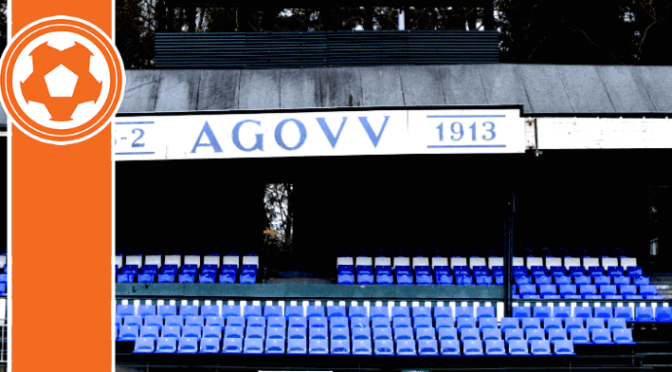
A few months prior to RBC securing its first promotion since its rebirth in the amateur ranks of Dutch football, on January 11th 2013, AGOVV Apeldoorn was declared bankrupt and was thus according to Dutch league rules excluded from competition, with all its previous results in the ongoing competition expunged and its players (and staff) becoming free agents, while it’s amateur side continued to operate in the Vierde Klasse.

Initially founded on February 25th 1913 as AGOSV (Apeldoornse Geheel Onthoudersvoetbalvereniging Steeds Voorwaarts), the club later had to change its name due to the fact that another club was also called Steeds Voorwaarts. The name was changed to AGOVV, or Apeldoornse Geheel Onthouders Voetbalvereniging (Apeldoorn Football Club for teetotallers) with the meaning of the abbreviation later altered to Alleen Gezamenlijk Oefenen Voert Verder (Only Practising Together Brings Us Further).

AGOVV, runners up in the KNVB Beker in 1938, gained professional status in 1954 before returning to the amateur ranks in 1971 due to financial problems. They remained an amateur outfit for over thirty years, until, on July 1st 2003, the club was re-admitted to the Eerste Divisie.

In their first season back in the professional ranks, forward, Klaas-Jan Huntelaar was the Eerste Divisie’s top marksman with 26 goals and is just one of a number of notable players to have represented De Blauwen including: Nacer Chadli, Raimond van der Gouw, John Karelse, Dries Mertens and Paul Verhaegh. During its ten-year stint in the second tier of Dutch football, the Apeldoorn-based outfit achieved mainly middle and lower half of the table finishes prior to its bankruptcy in January 2011.

Two months after AGOVV’s demise, another Eerste Divisie club, SC Veendam, also filed for bankruptcy.

Founded on September 4th 1894 and one of the oldest professional Dutch football clubs; SC Veendam was initially known as, Look-Out, before later becoming, Prinses Juliana Veendam (Princess Juliana Veendam) in 1909, which was later shortened to simply, Veendam.

Veendam became professional in 1954 following the introduction of the Dutch professional league. The professional branch left the club in 1974 to form Sportclub Veendam, while the amateur branch became Veendam 1894 with Sportclub Veendam later becoming Betaalde Voetbal Veendam or BV Veendam.

The club spent much of its professional existence (42 seasons) in the second tier of the Dutch footballing pyramid but also enjoyed brief spells in the top flight: in 1954–55, 1986–87 and 1988–89.

However, during the 2009/10 season, a number of financial issues emerged and on April 28th 2010 (only days after the end of the 2009/10 season) the club was requested to be declared bankrupt due to excessive debts. On May 12th 2010, bankruptcy was confirmed, threatening to put an end to the club’s 115-year history. However, the verdict was later overturned on appeal after the club managed to pay off the majority of its debts before the deadline of June 2nd 2010 and, seemingly out of the financial wilderness, the following year the club underwent yet another rebranding, changing its name from BV Veendam to SC Veendam.

However, this proved to be a false dawn, as, two years later, the funding problems that had plagued the club since the 2009/10 season re-emerged, forcing the club to once more file for bankruptcy, which was declared on March 25th 2013.

Bankruptcy amongst football clubs is not an uncommon occurrence in the Netherlands (especially for those clubs forced to operate with limited resources in terms of sponsorship, media exposure and gate receipts outside the top flight) with the aforementioned recent casualties of the economic downturn joining the likes of: FC Wageningen, SVV, SC Amersfoort, FC Amsterdam and Fortuna Vlaardingen in extinction.

What Next?

When such events occur, we are left to wonder where the fans of these storied clubs go.

With this in mind, journalists: Leo Oldenburger and Edwin Struis, created the 2e Divisie.

The 2e Divisie, was a four team mini competition that was set to be held over the course of four match days in June 2015. Beginning in Haarlem, the concept pitted four storied but now defunct Dutch clubs against one another: HFC Haarlem, FC Wageningen, SVV and SC Veendam. Added to the air of nostalgia was the use of each of these famous old clubs’ stadia and players along with a new line of apparel produced by technical sponsors, Copa Football and the added incentive of free admittance for all.

Unfortunately, this romantic notion was crushed in its infancy by the outbreak of riots between sections of supporters during the opening round of the competition which was held on June 3rd at Haarlem Stadion.

Following these events, on June 8th the mayor of Wageningen, on the advice of police and fearing a repeat of the violence witnessed at the Haarlem Stadion, elected to revoke the license for match day two of the competition which was set to be held at the Wageningen Berg. In turn, this led to the cancellation of the remainder of the competition and the abandonment of the concept by the organisers.

Life after Death?

Elsewhere in Europe, bankruptcy has not meant the end for all clubs, with the likes of Chester FC and FC Halifax Town reforming and making their way through the lower ranks of amateur football in England to now find themselves knocking on the door of the Football League, while, in the aftermath of a move to Milton Keynes which eventually saw Wimbledon rebranded as MK Dons; AFC Wimbledon (founded on May 30th 2002) rose like a phoenix to eventually achieve league status in 2011. This fairy tale resurgence followed the examples of the likes of Accrington Stanley F.C. who were promoted to the Football League in 2006 and Aldershot Town who followed suit two years later. Most recently, Newport County A.F.C. replicated the feats of all three clubs by achieving Football League status in 2013.

In Italy, the most notable instance was that of the demise and resurgence of Fiorentina, who, in 2001, with debts of around US$50 million, were relegated at the end of the 2001/02 season before entering into judicially controlled administration in June 2002. Subsequently refused a place in Serie B for the 2002/03 season, the club effectively ceased to exist.

Re-established in August 2002 as Associazione Calcio Fiorentina e Florentia Viola under the ownership of Diego Della Valle; the club was admitted into Serie C2 (the fourth tier of Italian football) and won its Serie C2 group with considerable ease, which would normally have led to a promotion to Serie C1.

However, the club bypassed Serie C1, being instead admitted into Serie B as a result of the Italian Football Federation’s decision to resolve the Caso Catania case by increasing the number of teams in Serie B from 20 to 24 and promoting Fiorentina for “Sports merits.”

In the summer of 2003, the club re-acquired the right to use the Fiorentina name and shirt design, re-incorporating itself as ACF Fiorentina before finally regaining top flight status after playoff success against Perugia at the end of the 2003/04 season.

Hope for the Future?

Despite the recent spate of heart-warming stories of clubs remerging from the ashes across the continent, until recently, it was highly unlikely, under the current format, that we would ever see the likes of Haarlem Kennemerland or the reborn, RBC return to the professional ranks of Dutch football.

However, a sole crumb of comfort for supporters of these clubs and others of a similar standing came in the form of an announcement made by the KNVB on December 3rd 2014, which stated that, from 2016/17 onwards, the amateur and professional leagues in the Netherlands will be interlinked more closely in a new footballing pyramid.

Within this new structure there will be mandatory promotion and relegation between the Eerste Divisie and a new, semi-professional National Division. In addition, a new licensing system will be introduced with the reserve sides of all professional cubs integrated into the Hoofdklasse and Topklasse (the top two amateur tiers) as well as the new National Division and the Eerste Divisie (the second and lowest professional tiers in the Dutch game).

“This is (a) historic day for Dutch football. For the first time since the introduction of professional football in this country, we have a completely open league structure. The bottom region of the Eerste Divisie and the top sections of amateur football were like stagnant water, and we needed a flow of movement to establish a healthy breeding ground,’ Bert van Oostveen, Director of the Netherlands Professional Football Association, commented, ‘We have battled many years for this and now we have implemented it. This is a major step in our efforts to further develop football in the Netherlands.”

The new league system with the Eredivisie at its apex, will have the Eerste Divisie directly beneath and the new National Division making up the third tier, while below this there will be two Topklasse and six Hoofdklasse amateur divisions.

It is intended that the newly formed 18-club National Division will create a better transition between the demands of professional and amateur football and thus improve the financial viability of running a football club at this level of the game in the Netherlands.

“From now on, sporting achievements will be rewarded in the best possible way,” van Oostveen insisted, “There is more excitement because of the chances of promotion in each league and teams will be playing at a level where they really come into their own.”

The new league structure will mirror the system in operation in both Germany and Spain with reserve sides competing within the new league structure and not in a separate competition.

Currently, two reserve sides are active in the Eerste Divisie: Jong Ajax and Jong PSV (there having previously been three prior to the withdrawal of Jong Twente ahead of the 2015/16 campaign following the club’s financial difficulties in 2014/15). In the new structure, four reserve sides will enter the new National Division with four more in each Topklasse league. The remaining ten will be incorporated into the six Hoofdklasse leagues with Jong Twente’s eventual level of inclusion yet to be determined.

In addition, new licensing terms will be established for the top four tiers of football in the Netherlands. With terms becoming stricter with progression up the pyramid; the new system will provide an essential transitional period of a number of years for clubs promoted from the National Division to the Eerste Divisie.

With strict policing of the licensing system, an inbuilt transitional period for clubs moving between tiers three and two as well as the added jeopardy of promotion and relegation increasing interest in terms of support, sponsorship and media exposure, it is hoped that we have seen the last of clubs going to the wall and being consequently consigned to footballing oblivion in the Netherlands.

Name-StevenDavies

Click on Steven’s name above to follow him on Twitter