Category Archives: FEATURE

KYLE EBECILIO: EX-ARSENAL YOUTH THRIVING IN THE EREDIVISIE

This article is courtesy of

TheFootballRoom-Main


Team-FCTwente

In the first Eredivisie match of the New Year, FC Twente took on lowly Heracles, who managed to pull off a couple of wins before the winter break, but got off to a poor start to the second half of the season. FC Twente took the lead early on in the first half and controlled the match throughout the rest of the 90 minutes as they won easily by a score of 3-1. The home side netted a penalty late on in the second half to seal the deal, which has also moved them to the top of the table, at least for the night. However, both Ajax and Vitesse should both be looking to win their matches fairly easily this weekend, so Twente will most likely fall back down into third place.

The Dutch giants came out attacking in a 4-3-3 formation with the sensational Luc Castaignos scoring the second goal of the match. The Twente footballers were allowed to roam from their positions moving forward in order to find space in between the opposition’s defense as they were always moving around. The young striker has scored in 6 of his last 7 Eredivisie matches. When Twente were in defense, they switched to a 4-4-2 formation to overload the midfield area and snuff out any space that might have been left from the other formation. In defense, there were usually 10 players behind the ball with two strikers playing off the shoulders looking to spring into a counter attacking movement looking to cut the opposition’s back four apart.

Kyle Ebecilio was a member of the Feyenoord youth academy until 2010 when European giants Arsenal snatched away this budding Dutch star. Ebecilio thrived in their youth system and broke onto the scene with the Dutch U17 squad where he won the Golden Player award at the under-17 European Championships back in 2011. However, Ebecilio wanted some first team action and he was not going to get it at Arsenal, so in May of 2013, the young Dutchman moved back home and signed a five year contract with FC Twente. Ebecilio stands at 1.82 meters tall and is a big presence in Michel Jensen’s midfield. At still just 18 years of age, Ebecilio wanted first team action and has certainly gotten some this season. In 19 league matches, he has made a total of 18 starts, while being an unused sub just one time.

Ebecilio has a very good work rate in him. He is always working hard, whether the club is moving forward in attack or going back and defending. The Dutchman is always looking for space to move into along the right side of the pitch to deliver crosses into the box so his teammates to get onto the end of them and slide them into the back of the net. Kyle will not blow by any defender but he will stretch the opposition’s defense apart with his triangle passing with his teammates along that flank. In the match against Heracles last night, he did just this.

Ebecilio has a very good work rate in him. He is always working hard, whether the club is moving forward in attack or going back and defending. The Dutchman is always looking for space to move into along the right side of the pitch to deliver crosses into the box so his teammates to get onto the end of them and slide them into the back of the net. Kyle will not blow by any defender but he will stretch the opposition’s defense apart with his triangle passing with his teammates along that flank. In the match against Heracles last night, he did just this.

Although he was fairly anonymous in the first half, Ebecilio stepped up his game in the second half. The young Dutchman got more involved in the attack as he managed to get a shot off, but it was not a good attempt at all. If there is one thing, his goal count will definitely not blow you away, but that is partially due to where he is being played at Twente. This was not the best match he has played this season, but Ebecilio is capable of much better and expect him to do so in the near future. By the time his contract runs out at Twente, he will still be just 23 years of age and look for the bigger clubs around Europe to be scouting him well before then. Despite last night’s match against Heracles, Ebecilio is an excellent player and will continue to develop into a phenomenal player and will feature with the Dutch National squad regularly.

 Name-KyleSennikoff

Click on Kyle’s name above to follow him on Twitter

 

Royston Drenthe – Where did it all go wrong?

Header-DutchmenAbroad

When Royston Drenthe signed for Real Madrid in 2007, he was a precociously talented youngster with a bright future and one of the Netherlands’ leading lights for the future.

Seven years on and he is one of football’s forgotten men, struggling to break into a Reading side just inside the Sky Bet Championship playoffs – it seems unlikely he will add to his solitary international cap any time soon. He is blessed with electric pace and impressive strength for his 5’6” frame, but it has been his options off the pitch which have caused him problems, frequently missing training sessions and being filmed drink driving by a friend.

Born in Rotterdam, Drenthe joined his first club Neptunus at the age of five, before being snapped up by Feyenoord eight years later. He had disciplinary issues as young as 15 and was nearly forced out of the club while still in the B-side, but he went on to make 29 appearances in the Eredivisie before his big-money move came along. £12million was a lot for then-manager Bernd Schuster to spend on an unproven youth player which says something about the excitement surrounding his talent, and he played regularly in his debut season. Occupying the left wing and left back roles, he scored an absolute scorcher from 35+ yards against Sevilla, (see video below) but was gradually phased out due to the emergence of first Marcelo at left back, then the purchase of Cristiano Ronaldo. His form dipped and his popularity with the fans followed, and under Juande Ramos it is rumoured that he asked not to be played after being viciously booed by the Madrid fans.

His first loan spell, to Hércules, followed in 2010 and although his performances were good he found himself relegated amidst a row over unpaid wages. He then spent a year under David Moyes at Everton, and again his performances made him popular with the Toffees’ faithful – once again, though, eventually his manager lost his patience. After several missed training sessions, Moyes decided he’d had enough and left him out of his squad for the FA Cup semi-final. After a period out on compassionate leave, he even accused Lionel Messi of being racist, saying that the Argentine repeatedly called him “negro” after an on-field altercation.

After returning to Madrid, he finally left as his contract expired and decided to make a move off the beaten track to FC Alania Vladikavkaz of Russia. He was there for less than a year and scored three goals in six games, all in a crucial victory over fellow relegation rivals Mordovia Saransk. His manager called him “a great professional and an example for the youth”, but it wasn’t long before he made his way to Reading. He has since struggled with injuries, but is slowly finding his way back into the first team after two months out. There is, then, a glimmer of hope under Nigel Adkins. A good season for the Royals and a promotion challenge would put him well and truly in the shop window for a Premier League club, which could even alert him to Louis Van Gaal; who knows, he could even build on that solitary substitute appearance against Turkey.

Name-SamFrance

If you enjoyed this, be sure to check out my own personal blog at sjfootball97.blogspot.com, and give me a follow on Twitter, @sjakef!

Dutchmen in the A-League

Header-DutchmenAbroad

We have been following the fortunes of the following Dutchmen who have been playing in the Australian A-League in the 2013/4 season.

Marcel Seip (Central Coast Mariners) – the former VVV man was signed by the Mariners to replace the retired Patrick Zwaanswijk.  Unfortunately it hasn’t gone quite to plan for Seip who hasn’t lived up to his countryman’s shoes.  Has played a sum total of 8 games thus far and is currently out of favour in Gosford.

Orlando Engelaar (Melbourne Heart) – The former PSV man suffered an horrific leg break in a pre-season friendly against Brisbane which ruled him out of the first half of the season.  He has now returned to full fitness and has played bit parts in the past 2 games for the cellar dwellers.  His presence will hopefully lift the squad off the bottom.

Rob Wieleart (Melbourne Heart) – The former Ajax and PSV man has been a mainstay in the defence of the bottom placed Heart.  He has played 15 games thus far this season but has been unable to lift the defence.

John van’t Schip (Melbourne Heart) – Has recently been reinstated to his former role as Manager of the struggling Heart following the dismissal of John Aloisi.  He has steadied the ship and managed to lead the side to their first win of the season last week against Newcastle.  The club has been taken over by Manchester City and they are said to be impressed with van’t Schip’s experience.

Kew Jaliens (Newcastle Jets) – Jaliens has been ever present in the heart of defence for the inconsistent Jets.  His experience has lead to 12 appearances and 1 goal so far this season as well as a red card.

Pascal Bosschaart (Sydney FC) – Pascal suffered a serious Achilles tendon injury last season that resulted in him being released by Sydney FC early in the season.  He is now back in the Netherlands with Ijsselmeervogels.

Youssuff Hersi (Western Sydney Wanderers) – Hersi has quickly become a club legend at the Wanderers after his exploits last season.  He has been a bit inconsistent this season but has still managed 11 appearances for 1 goal in 16 game thus far for Western Sydney.

Name-RogierWaalder

Click on Rogier’s name to follow him on Twitter.

Feyenoord look to future Cuban talents

Team-Feyenoord

Dutch giants Feyenoord, currently sitting fourth in the Eredivisie are well renowned for producing great talents.

In the past stars like Ruud Gullit, Johan Cruyff and current manager Ronald Koeman have all being given their ‘big break’ at the Rotterdam club and went on to become Dutch footballing legends. The current crop of home-grown stars like Stefan de Vrij, Jordy Clasie and Tonny Vilhena are excelling and wowing scouts from some of Europe’s top sides.

In an interesting development, the Dutch side have branched out into the Caribbean in Havana, Cuba. The club opened up a five-day soccer clinic earlier this month, in the nation where the main sports that are watched and participated in are boxing, baseball and basketball.

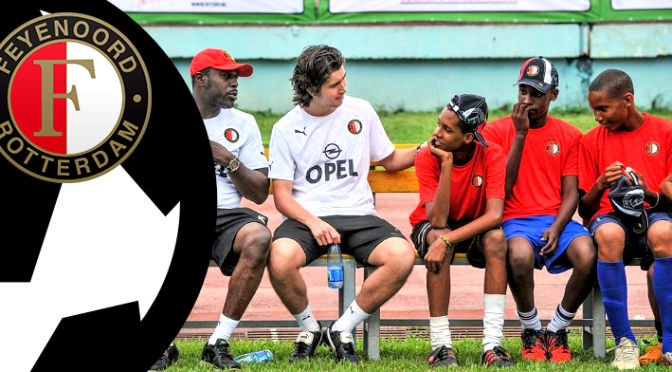
Feyenoord sent two ex-players to Havana to run the clinic, former striker Robin Nelisse (from the Dutch Antilles) and ex-Oranje international defender Ulrich van Gobbel. Nelisse and Van Gobbel coached and scouted the youngsters with ages ranging from six to sixteen, looking to take anyone that catches their eye to Rotterdam on a trial at their youth academy.

With football not being big in the nation, Cuba has always struggled with qualifying for major tournaments and developing youngsters as the lack of investment in football has always been a problem. However, Nelisse was impressed with the youngsters he has trained and speaking to Sarah Rainsford of the BBC, he stated: ‘The discipline of the kids is really good, if you tell them something and they will listen and they work really good.’

Van Gobbel added: ‘If you compare the level of talent to Holland, it is low but I think the first thing that is really important that the kids have pleasure playing the game. If they experience pleasure then we can see if some kids have more quality than others but it most important that they enjoy the experience.’

A main problem for the two coaches was that although Nelisse and Van Gobbel can speak excellent English and basic Spanish, communicating with the kids was a challenge, but by a few days the kids were responding well.

The Cuban trainer at the academy, Alfredo Martinez stated that since the opening of the school in Havana, he has seen a vast important from the majority of the youngsters. Now that football is becoming more popular in the country, other sports are being dropped by the children in favour of ‘the beautiful game’ with the Spanish La Liga being the most watched league on Cuban television.

To gain some publicity and to help political relations with the communist country, Dutch foreign minister, Franz Timmermans was present on 6th January at the training camp. He is the first member of the Dutch government to ever visit Cuba.

Timmermans looked to the visit to strengthen political links between the Netherlands and Cuba. Timmermans said: ‘I am a strong believer in football diplomacy. I think that it is important that we increase the human contacts of Europe and the people of Cuba and sport is a fantastic way of doing this.’

Name-WillBurns

Click the name above to follow Will on Twitter.

TotalDutchFootball.com    WorldFootballWeekly.com

Ajax vs. PSV Analysis

In the past three years, many teams have been forced to bow before the superior quality and resilience of Frank de Boer’s Ajax. On Sunday, it was the turn of PSV. The latest Derby van Nederland in Amsterdam was an absorbing affair, with both sides playing some insatiable football and displaying great technical skill. Ultimately, the sheer relentlessness of Ajax outlasted the brave adventure of PSV; de Amsterdammers remaining stoic when faced with a half of varied Eindhoven pressure before capitalizing on a typical lapse in the PSV backline to secure victory. In many respects, this game encapsulated finely the prevailing narrative of modern Dutch football.

As a PSV fan, I knew that the season was on life-support heading into this fixture. The early season positivity created by stirring home performances and a 4-0 September victory over Ajax were distant memories, washed away in a sea of frustrating inconsistency. A spiraling decline saw Phillip Cocu’s side mired in eighth place prior to kick-off; any slim hopes of a roaring comeback after the Winter Break were dependent on victories against closest rivals. It was a must-win for PSV.

The opening exchanges provided great cause for encouragement. Cocu fielded an attacking lineup, with Bryan Ruiz handed a debut alongside Jürgen Locadia and Memphis Depay in a lively forward three. The silky Costa Rican, loaned from Fulham last week, was intelligent in possession and helped create a steady flow of attacking opportunities for PSV. Locadia steered agonizingly wide on two separate occasions; Depay, whose technical development continues to impress, diverted a whipped cross barely wide of Jasper Cillessen’s post; and Ruiz himself flashed a left-footed shot tantalizingly across the face of goal. PSV looked strong, fit and powerful in the attacking third, with strong pressure being applied. On the counter-attack, they manipulated a number of three-on-three situations, with only the finishing touch lacking. At times, it looked like Ajax would cave as PSV attacked with strength and verve. The capacity crowd became somewhat restless as Ajax scrambled to extinguish a persistent PSV threat. I was surprised and incredibly excited.

Cocu’s side also looked strong defensively. The unorthodox midfield combination of Stijn Schaars and Ji-Sung Park lacked pace in defensive transitions, but compressed gaps adequately and helped command the pivotal space between defence and midfield in which Ajax’ technical playmakers so frequently devastate. Ajax instead attempted to work an overload against PSV right-back Santiago Arias, taking advantage of Ruiz’ low defensive work rate. Viktor Fischer was lively, asking many questions with tremendous dribbling skills and incisive vision. When Jeffrey Bruma and Rekik stood strong, and Jeroen Zoet proved reliable between the sticks, this game may have started to resemble a stalemate to the neutral. However, for the purists, it was fascinating to watch another fine tactical battle between Cocu and de Boer.

During the half-time break, de Boer won that battle, and the second half proven to be a morbid postmortem of this failed PSV season. It was a half totally different to its forebear in emotion, tempo and quality. It was quintessential Ajax. I do not know what Frank de Boer said in that Amsterdam ArenA dressing room, but his tinkering resembled the work of a genius. The Ajax coach somehow managed to alter the entire pattern, narrative and outcome of this game almost instantaneously; the second half feeling like a siege from the very kick-off. It was quite remarkable that Ajax could, with the succinct influence of de Boer, rebound from a rigorous half of football into a state of utter dominance. The resounding self-confidence of this Ajax team is incredible.

As a PSV fan, I was naturally frustrated as my team became ragged and stretched but, as a football fan, one can only admire what de Boer has built. Eventually, he will graduate to the very top with Barcelona, and I cannot think of a more deserving coach. The native tribalism of this game often lends itself to hatred, cynicism and delusion. I regularly have heated football debates with Ajax fans fueled by the rivalry but, on Sunday, I had to strip all of that back. After a half of vibrant PSV pressure and a capricious change of momentum orchestrated by de Boer, I was entirely devoid of answers as to how any domestic Dutch outfit can consistently out-perform this current Ajax team. They’re just too strong.

It was torture and it was educational. Simultaneously. Ajax pressed in packs at such ferocity that PSV struggled to construct a meaningful sequence of passes. As with all world class teams, de Boer’s Ajax strike fear into opponents when in possession anywhere on the field. Even when Veltman or Moisander are on the ball, stroking it about the backline, Ajax look to be on the very verge of creating something terminal. It’s just terrifying.

Such was the case with the winning goal. In this entire Eredivisie season, you’ll struggle to find a more symbolic goal. It encapsulated the root of PSV’s problems and explained why Ajax will likely march to a fourth successive crown. Moisander plays a darting cross-field ball to the highly-impressive Lasse Schöne, whose instinctive side-foot into the penalty area exposes a fatal lapse in concentration between Bruma and Rekik. Sigþórsson nips in-between them to head home what proved to be an Ajax winner. Initially, this goal informs of Ajax’ granite-like resolve and spirited belief. They will keep probing and penetrating and working until an opportunity presents itself. As for PSV, this goal highlights the undeniable need for leadership.

The occasional brilliance of Bruma & Rekik has been regularly unhinged by such momentary lapses in concentration. Earlier in the game, both central defenders bestrode the backline with passion and intelligence, blocking shots and cutting-out Ajax passes with ease and elegance. However, the lack of a fearsome captain to preach the importance of concentration throughout an entire ninety minute game proved costly again. In dealing with such naivety, PSV are desperate for a midfield stopper in the mould of Mark van Bommel; a true captain who the younger players feel accountable to, and are perhaps even a little scared of. PSV need a quality combative anchor in midfield with the heart, intelligence and passion to provide security and inculcate a message of awareness throughout a whole game.

Since van Bommel’s retirment, those human qualities haven’t been replaced. The summer sale of superstars like Kevin Strootman, Dries Mertens and Jeremain Lens again demonstrated the importance of Champions League football to a club like PSV; the greater revenue streams opened-up by such a competition are required to acquire and keep this calibre of in-prime player. Strootman and Mertens have flourished into global superstars, with sensational performances in Serie A for Roma and Napoli, respectively. Mertens has been ubiquitous in the selection of Rafael Benítez, whilst Strootman has settled into a multi-talented midfield alongside Daniele De Rossi and Miralem Pjanić. Cocu can only yearn for such proven quality within his current squad. If PSV had a van Bommel or Strootman-type figure this season, they would still be challenging on three fronts.

Ultimately, the Ajax game resembled so many PSV encounters this season. In the first half, Cocu’s side had thrown everything at Ajax, who seem impregnable even when pressured intensely. A lively start full of youthful exuberance yielded no breakthrough, before a naïve lapse in attention let the opposition grab a goal from a most unlikely situation. Once behind, the youthful heads dropped, the tactical shape became frayed, and the opposition trampled all over PSV. Ajax rushed through a disintegrated PSV midfield, creating opportunities and taking aim at Zoet. Their only failure was in adding more goals. It was one-way traffic, with many PSV players again bypassed by the emotion of a big game. It was excruciating to watch, but this kind of scenario has become a regular hardship for PSV. The script isn’t new.

But we must continue to support our team. We must believe in the process of change embarked upon by Cocu. Of course, it hurts to lose to a fierce enemy, but all true football fans must endure to enjoy. We have watched PSV win Eredivisie Titles, play in Champions League semi-finals and thump close enemies by huge scorelines. Now, perhaps it’s the turn of other clubs and other fans to have their moment in the sun. I firmly believe that those who flee in times of darkness have no right to enjoy the eventual glory. That glory will return. Even de Boer said as much, stating his belief that “I think it will eventually turn out right for Cocu and PSV.” It’s incredibly difficult to admit that a bitter rival is plainly better than you. However, at this moment, arguing that fact would be futile. PSV must act honourably, accept the reality, and strive to emulate the kind of steely resolve on show in Amsterdam.

Name-RyanFerguson

Click on Ryan’s name to follow him on Twitter

Marvin Emnes: A Dutchman on Teesside

Header-DutchmenAbroad

Having represented the Netherlands’ youth teams from u-16 to u-21, it was with a sense of excitement and intrigue that Middlesbrough fans greeted the signing of 20 year old sprinter-turned-striker Marvin Emnes in the summer of 2008. He joined Gareth Southgate’s young side with big things expected and turned in some star performances early on in his Boro career, but has earned a reputation as something of a mercurial forward; amazing one week, anonymous the next.

Following a disappointing relegation in 2009 and the eventual sacking of the man who bought him, Emnes was largely frozen out by new managed Gordon Strachan, who sent the youngster out on a short, but memorable loan move to Swansea. Despite only making four appearances, he became something of a cult hero in South Wales having scored the winner in a heated derby against local rivals Cardiff. Having fought for his Boro place upon his return, he has been repeatedly linked with a move back to Swansea in the years since, but nothing has ever materialised. There is some debate among Middlesbrough fans as to whether Emnes would be good enough to make the step up to the Premier League – although some point to his meagre goal scoring record, there are those who would argue he can be unplayable, when he is willing to ‘put a shift in’.

In terms of goals, the 2011-12 season under Teesside hero Tony Mowbray has so far been Emnes’ most successful season. In the opening month, Emnes shot to the top of the goal scoring table as Boro found themselves at the top of the Championship, but after Christmas both Emnes’ and Boro’s form dropped off – Boro finished seventh, with Emnes bagging an impressive if unspectacular 14 goals along the way. That season saw the best of Emnes; his pace and strength from his childhood as an athletics nut were evident, and confidence pulsed through his veins. He took defenders on at will and seemed to be able to find the net from any angle, however acrobatic he had to be – a League Cup volley against Walsall sticks particularly in the mind.

Since then, his career has taken a dramatic downward turn, with rumours of £5million bids from Premier League clubs a startlingly distant memory. In fifty appearances in all competitions since the agonising end of that season, Emnes has only found the net seven times and only once in twenty games this season. His form was symptomatic of the ignominious end of Mowbray, with a perceived lack of interest drawing abuse from an irate fanbase. A double in pre-season against French Cup champions Bordeaux seemed to herald a new dawn, and in truth his performances this season haven’t been too bad. His work rate has improved and at least in his dribbling, if not his finishing, there are some signs of the Emnes of old. Aitor Karanka has already started to work miracles for the Boro; at only 25, there is time for him to do the same for “Marvellous Marv”, but Boro have been heavily linked with strikers across the Football League and beyond this month. Another loan spell could do him the power of good… if not, the former Sparta Rotterdam man could soon find himself shipped back to the Eredivisie.

Name-SamFrance

If you enjoyed this, be sure to check out my own personal blog at sjfootball97.blogspot.com, and give me a follow on Twitter, @sjakef!

PSV’s All-Time XI

Team-PSV

It’s notoriously difficult to pick an all-time eleven. However, they make for great entertainment in bar-room debates of a weekend, so it was that I sat down this week to compile my all-time PSV team. I poured through historical records, aiming to highlight those true greats who often go without recognition but are deserving nonetheless. Furthermore, I tried to concentrate on the legacy created by certain players and incorporate my own appreciation of their skills into the team. Accordingly, one or two of my favourites make somewhat surprising appearances.

As with most all-time teams, this is a highly subjective process and you are bound to disagree with some selections. If so, I would be really interested to see what your team all-time team would look like. I’m always open to a great Dutch football debate.

So, without further adieu, here is my all-time PSV team:

GK: Hans van Breukelen, PSV 1984-94

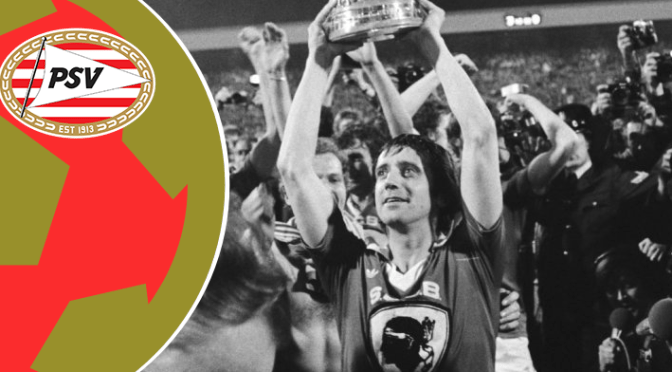
An alert goalkeeper who helped Oranje win Euro ’88, van Breukelen played in excess of 300 times for PSV after signing from Nottingham Forest. In Eindhoven, he was part of a richly successful team and won six Eredivisie titles and three KNVB Cups. The Utrecht-born stopper is most famous for a fantastic penalty shootout save which won PSV the European Cup against Benfica in 1988. Nowadays, van Breukelen works as an entrepreneur and also serves on the PSV board.

RB: Eric Gerets, PSV 1985-92

A rampaging right-back, Gerets is widely considered one of the greatest Belgian footballers of all-time. During an illustrious spell at PSV, Gerets was affectionately nicknamed “Lion” due to his long flowing hair and beard. Gerets won six Eredivise titles as a player, in addition to two KNVB Cups, and remains the only PSV captain ever to lay hands on the European Cup. Currently, Gerets manages Lekhwiya SC in Qatar.

CB: Huub Stevens, PSV 1975-86

The grizzled Stevens was a combative defender who took no prisoners. A brave-hearted winner, Stevens helped PSV to three Eredivisie titles and one KNVB Cup triumph during his eleven year spell. He also starred for the UEFA Cup-winning PSV side of 1978, producing a valiant display in the Final. After retiring, Stevens embarked on a distinguished coaching career, most notably with PSV, Schalke 04 and Hamburg. Now, he is head coach of PAOK Salonika.

CB: Jaap Stam, PSV 1996-98

Stam may have spent only two seasons at the Philips Stadion, but his fantastic performances helped the club win one Eredivisie title and KNVB Cup whilst also opening the door to a distinguished career throughout Europe. PSV received a then-record £10.6m transfer fee for the robust defender, who went on to play for Manchester United, Lazio, Milan and Ajax, where he currently serves as a coach.

LB: Jan Heintze, PSV 1982-94, 1999-2003

A whole-hearted, defensive-minded full-back, Heintze made over 500 appearances for PSV during two separate spells. Heintze is perhaps the most-decorated PSV player of all-time, having won nine Eredivisie titles, three KNVB Cups, three Johan Cruyff Shields and one European Cup during sixteen years of loyal service. Heintze is now a commercial real-estate developer in the Eindhoven area.

CM: Willy van de Kerkhof, PSV 1973-88

A consummate box-to-box midfielder, Willy van de Kerkhof was an integral part of some great PSV and Oranje teams. Along with twin brother Rene, Willy represented Oranje on 63 occasions, including World Cups in ’74 and ’78. At PSV, van de Kerkhof also won six Eredivisie titles, in addition to three KNVB Cups and, of course, the 1988 European Cup. The great Pele named Willy one of the top 125 living footballers in 2004, a fitting tribute to a fine player. He currently works for his own business networking firm in Eindhoven.

CDM: Mark van Bommel, PSV 1999-2005, 2012-13

When I first began watching PSV, Mark van Bommel embodied the heart and soul of the club. He was tenacious, driven and passionate; a fine captain who was often misunderstood by the British media. After arriving from Fortuna Stittard in 1992, van Bommel played a vital role in PSV winning four Eredivisie titles, one KNVB Cup and four Johan Cruyff Shields. A current coach within the PSV youth system, van Bommel also played for Barcelona, Bayern Munich and AC Milan before returning and ending his career in Eindhoven last term.

CM: Phillip Cocu, PSV 1995-98, 2004-07, Current Manager

A clean-spirited maestro, Cocu was born and raised in Eindhoven before starring for PSV in numerous spells and capacities. A centurion for Oranje, Cocu is a fan favourite at the Philips Stadion, having won four Eredivise titles and two KNVB Cups in a career which also took him to Barcelona. I remember Cocu mostly for his second spell at the club, a magical time during which he was club captain. Nowadays, Cocu is manager at PSV, having coached within the academy since retirement.

CAM: Ruud Gullit, PSV 1985-87

Ruud Gullit is one of the greatest Dutch footballers who ever lived. In an illustrious career highlighted by Euro ’88 success and European Footballer of the Year honours in 1987, Gullit used PSV as a springboard on to the world stage. The silky-skilled midfielder was versatile and dynamic, scoring 53 goals in just 75 PSV games, whilst providing innumerable assists. A defining image from the Eredivisie during this era has Gullit streaming effortlessly through midfield for PSV, with dreadlocks dancing and toes twinkling. The former Oranje captain now works occasionally within the football media.

ST: Willy van der Kujlen, PSV 1964-81

A standard-bearer for a future lineage of exceptional PSV strikers, van der Kuijlen was awarded a statue at the main entrance of the Philips Stadion, a fitting tribute to his incredible legacy. In seventeen years, Mr PSV scored a 311 goals for the club, an untouchable record which is unlikely ever to be broken. The clinical striker won three Eredivisie championships, two KNVB Cups and was a scorer in triumphant 1978 UEFA Cup Final.

ST: Mateja Kežman, PSV 2000-04

The Doelpuntenmachine, Kežman is my all-time PSV idol. I grew up watching him score at an obscene rate in the early Millennium, earning worldwide recognition and shooting PSV to two further Eredivisie championships. A move to Chelsea sullied Mateja’s reputation in Britain, but his 105 goals in 122 PSV appearances earn him a place in my legendary lineup. Kežman retired in 2011, and is now working as a sports agent.

Manager: Guus Hiddink, PSV 1987-90, 2002-06

A highly-respected figure within world football, Hiddink is royalty in Eindhoven. The rotund coach, who brought his fine tactical acumen to jobs with Oranje, Real Madrid, Russia and Chelsea during an extensive career, oversaw two unique periods of absolute domination for PSV. In all, he steered the club to six Eredivisie titles, four KNVB Cups, one Johan Cruyff Shields and, of course, the European Cup of 1988. Now, Hiddink is seeking one last challenge after a truncated spell with Russian side Anzhi.

Substitutes Bench

Ronaldo – Yes, the Brazilian Ronaldo. Even before Barça, Madrid, Inter and Milan, Ronaldo spent two years in Eindhoven with PSV. He tore through the Eredivisie with 42 goals in 46 games.

Ruud van Nistelrooy – A phenomenal striker at PSV, Ruud scored a staggering 62 goals in just 67 appearances for his hometown club before a £19m move to Manchester United. He now works as a coach within the PSV youth academy.

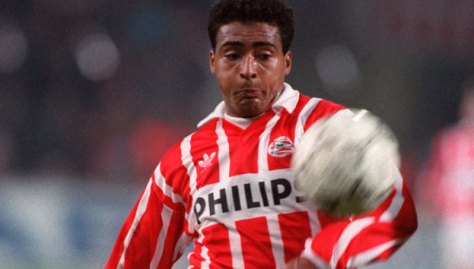
Romário – One of the few known men to score 1,000 career goals, Romário beguiled a generation with five years of brilliance at PSV from 1988-93. Also, branded a “genius” by Johan Cruyff.

Coen Dillen – The first great PSV goalscorer, Dillen set the record which van der Kuijlen broke; his 288 goals helping to success at the dawn of professionalism in Dutch football.

Luc Nilis – A real fans favourite at PSV, Belgian Nilis formed a formidable partnership with van Nistelrooy and ultimately scored over a century of goals for the club in a six-year period.

Arjen Robben – You can’t have Batman (Kežman), without Robben. Arjen was one of my first PSV heroes, back when he had hair! Now, of course, he is one of the world’s very best players, and scored the winner in last years Champions League Final for Bayern Munich.

Rene van de Kerkhof – The twin brother of Willy, Rene was also a fine player for PSV and Oranje, winning multiple medals and earning similar recognition amongst Pele’s top 125 living players.

So, that’s my team. In total, the chosen players have made thousands of appearances for PSV, won hundreds of medals, and won earned a place within the clubs illustrious history. Now, let’s see if you can pick a team to beat mine.

Name-RyanFerguson

Click on Ryan’s name to follow him on Twitter

The kit history of PSV Eindhoven

In the club’s centenary year, PSV decided to revert to a club strip reminiscent of past glories. The current home kit, comprising of red shirt, white shorts and red socks, is intentionally similar to that worn by the successful side of 1987/88. After discussions with supporters groups over the summer, it was decided that PSV should remember that formidable side which won the Eredivise, KNVB Beker and European Cup. It looks great, and is but the latest in a long line of classy football kits from the Eindhoven club.  
A sensational rumour surrounds the initial selection of the PSV club colours; an old yarn perhaps too poetic to hold any truth. The story goes that, at the founding meeting of Philips Sport Vereniging in 1913, Jan Willem Hofkes, the first chairman, was taken aback by the sweet contrast between his raspberry punch drink and the white notepad resting on his desk. In a true Eureka! Moment, it was decided there and then that PSV would be a club of red-and-white. The tradition has been preserved for one-hundred years, with many different kit designs following Hofkes’ raspberry idealism.
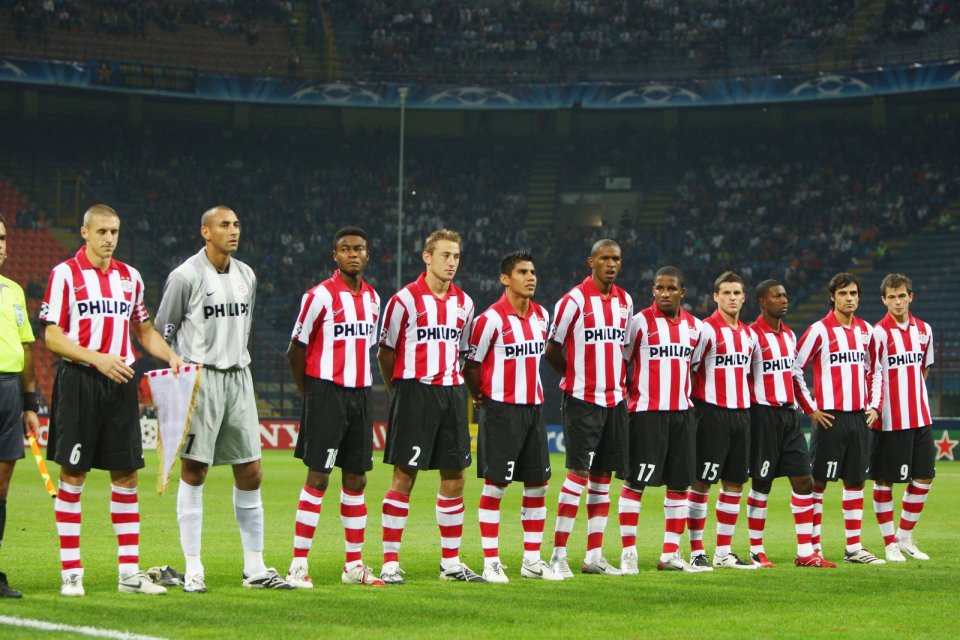
The first strip was classic PSV: a jersey of red-and-white vertical stripes with black shorts and red-and-white horizontally striped socks. The true heart of PSV is rapped in these colours, this design, and this pattern. It remained largely untouched from the clubs very founding until the seventies, when hedonism and diversified thinking attached to the expanding professional game in Holland forced experimentation. When PSV won the embryonic League Championship in 1929, they did so wearing the red-and-white stripes; stalwarts such as Sjef van Run and Jan van den Broek making a success of the iconic strip just like Ronaldo, Luc Nilis and Mark van Bommel would generations later.
PSV won two further league titles and a Dutch Cup before the dawn of professionalism in 1954, the Eindhoven side victorious in the national playoffs in 1935 and 1951 with legendary striker Coen Dillen making an instant impact. In 1955, the red-and-white stripes would be seen by an entire continent, as PSV became the first Dutch side ever to enter the European Cup. Nonetheless, the club was on a fast-track towards big-time professionalism, with pioneer Ben van Gelder expanding many aspects of the club. An ambitious board member, van Gelder expanded the clubs recruitment policy from solely Brabantian players to include overseas footballers capable of helping the club compete on the continental stage. Accordingly, Trevor Ford, a superstar Welsh striker, became not only the first Brit to wear the famous red-and-white PSV kit, but also the first British player to play professionally in Holland.
A fourth league title in 1963 was perhaps PSV’s biggest shove towards changing the core principles which remained in-place since Willem Hofkes’ raspberry revolution fifty years prior. Now, PSV, like many Dutch clubs, had dreams of reaching far beyond the localities they’d initially represented as an amateur club. PSV power-brokers had eyes for the world stage. In the next decade, many aspects of PSV would evolve, including the kit worn by its ever more sophisticated players.
The 1960s and 70s were a time of great social change, both in North Brabant and the Netherlands as a whole. A new class of highly-educated youths challenged the traditions of society and pressed for change in issues ranging from women’s rights to environmental policy.  In Eindhoven, church attendance declined as the totality of Catholic pillarisation waned. All over Holland, a collective urging of change was felt. Somewhat trivially, it even extended to the kits worn by football teams throughout the nation, with manufacturers displaying logos on jerseys for the first time. Le Coq Sportif supplied PSV kits during a four-year spell beginning in 1970, and displayed an eagerness to change the club’s strip to an all-red shirt with either white or black shorts. Accordingly, a new chapter was opened in the kit history of PSV.
The new-found taste for experimentation accelerated in 1974, when sportswear giant Adidas agreed a deal to become the clubs new kit manufacturer. At the time, the all-red jersey was popular with PSV fans, and a similar design was kept for fifteen years, with a few famous innovations. In 1982, for instance, main jersey sponsorship was introduced to the Eredivisie, and the symbiotic relationship between PSV and Philips was acknowledged in a deal which still flourishes to this day. The first PSV kit emblazoned with ‘PHILIPS’ on its front was all-red with very fine white pinstripes and the classic Adidas logo. The most epochal period in the clubs history came with this all-red number in its pomp. PSV won the 1978 UEFA Cup wearing this strip. The aforementioned 1987-88 European Cup winning team made this kit famous. PSV announced itself on the global stage as a club with an all-red shirt.
The shorts to this strip were altogether more capricious, however, with their colour changing as with the opponent and whim of certain star strikers. Ruud Gullit, the dread-locked superstar of PSV from 1985-87, personally decided to change the shorts’ colour from black to white in order to improve the aesthetic quality of the overall kit. It seemed to work, as Gullit fired PSV to two further Eredivisie titles before taking Europe by storm with Milan.
In 1989, it was decided that PSV would return to its traditional base with the re-introduction of an Adidas red-and-white vertical striped jersey. The next decade brought a swathe of eye-catching and unique variations on this traditional theme, insuring that many of PSV’s greatest ever players wore its rightful strip. Luc Nilis and Ronaldo won the hearts of Eindhoven and numerous medals along the way, all dressed up in red-and-white. Sir Bobby Robson famously swapped England for PSV in 1990, helping to make the striped renaissance a success. Phillip Cocu, current manager and former midfield maestro, donned the stripes of his hometown club. It all felt so natural, so right, so classically PSV.
The last major change to the kits basic principles prior to this seasons centenary special came in 1995, when Nike ceded Adidas as the manufacturer. Nike increased the visibility of white on the PSV shirt, so much so that, for the first time, it could be viewed as primarily white with red stripes. It was in this style that Ruud van Nistelrooy shot to fame, fueling the clubs 15th and 16th Eredivisie titles from 1998-2001 before a £19m move to Manchester United.
The new Millennium brought greater commercialism to global football. Therefore, clubs sought to open as many new revenue streams as possible, with the sale of official merchandise booming and creating a market for new kit designs every one or two seasons. In keeping with the rest of football, PSV released many strip variations throughout the 2000s, with some more memorable than others. My favourite kit is undoubtedly that worn by the club when I first began watching games in 2004. It had the classic red-and-white vertical stripes but, more importantly, holds the fantastic memories of players such as Mateja Kežman, Mark van Bommel and Arjen Robben. I still have that shirt tucked away in a wardrobe for posterity.
I will likely purchase this seasons jersey soon, because it’s a real collectors item. The circumstantial return to the all-red of former glories is a nice touch from management, preserving one of the clubs true glory periods. However, I also eagerly await the day when PSV again run out in their famous red-and-white vertical stripes; from Hofkes’ aberration to modern day success, those colours are at the clubs core.

RyanFerguson

Click on Ryan’s name to follow him on Twitter

PSV YOUTH REAPING THE REWARDS

The international break can be a frustrating time for football fans. When Europe’s top leagues shut down for a week as players turn-out for their national sides, a lack of club news often presents itself. However, for PSV, the recent round of World Cup Qualifiers brought cause for great celebration; the international debuts of Memphis Depay and Zakaria Bakkali constituting a major landmark in the growth of its youth system.

At De Herdgang, the impressive training complex for all levels of PSV, an emphasis on the production of talented players isn’t entirely new. In the past, players such as Boudewijn Zenden, Ibrahim Affelay, and Zakaria Labyad have all graduated through the ranks and featured prominently in the first team. Even Coen Dillen, a renowned legend who has a statue at the Philips Stadion entrance, was taught as a youth at PSV. The difference now is that the youth system has been placed at the very nucleus of the clubs long-term philosophy, with significant investment being channeled into the development of young players and a technical team headed by Art Langeler drafted in to oversee the academy’s progression. Now, youth talent is regarded as an intrinsic aspect of the PSV plan, rather than a useful coincidence.

Phillip Cocu and his coaching team are the public figureheads of this ethos. When the former PSV captain was appointed manager on a four-year contract in the summer, promising to enact this widespread belief in youngsters, a few core players were earmarked for more prominent roles. Memphis Depay and Zakaria Bakkali, a pair of lively and skillful wingers, were duly unleashed on the Eredivisie stage. In the first three months of the season, both have earned rave reviews with a succession of electrifying performances and breath-taking wonder goals; Depay netting five important goals thus far and Bakkali becoming the youngest player ever to score an Eredivisie hat-trick. The recent international call-ups were fine reward for two shining jewels of the PSV revolution.

Depay, a Dutch-born Ghanaian, joined PSV in 2006 at the age of twelve. In time, the enigmatic winger has found his niche, his style, his role within a team. While working with Cocu in the Jong PSV set-up and representing Oranje at three different youth levels, Depay began to distinguish himself as a genuine prospect for the first-team. When Cocu briefly assumed interim control in 2011, Depay was granted his PSV debut, scoring two and assisting another in an emphatic 8-0 demolition of Noordwijkerhout. He later featured in the Eredivisie, before continued improvement saw the forward make thirty appearances under Dick Advocaat last term, when he often impressed the fans of PSV with dynamic, explosive performances.

The new direction embarked upon by PSV this summer owed much to youngsters such as Depay, Bakkali, and Jurgen Locadia pressing for greater first team inclusion. Cocu has relied heavily on these players as the foundation to his squad. Depay, in particular, has repaid him with a growing list of sensational goals from long-range and set-pieces. When watching Memphis, it’s immediately evident that his footballing idol is Cristiano Ronaldo; many of Ronaldo’s famous mannerisms, from the free-kick technique to the powerful running stride, are visible in Depay’s play. It’s exciting to see such a talented homegrown player at the fore of a new PSV generation.

It’s also exciting to see products of the academy featuring in an uber-talented Dutch national side. Depay, a prominent member of the Dutch Under-21 squad which reached the European Championship semi-finals in the summer, was an unused substitute for the senior team in a September game against Estonia. However, Louis van Gaal summoned him from the bench for the final few minutes against Turkey in Istanbul on 15 October, thus granting Depay a full international debut. Whilst he had little time to impact the game, it was still a proud moment for PSV; another of its homegrown players breaking through on the international stage.

At roughly the same time 1,600 miles away in Brussels, Bakkali doubled the delight for PSV. The immensely-talented seventeen year old took the impressive step of debuting for a Belgium side experiencing its greatest ever epoch. If you thought playing within a galaxy of Belgian stars at such a tender age would faze the wide-man, you’re sadly mistaken. “Well, isn’t it just a game like any other?,” Bakkali deadpanned while talking with Belgian daily Het Nieuws Blad after the game in which he replaced Everton starlet Kevin Mirallas for the final twelve minutes. It was apparently just a routine day in the continual growth of a superstar. A growth which has already seen him score in the Champions League, fire the aforementioned historic hat-trick at Philips Stadion against NEC Nijmegen, and become an integral part of a vibrant young team.

Bakkali wasn’t always the most heralded prospect, however. In fact, only diehard fans and local journalist knew a great deal about him as he progressed through the youth ranks. However, Phillip Cocu has shown tremendous faith in his forward, who is averaging a goal every other game, and the hype has clearly extended to the international scene. While Moroccan football executives hoped that Bakkali would elect to represent their country, the enthusiasm of Belgian coach Marc Wilmots was likely a determining factor in Zakaria’s choice. Wilmots has already likened Bakkali to superstar Eden Hazard, opining that “Zakaria is a player who scores easily, is very fast and has skillful dribbling. He has just about the same profile as Eden.” No pressure, then.

The future is certainly bright for PSV, with such a stable of impressive youngsters. In a World Cup year, players are given greater motivating to produce their best form, which will only benefit both club and country. Bakkali already has his sights set on Brazil, stating that he’ll “do everything, truly everything, at PSV to be able to go to Brazil. That is my big dream!” Thus, the advantages of international football become clear: PSV will have a motivated Bakkali striving to impress Wilmots and earn a place on the plane to Brazil which, in turn, will help sustain the phenomenal level of performance which he has shown, and help PSV in their quest for an Eredivisie title.

Ultimately, however, all of this comes back to Cocu and his vision. If his thorough belief in youth is to be vindicated, the cases of Depay and Bakkali must continue to be replicated. There is ample reason to believe that, with continued investment in youth development and the bright ideas from those in charge, they will. Every young player currently being taught at De Herdgang must hold these fully-fledged internationals as role models and standard-bearers. The rise to international prominence of such homegrown talents must act as inspiration. If we see more like Memphis and Zakaria in the coming years, PSV may seriously threaten Ajax and Feyenoord as traditional seats of young Dutch talent.

RyanFerguson

Click on Ryan’s name to follow him on Twitter

——-

TotalDutchFootball.com

WorldFootballWeekly.com

FEATURE: How I became a PSV fan?

Why PSV? It’s a question asked of me on a near-daily basis. The people asking are compelled to do so by a variety of different factors: they acknowledge the Lighttown logo currently masquerading as my Twitter icon, or they see the red-and-white stripes of some retro jersey plucked lazily from the wardrobe that morning. In truth, they are correct to be a little bemused; actively supporting a football club from Holland isn’t exactly normal around here. However, I have a very reasonable explanation and, with the club celebrating it’s centenary year, I could think of better time to tell the story. So, if you’re interested, sit back and relax: this is the tale of how I became a PSV fan.

It’s conventional to start at the beginning. My love of football was hereditary. I was raised in a family which loves football almost as much as it loves Tranmere Rovers. After attending my first match in 2001, I was similarly gripped by the bug. The atmosphere. The grass. The excitement. Tranmere are in my heart, and are will always be my main club, with PSV serving as a delightful secondary obsession. It was on the Kop of Prenton Park that I learnt to appreciate football; learnt of players and managers and rivalries; learnt an extensive vocabulary of four-letter obscenities. It was only natural that this home-grown knowledge, and this hunger for football, would extend overseas. I quickly became interested in the different footballing cultures dotting the globe.

So it was that, after midnight on a warm February day in 2004, I began flicking the channels of my small bedroom TV. The usual assortment of late-night dross was in evidence; the quiz shows which give you no chance and the sign zone repeats of Murder, She Wrote. However, my attention was eventually held by the gloriously-named Dutch Game of the Week on Channel 5. Although I was initially oblivious, this was a weekly re-run, in entire ninety-minute form, of a top Dutch Eredivisie fixture!

I still remember that first game, that first episode, that first intoxication on the PSV drug. It was a night game at the Philips Stadion. PSV Eindhoven versus FC Twente Enschede. The whole occasion was so evocative, so atmospheric, so mesmeric. The capacity crowd enthralled me; I recall thinking how they all looked so cold, dressed in considerable dark coats with hats and scarves aplenty. In retrospect, the commentary was classic, describing the insatiable football and introducing me to hallowed names. Bouma and Affelay. Van Bommel and Vogel. Robben and Jan Vennegoor of Hesselink. The crowning climax of that sacrosanct game far outweighs even these lofty pleasures, however. Yes, the red-and-white stripes looked resplendent. Yes, the miasma of Eindhoven virtually pouring through my television was sensational. But they were outshone in my pantheon of memories by the heroic way in which that game was won.

After ninety-plus minutes of absorbing fixation, the game was still goalless. In a blurry haste, PSV whooshed the ball about the pitch one last time. I cannot recall quite how the ball fell precariously inside the Twente penalty area, but it did! There to gobble it up, with a desperate-yet-shrewd flick was my first PSV hero. Mateja Kežman had just won the game, sparking sheer delirium in wintry Eindhoven. As he wheeled away in timeless celebration, unleashing a detailed portrayal of Jesus Christ on his undershirt, I was won-over for life. I was up, celebrating with all the might a ten-year-old can muster at 3am on a school night. It was a dream-like moment which still makes the hair stand on-end. If anybody has a DVD of that game, PSV-Twente on 14th February, 2004, I would pay very good money for a copy.

In retrospect, those were the halcyon days of modern Dutch football. Ajax had Sneijder, Van Der Vaart, and Ibrahimovic; Stekelenburg, De Jong, and Vermaelen. Feyenoord had Van Persie, Kuyt, and Buffel; Kalou, Paauwe, and Ono. It was a special era. I watched religiously every week, putting my football education before my actual, real education. It’s undoubted that I learnt more from Guus Hiddink than I ever did from any primary school teacher.

Even in an Eredivisie awash with stars, it was always PSV Eindhoven for me. The experience of watching that first game was incredible; it was like watching a whole new footballing heaven unfurl before me. When I watched PSV, there was a sense of harmony, a co-existence with the team, and a natural desire to see them win. It was just always meant to be.

As I began to watch the Dutch Game of the Week with greater regularity, the fantastic memories began to form. One of my earliest, and the brightest of my PSV fandom, came during the 2004-05 season, when Hiddink’s men travelled to Amsterdam for a massive game with rivals Ajax. By that time, I was reading extensively on the subject of PSV, and was becoming ever more engrossed with the day-to-day news dripping out of Eindhoven. However, I vividly recall avoiding all potential snippets of information on this game, so as to watch the Channel 5 re-run with greater intensity. It was worth the wait. Phillip Cocu opened the scoring with an epochal diving header, before Mark Van Bommel scored an unbelievable hat-trick. It was fantasy football. I was truly thrilled.

It’s that particular incarnation of PSV which I still cherish the most. Gomes kept goal with enigmatic abandon; Park Ji-Sung matched mercurial talent with spirit and determination; Cocu was a genius. The other names still bring happy memories to attention: Ooijer, Lee Young-Pyo, Alex, Bouma, DeMarcus Beasley, Farfan, and, yes, even Remco van der Schaaf. Whereas many footballing purists talk about Brazil in 1970 or the Barcelona of Xavi, Iniesta, and Messi, I still hark back to these priceless PSV days. It was a pleasure to be involved during such a glory period.

In my mind, one game encapsulates that entire era more definitively that most: the 2004/05 Champions League Semi-Final against Milan. I’ve written extensively about this tie, and the bitter-sweet memories it evokes, but, in hindsight, it was truly emblematic of a golden period for Dutch football. Here, we had PSV Eindhoven, traditionally underestimated by the widespread European media, overcoming a succession of hurdles to demonstrate on a huge stage their true talent. The result still hurts, but I was prideful that the entire world was able to see just why I fell for PSV. Additionally, I still maintain that, if they had somehow ended up in Istanbul, Liverpool wouldn’t have stood a chance!

The years following the Milan trauma were truly historic, as PSV became the first club ever to win four consecutive Eredivisie titles. It was a blur of classic kits, memorable goals, and abundant confetti. New heroes, with names like Kone, Culina and Simons, brought a new wave of success and celebration. I became even more fascinated with PSV during this stretch, and learnt a keen appreciation for the clubs history and tradition. The trophies kept on coming, and so did the memories. It was simply fantastic.

Now, those days seem so far away. In recent times, PSV have struggled with settling upon a definitive direction for the future; a period of uncertainty which has given rise to a five-season Title drought. In that time, even AZ and Twente have won the Eredivisie! It has been a very testing period, but my passion for PSV has only grown larger. The memories and appreciation I have for those golden eras make me more determined than ever to see and experience them again and, with a hero such as Phillip Cocu promising to overhaul the club’s entire ethos, I have every faith that we will. When those illustrious times return, I hope to be there, waiting; my greatest hope is to visit Eindhoven and watch my first-ever game live at the Philips Stadion soon.

So, now you know. The next time you read my tweets about Dutch football, or the next time you see me wearing a PSV Eindhoven cap, you’ll know why! The shows which lurk on your television in the dead of night rarely hold attention for more than ten minutes; the Dutch Game of the Week, however, sparked a fascination in me which has lasted nearly ten years. It’s funny how things work out.

RyanFerguson

Click on Ryan’s name to follow him on Twitter

Cocu’s tactical masterclass

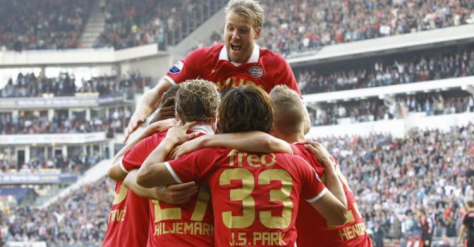
The scene was one of unbridled joy; with fans bouncing on the terraces and raising the Philips Stadion roof. After years of frustration at the hands of their greatest enemy, PSV had finally beaten Ajax in the league, the first time they had managed to do so since 2009. In emphatic style, the Eindhoven side demonstrated their true potential with a comprehensive 4-0 rout. It was a euphoric result. It was a warning signal to the Eredivisie. It was the greatest achievement of Phillip Cocu’s burgeoning managerial career.

In recent encounters with Ajax, PSV have let emotion destroy rationality. The magnitude of fixtures against de Amsterdammers seemed to bring about a cavalier attitude, with PSV overly-eager to earn bragging rights. When the two clubs met last season, Dick Advocaat employed a typically-offensive style which led to high-scoring affairs won by the more composed Ajax. It felt like PSV were lacking a solid foundation from which to attack, rushing forward with reckless abandon. In many ways, they were victims of their own desire.

However, the more pragmatic approach of Phillip Cocu proved to be a perfect antidote for PSV this time. Cocu is of a similar ilk to Ajax head coach Frank de Boer; the two sharing a similar career trajectory culminating in a coaching partnership with Holland at the 2010 World Cup. The dividing lines between PSV and Ajax are well-documented, but Cocu and de Boer have a lot in common. They are from the intellectual breed of coaches, who take an almost scientific approach to analysis and game preparation. Therefore, it was tremendously-exciting to see this subplot develop over the weekend.

In all honesty, Cocu outmaneuvered de Boer from a strategical standpoint, which is fine praise for even the greatest managers. The highly-successful de Boer is amongst the sharpest coaches in the game today, as illustrated by the succession of Eredivisie championships which he has masterminded. In recent times, PSV have lacked a manager to compete with de Boer’s new-wave ideas and philosophies. Fred Rutten wasn’t favoured. Advocaat was consumed by a love of goals. However, now it appears that, in Phillip Cocu, they’ve finally found a manager to compete with de Boer on every level. PSV’s 4-0 victory was the biggest league defeat inflicted upon Ajax in the de Boer reign, and may prove to be a portent of greater competition to come. It shows that PSV are serious again. It shows that Cocu, viewed as a figurehead of change, also has the tactical acumen which could lead to great things. It shows that de Boer may be facing his stiffest test yet.

For the first time in four years, PSV entered a heated game against Ajax with a discernible game-plan. It’s no coincidence that they won for the first time in that duration. As a spectator, it was clear to see that Cocu, along with impressive coaches Ernest Faber and Chris van der Weerden, had plotted a comprehensive plan as to how his side should deal with Ajax and win the game. It worked to perfection.

The first part of PSV’s plan relied on greater discipline than they’ve shown for a number of years against Ajax. It revolved around pressurising in sensible, important areas of the pitch and earning a right to play. Ajax are renowned for a slick-passing style, often beginning with goalkeeper Kenneth Vermeer and his ball-playing centre-halves. Thus, PSV directed a majority of their defensive energies to this portion of the field, closing down quickly and restricting any Ajax rhythm. The high-octane industry of Park Ji-Sung was instrumental in setting this standard, which is surely the type of impact Cocu envisioned when bringing the South Korean back to Eindhoven. Ajax were stifled by PSV in the areas of maximum importance around each penalty area, with only long-distance shots from Bojan and Ricardo van Rhijn really troubling Jeroen Zoet during a controlled first half.

20131001 - PSV 4-0 Ajax

Now, PSV had earned a measure of control, in much the same way we’ve become so accustomed to Ajax doing. After the break, Cocu saw the second part of his plan come to fruition. In a more prudent manner than recent years, the teams offensive spontaneity was unleashed. Memphis Depay broke into intelligent positions. Oscar Hiljemark began to probe forward from a central midfield berth. Even Jetro Willems broke into advanced positions when sensible to do so. In essence, PSV were using energy where it was needed, rather than wasting it in the all-out, gung-ho style of previous regimens. It gave them a more sustainable footing within the game. Eventually, Ajax were on the ropes.

The eventual flurry of goals even took Cocu by surprise; the manager fist-pumping in giddy excitement at the success of his plan. PSV went wild, scoring four goals in fifteen mesmeric minutes. When Ajax ‘keeper Kenneth Vermeer spilled an innocuous cross, allowing Tim Matavž to poke home the opener, it was symptomatic of that self-same pressing which so restricted the Amsterdam side earlier in the game; first Joritt Hendrix and then Memphis Depay working hard to force Ajax into uncompromising positions. The latter eventually wrestled back possession, whipped over a cross, and watched as Vermeer’s howler let Matavž in. Whilst the goal was somewhat suicidal from Ajax, PSV forced the issue so as to create such openings.

A scintillating breakaway saw Jetro Willems dance inside before bending a shot around Vermeer on the hour mark, before Oscar Hiljemark rapped one into the top corner and Ji-Sung Park completed the rout when through on goal. The blind fact of Ajax’s 4-0 thrashing was that they weren’t accustomed to seeing such a balanced, all-encompassing PSV. In many respects, PSV played like Ajax have for many years, taking an even-keeled, controlling approach with resourceful counter-attacks and searing breakaway goals. It could be said that PSV out-Ajax’d Ajax.

If you’re a PSV fan, this is a great sign. The future certainly looks bright under Phillip Cocu. After a disappointing performance and result in the Europa League against Ludogorets, it was especially pleasing to see such a rebound. When PSV most needed a strong performance, they were able to find one, helped by a mightily-impressive tactical plan from their exciting young coach. Now, as PSV look to drive towards the winter break as Eredivisie pace-setters, and as Cocu continues to gain deserved notoriety, the exciting times are back in Eindhoven. If a celebration is to be held in May, we may look back at this weekend, the 22nd September, as a seminal moment. It was when Phillip Cocu came of age as PSV manager.

RyanFerguson

Click on Ryan’s name to follow him on Twitter

The greats of the PSV forward line

At PSV’s Philips Stadion, two prominent statues guard the main entrance. In glorious bronze, the contributions made by two Eindhoven greats is preserved forever. Coen Dillen and Willy van der Kuijlen were that influential.

The former played in excess of 400 games for PSV and, in scoring 288 goals, became a standard-bearer for a future procession of lethal strikers. The latter, known affectionately as Mr. PSV due to eighteen years of loyal service, scored an untouchable 311 goals for the club whilst eclipsing many of Dillen’s records. The rich lineage of prolific PSV goalscorers started with two legends; with Dillen in the 40s and 50s, and van der Kuijlen in the 60s and 70s. Now, as PSV search for the next great forward capable of earning a Stadion statue, it’s fitting that we explore a city and it’s enduring love of goals.

The succession of legendary PSV forwards extended from Dillen and van der Kuijlen and encompassed some of the games greatest-ever players. It’s a legacy of goalscorers which includes Romário, one of the few known men to score 1,000 career goals and to be branded a “genius” by Johan Cruyff. The vaunted Brazilian spent five years in Eindhoven, winning the affection of fans who were thrilled by his mercurial brilliance around the penalty-area. When Romário moved to Barcelona in 1993, many worried about PSV.

However, management created a new striking tandem: Ronaldo and Luc Nilis. In time, Ronaldo would play for the likes of Real Madrid and Internazionale, and win two World Cups with Brazil. However, from 1994-96, he was a raw phenom who illuminated the Eredivisie with a wide array of silky skills and incredible goals. He was lauded in Eindhoven. Nilis stayed around for six years, demonstrating himself as a complete player capable of scoring all manner of goals. In later years, he was paired with another PSV prodigy, Ruud van Nistelrooy, who wooed Lighttown with a similar variety of skill and predatory instinct. I grew-up watching Mateja Kežman. He is a player all-too-frequently derided for a difficult spell in England with Chelsea. I’ve watched a lot of football, however, and I’m still yet to see any goalscorer as good as Kežman in the early Millennium. He was untouchable in front of goal, earning the moniker Doelpuntenmachine from the adoring PSV masses. It was a privilege to watch.

The seven players mentioned combined to score 1085 goals for PSV Eindhoven. Just four of the players, namely Romário, Ronaldo, van Nistelrooy and Kežman, earned the club £55 million in transfer fees. It’s those goals, and that income, which has kept PSV relevant throughout the decades; allowed it to become a club capable of renewing itself as with more modern eras. The goals also brought trophies: PSV has twenty-one Eredivisie titles, one European Cup, and a UEFA Cup triumph. In Eindhoven, great weight is given to the currency of goals.

However, PSV is enduring its longest drought in twenty years. The club is without an Eredivisie championship since 2008; without full-time Champions League football since a similar mark. A solitary KNVB Beker and Johan Cruyff Shield is all they have won in five years. During this stretch, PSV have been noticeably devoid of that one predatory striker which once so signified their style. Sure, they have never struggled to score goals, with impressive totals in all those seasons. However, in the past half-decade, PSV have been more reliant on wide players and midfielders to score their goals; players like Jefferson Farfán, Balázs Dzsudzsák, and Dries Mertens finishing as top-scorers. What is the problem, I hear you ask, so long as PSV win?

The defence is surely more of problem, you may argue? Nevertheless, there is a fine difference between a goal-scorer and a scorer-of-goals. In order to win an Eredivisie championship, a poacher is required to rescue three points at difficult away games, to feed off scraps and earn a victory even without playing well, to breed confidence into fans and teammates alike that they always have hope. Every elite team needs a Kežman, a van Nistelrooy, a Nilis.

Do PSV currently have one? It’s difficult to assess. In 19-year old Jürgen Locadia, they have a player with potential to become such a predator. The Emmen-born forward has already demonstrated his clinical ability in the penalty area, entering PSV folklore with a 22-minute hat-trick in his Eredivisie debut last season. As reward, he was given a five-year professional contract and, with an increased role in First Team affairs, scored a further hat-trick in the KNVB Beker semi-final, in addition to netting in the final. He currently has a record of 12 goals in 26 PSV appearances, which is a tremendous return. Locadia is sensational in front of goal. He is also young. These ingredients unfortunately make him a convenient late-game substitute for Phillip Cocu at present, with the forward being used either when PSV desperately need a goal or when they’re comfortably ahead. Accordingly, until Locadia begins to play ever week, it’s difficult to furnish him with the teams main goal-scoring burden.

The player he is attempting to oust in the PSV forward line is the enigmatic Tim Matavž. When the 24-year old Slovenian arrived from Groningen on Deadline Day 2011, there was tremendous expectation; many feeling that Matavž was at the right club to really develop his game and become a force in front of goal. In a purely statistical sense, Matavž has done just that, reaching the 20-goal plateau in his first two PSV seasons, and thus far holding a record of 42 goals from 86 appearances. However, many are still skeptical as to whether Matavž is the arch-poacher who can really drive PSV to an Eredivisie crown. It’s difficult to watch Matavž at times; he seems to score wonderful, unexpected goals, yet struggle with the ‘easier’ chances. Despite his first leg goal against Milan, I’m still not entirely certain that Matavž is the man who is going to score when PSV need it the most. The fact that Cocu regularly replaces the Slovenian with Locadia late in close games substantiates this point. Matavž will likely score twenty goals per season, but the debate persists as to whether he can add his name to the list of great PSV strikers.

It’s vitally-important that PSV find a reliable source of goals this season. If they have serious Title aspirations, somebody will have to step-up and provide regular punctuation to their often-exquisite approach play. In such a demanding football city, the difference between ‘good’ and ‘great’ is eminently clear. Matavž has a long way to go before he is cast in bronze beside Dillen and van der Kuijlen. Locadia might just get there before him.

RyanFerguson

Click on Ryan’s name to follow him on Twitter

PSV vs. AC MILAN: A rivarly

It’s an unlikely rivalry, that between PSV and AC Milan. It’s born of neither geography, with the seats of Eindhoven and Milan situated nearly six-hundred miles apart, nor of over-familiarity, with the clubs competing on just five occasions all-time. However, when the two stalwarts of European football met last week, it was clear to see that this is no ordinary fixture. In actuality, it was the latest renewal of a footballing epic.

The roots of this contemporary feud can be traced to the Spring of 2005. In a lucrative Champions League semi-final, the two clubs, enjoying relative glory periods, would meet. The first leg, played at a packed San Siro, saw PSV control vast portions of the play but succumb to incisive Rossoneri breaks in the dying embers of each half. A goal from Andriy Shevchenko on the stroke of half-time, and a late strike from Jon-Dahl Tomasson left Guus Hiddink and his side starring up at an undeserved mountain.

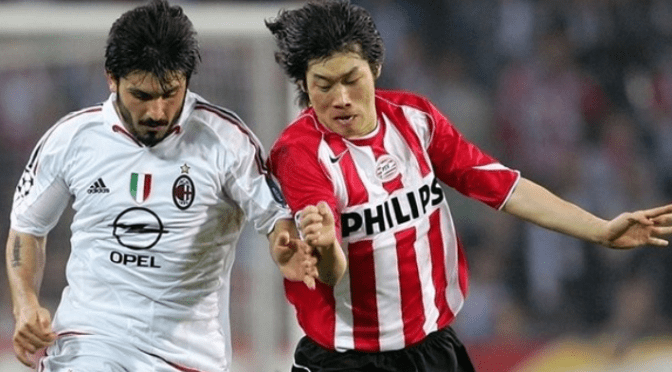
In a throbbing second leg encounter, they began to climb. The Phillips Stadion, bedecked with colour and ferocious with noise, experienced a night quite unlike any other in its considerable history. After ten minutes, Ji-Sung Park ran on to a loose ball and opportunistically thumped it high into the net. Liftoff!

When Phillip Cocu, former midfield maestro and current PSV manager, rose to nod home a Lee-Young Pyo cross in the second half, Eindhoven rejoiced. It was a moment, an achievement, which encapsulated an entire era of PSV glory; this team of heroes fighting back to earn parity with one of European football’s defining powerhouses. In a surreal, dreamlike state, PSV had Milan on the ropes.
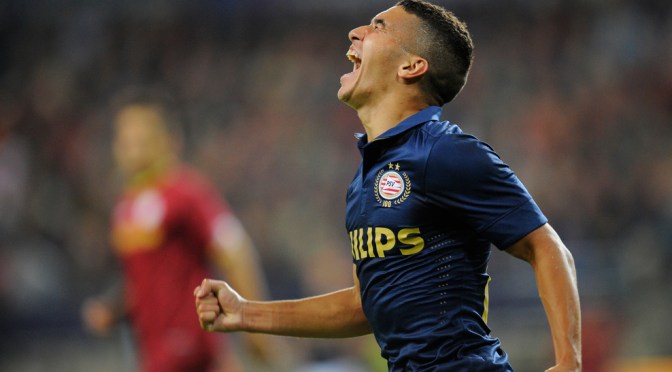
A cruel, 89th minute twist was the seminal moment in this heartfelt rivalry. As PSV looked for the knockout punch, a crowning moment to cap a performance of raw ambition, it came at the other end. A sluggish Milan kept the ball so as to insure extra-time. However, when Mauro Ambrosini ghosted in to flick a hopeful cross past the despairing dive of Heurelho Gomes, PSV hearts were broken. The pivotal away goal earned Milan a date with Liverpool in Istanbul, and rendered Phillip Cocu’s late acrobatic half-volley a mere consolation. In the gloom of crushing defeat, Eindhoven had a new nemesis.

I remember only select vignettes from that fateful night; it came in the embryonic stages of my PSV fandom. For instance, I vividly recall Cocu’s towering leap to plunge home the equaliser. I also remember Jan Vennegoor of Hesselink flicking a Van Bommel free-kick against the bar. These memories have become bittersweet in recent years. The frenzied atmosphere and the exceptional display from Hiddink’s team are still sources of pride, but the images of Ambrosini collapsed in celebration provide a chilling reminder of the end result. In whatever manner you look at that fixture, it pulls on the heartstrings.

Even though the two clubs would meet again in the 2005/06 group stages, where a sweet 1-0 victory for PSV in Eindhoven was coupled with a credible 0-0 draw in Italy, last Tuesday saw the most meaningful renewal in the conflict. A place in the Champions League Group Stages lay as the reward. In Eindhoven, talk of “revenge” was fresh in the air; fans taking great confidence in this young team and its sensational start to the season. Whilst PSV were seen by many as the “underdogs,” an undercurrent of belief manifested itself in a fantastic atmosphere for the first leg. Eindhoven was ready for another big European night.

The performance of PSV was admirable. In the glare of a large television audience right across the continent, the youngsters represented the club with true pride; a display of explosive excitement rekindling all those memories from eight years ago. A rip-roaring start saw Adam Maher, Georginio Wijnaldum, and Jetro Willems test the reflexes of Milan ‘keeper Abbiati. Cocu’s men were playing lively, attacking football with intricate passing combinations and raw pace. They were dominating.

In these games, it seems obligatory for a brutal twist of fate. Just as you begin to rise from your seat with greater regularity, expecting wave-after-wave of PSV pressure to result in a goal, Milan punch you in the gut. A shrewd breakaway, one of Milan’s very first of the tie, saw full-back Ignazio Abate exploit the defensive naivety of Memphis Depay before crossing for Stephan El Shaarawy to nod home into the far corner. Another Milan away goal in front of the Phillips Stadion Oost Staan.

If anybody thought that this team of energetic youngsters was about to lie down and give-up, they were sorely mistaken. Even after Mario Balotelli crashed a shot against the bar, PSV regained a measure of composure and began pressing for an equaliser. Adam Maher, ubiquitous in a play-making role, again worked Abbiati, before crunching his own shot off the woodwork. In a breathless and thoroughly-entertaining first-half, Cocu’s men did everything except score.

After so much exquisite football, unpicking the Milan defence with deft passing and movement, PSV’s eventual equaliser was drenched in irony. As Milan became more compact in midfield, space was at a premium. Thus, when found open some forty yards from goal, Jeffrey Bruma decided to just thumpn the ball. It swerved in the air, causing Abbiati to fumble. Tim Matavz arrived to prod home a richly-deserved equaliser, sending the PSV masses into delirium. The game trickled to a fairly calm end, with the tie balanced precariously at 1-1 heading to Italy.

At this stage of the season, we continue to learn a lot about this new-look PSV. In matching, and even dominating, Milan for periods during the first leg, a major milestone in the Cocu Revolution was achieved. The manager was using this tie to measure the progress of his developing squad, stating that “it give us a chance to compare ourselves to a great team.” The players came-of-age, a rock-solid bond between Bruma and Karim Rekik emblematic of a maturing PSV rising to a daunting challenge. On PSV’s biggest European night for five years, a sense of pride was restored.

The experts are wrong to dismiss PSV’s chances in the second leg. This is a tie which can change entirely with just one goal, and PSV have scored in thirty-four consecutive games. Furthermore, the Dutch giants dominated the first leg in periods, showcasing football which had Milan hanging by a thread. Nobody should underestimate the potential of this PSV side.

As the excitement builds ahead of Wednesday’s clash, PSV fans are in buoyant mood; they believe in another European fairytale. After all, anything can happen when rivals meet.

RyanFerguson

Click on Ryan’s name to follow him on Twitter