We’ve already learnt a great deal about the new-look PSV. After a summer of change in Eindhoven, Phillip Cocu looks to have assembled a young squad capable of competing for all domestic honours. As the club attempts to distance itself from a boom-and-bust transfer culture to one of organic development, fans are already beginning to see a very different PSV Eindhoven.
In the first instance, we’ve learnt that PSV will play some brilliant football and score some wonderful goals. The Champions League qualifier against Zulte Waregem proved as much; the youthful side producing some irresistible passing football en route to an impressive 5-0 aggregate victory, whilst capturing the attention of fans throughout Europe with a pair of memorable goals. In Eindhoven, Memphis Depay produced another twenty-five yard firecracker to give PSV the lead, before live-wire starlet Zakaria Bakkali sealed progression with an exquisite volley in Brussels. As Cocu’s side secured a playoff rendezvous with AC Milan, the spotlight began to shine brighter than ever on the prodigious talent of his young players. Even Zulte head coach Francky Dury couldn’t contain his admiration for PSV’s offensive style, stating that they “have a great team,” which plays “football of a very high level, the like of which we hardly know in Belgium.” Thus, PSV fans will be treated to a highly-entertaining brand of football in the season ahead, as played by a cast of extremely-talented youngsters.
The opportunity to watch this talent grow and develop will be an even greater privilege. In Jeroen Zoet (22 years old), Jurgen Locadia (19), and Memphis Depay (19), to name but three, they possess some of the finest Dutch prospects in the Eredivisie. However, the majority of column inches thus far have been devoted to the aforementioned Bakkali. At the tender age of 17 years and 196 days, the Belgian winger became the youngest ever player to score an Eredivisie hat-trick; his arrival on the senior stage announced with a trio of superb strikes against NEC Nijmegen on 10 August. As if such an astonishing feat didn’t lend itself enough to hyperbole, Bakkali was also selected for the Belgian National Team ahead of their friendly against France. When you’re seventeen years of age, weeks don’t get much better than the one Zakaria Bakkali has just experienced.
He was the youngest of a very young bunch during the NEC game. In their illustrious one-hundred year history, PSV Eindhoven have never fielded a younger starting eleven than the one which took the field that night. A team with an average age of 19.9 made captain Georginio Wijnaldum (22), and playmaker Adam Maher (20), seem like elder statesmen! After years of assembling teams with costly veterans and expensive gambles, it makes for a refreshing change to see such a homegrown PSV side.
It’s a conscious change. When unveiled as Head Coach in May, Cocu promised to “build a new PSV,” which will “invest more to help smooth the path for youngsters to the first team.” In hiring PEC Zwolle miracle-worker Art Langeler to oversee a philosophical change at youth level, and in promoting prospects like Bakkali and Depay to prominent roles, the club has acted swiftly to substantiate these promises. However, the project is still very much a work-in-progress. It’s only natural that PSV will encounter difficulty at points, with such an all-encompassing trust in youth. As the players acclimatise to the rigorous fixture schedule and become aware of the growing responsibility placed upon them, frustrations are sure to be felt. There will be periods of inconsistency. There will be over-exuberance and even indiscipline. There will be defeats. In the wider scheme, however, these growing pains will be worthwhile, as PSV attempt to change the culture by giving greater freedom to their players. The young prospects will develop and grow after learning from the inevitable mistakes. So will the club.
The opening Eredivisie game at Den Haag was perhaps the most honest reflection of what we can expect from PSV. In a pulsating first half, goals from Wijnaldum and Jetro Willems were sandwiched between a bizarre own goal, as PSV raced into a 3-0 lead. However, a hint of defensive naivety set in, with Den Haag pulling a goal back from a set piece shortly before half-time. After the break, the tempo was rather flat and PSV became a little sloppy in possession. When Den Haag capitalised on a lapse in concentration to make the game closer than it ever should have been, it was clear that the youngsters on whom Cocu will rely are still to master the nuanced art of closing-out victories. They still won the game, 3-2, but stoppage time was nervy when it needn’t have been.
In teaching the more gritty aspects of winning games and championships, the more experienced players will be vital to PSV. The return of Park Ji-Sung is a smart acquisition; the former Eindhoven favourite has abundant experience, and will be well-positioned to school the younger players in what is required when representing PSV. Cocu admits that overwhelming experience was a motivating factor in Park’s return, stating that younger members of the team will “gain from someone who has already played at the top level for so many years.”
Similarly, experienced midfielder Stijn Schaars will be a major cog in the PSV machine. A veteran of nearly 250 career appearances, Schaars is viewed as the reliable anchor of an otherwise mercurial midfield, chiefly responsible for maintaining concentration levels, closing-out tight games, and finding ways to win when the skills and tricks aren’t quite working. In finding a correct balance between this kind of experience and the dynamism of younger players, the essence of Cocu’s project becomes visible.
It’s a project which has the passionate support of PSV fans. The games thus far have been played in fantastic atmospheres; the Philips Stadion faithful understanding the need for change. At present, they are enjoying the thrilling emergence of a new generation, roaring and cheering louder with each step-over, each wondergoal, each victory. Along the way, there’s sure to be setbacks and growing pains, but the journey on which this enthralling team promises to take the fans of Eindhoven will rarely fail to fascinate.
In 1606 the Dutch vessel the Duijfken contained the first Europeans to set eyes on the continent of Australia. Over the next 100 or so years other Dutch mariners would accidentally bump into the western coast of Australia on the way to their colony of the Dutch East Indies (now Indonesia). These mariners never thought to colonise Australia and instead left that to the British. So even though Australia was referred to as New Holland for a while the culture of the land was very much Anglo. Hence as Australia grew as a nation and a football playing nation the predominant influence was the British culture & methodology. Australia’s football cultures was based on the British way and for years and years Australia played to a very English system for very little return – one World Cup appearance in 1974.
Fast forward to 2005 and the Australian National Football team – the Socceroos – were still carrying the scars of past qualification campaigns under a British system. Back then billionaire property tycoon Frank Lowy took charge of the FFA and decided that it was qualification for the 2006 World Cup or bust. He then sent out his considerable resources to find a man that could lead Australia past 32 years of qualification heartache and into the World Cup. That man that was Guus Hiddink (pictured above) who combined his PSV role with that of managing the Socceroos. We all know the rest; Australia beats Uruguay in a play off to make the World Cup and then performs admiringly in Germany to make the 2nd round before narrowly losing to Italy. Australia fell in love with ‘Aussie Gus’ and so began the ‘Oranjefication’ of football in Australia.
Guus left after the World Cup but his legacy was his Assistant’s Rob Baan & Henk Duut who stayed on with the FFA and oversaw a revolution in the Australian system. Suddenly the British system was out and the Dutch way was in. They developed a new national curriculum, advocated adopting a default 433 style for all Aussie teams and shipped in any two-bit Dutch coach that wanted to come Down Under. Even at grassroots level the five & six year olds started playing ‘Small Sided Football’ in line with their Dutch counterparts and we became New Holland all over again. Another Dutchman, Pim Verbeek, also guided Australia to the 2010 World Cup although his style could only be referred to as ‘anti-Dutch’.
Those in Holland started to cotton onto this and after the wave of Dutch coaches coming down ended the next wave was Dutch players coming to play in the all new, all shiny A-League. Since its exception in 2006 the A-League has welcomed 17 Dutch players amongst its 10 clubs. This number in itself isn’t that impressive but when you look at that other great football frontier – the MLS – it’s only had 12 Dutch players despite starting a full decade earlier than the A-League. That being said let’s take a look at some of the hits and misses of Dutchies playing in the A-League
MISSES
Maceo Rigters – Rigters made a name for himself with the Dutch Under-21 side that won the 2007 UEFA U/21 Championships and made a big money move to Blackburn on the back of this tournament. Several years later he made a much trumpeted arrival to Gold Coast United who themselves were a flashy side from the glitter strip. Rigters unfortunately looked like he spent too much time sampling the great night life on offer on the Gold Coast and after playing 1 season with them was never seen on a football pitch again.
Marcel Meeuwis – After a decade playing in the Dutch and German leagues Meeuwis decided for a new adventure and played the last part of last season with Melbourne Heart. Unfortunately his adventure was short-lived and after playing only 6 games for the club his contract wasn’t renewed.
Andwele Slory – Another one who was much heralded at Youth level and who earned a big move to Feyenoord at a young age, Slory eventually made his way to Adelaide Utd. He played 11 largely anonymous games for the Reds before deciding that he had no further passion for football and retired.
Stef Nijland – Much in the same light as Rigters and Slory, Nijland was a former child prodigy who signed young for PSV and whom big things were expected. His career since has been a litany of loan moves, the most recent of which was with the Brisbane Roar (a club which itself has Dutch migrant roots). Rather than bringing his Eredivisie skills to the A-League Nijland was largely used as a substitute and had 10 uneventful appearances for Brisbane before returning to Holland.
HITS
Luckily there have been more hits than misses as the following list highlights:
Viktor Sikora – Sikora was, at the time, the best credentialed Dutch player to come to Australia having won 6 full caps in Oranje. He had 3 good seasons with Perth Glory and ended up playing more than 25 games and was a good contributor for the team before injuries eventually caught up with him.
Bobby Petta – a former Celtic legend, Petta joined Adelaide Utd in 2006 and became a mainstay for the side. He then became the first Dutchman to play for 2 A-League sides after a short stint at Sydney FC in 2009.
Sergio van Dijk – although Sergio is more Indonesian than Dutch these days, he did make a name of himself initially in Holland. van Dijk scored 50 goals in the A-League for first Brisbane Roar and then Adelaide Utd before scooting off to Indonesia.
Youssouf Hersi – Hersi’s early career prospects were blighted by injury and hence he didn’t quite live up to his potential. However a move to the newly founded Western Sydney Wanderers last season has revitalised Hersi who was one of the key players for his side in their fairytale run to the Premiership. Also made the end of season A-League All Stars side
Patrick Zwaanswijk – The consummate professional Zwaanswijk eventually moved to the Central Coast Mariners in 2010 to have one last adventure before retiring. After starring in his first season with the Mariners he decided to stay around and 87 games and 11 goals later he is a club legend after scoring the winning goal in last season’s Grand Final. Now retired, Zwaanswijk has joined the coaching staff at the Mariners.
This season we will see the following Dutchmen in action in the A-League:
Marcel Seip – Central Coast Mariners
Rob Wielaert – Melbourne Heart
Orlando Engelaar – Melbourne Heart
Youssouf Hersi – Western Sydney Wanderers
Pascal Bosschaart – Sydney FC
There’s a few more rumoured to be on their way Down Under as well which will see the continuation of the Oranjefication of football in Australia.
There are rumours of Manchester City being interested in signing a centre-back (Pepe to be precise) as Joleon Lescott seeks more playing time before the World Cup which may not be possible at City due to the meteoric emergence of Mataja Nastasic. But there’s one player who may well compete for the starting spot in the central defence in the upcoming years, Karim Rekik. Rekik is well known in the youth circuit and is rated as one of the most promising player from City.
Background
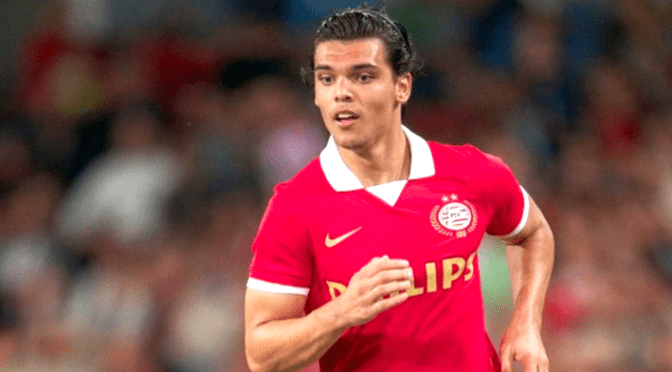
Karim Rekik,18, (Left Foot) plays for the Netherlands youth and is of Tunisian descent. Rekik spent 9 years at the Feyenoord academy before moving to Manchester at a very young age. He made his City debut at the age of 16 when he came on from the bench as a substitute for Wayne Bridge against Birmingham City in a League Cup tie. He was latter loaned to Portsmouth where he was a regular player on the team list having started 8 matches, usually occupying the Left back position for the
Pompeys. The next loan spell to Blackburn was a frustrating one as he started in only 4 matches and
being named on the bench in 8 matches. He made his Premier League debut in December when he started against Reading in a 1-0 victory, again occupying the Left back spot. Currently he is at PSV Eindhoven on loan and produced a match winning performance against Fenerbahce in 2-0 in the recent friendly, starting at his natural centre-back position. Rekik is a regular member for the Netherlands Youth national team. Infact, Rekik captains the Netherlands U19 squad. He had to withdraw from the U19 Euros because of his loan spell at PSV.
Scout Report
In his own words,Rekik’s natural position is centre-back but he can cover up the left-back spot whenever needed. Rekik has been/is the captain of Feyenoord youth, City reserves and the Netherlands youth national team. Despite his young age, he has already acquired some handy experience. Standing 6 foot 1 inch tall, Rekik uses his height to good use. He is very strong in the air and we can expect some power headers from him in set piece situations. Being robust, he is very difficult to push off the ball. Rekik is extremely confident possession and he showed his rich variety of passes in the recent friendly against Fenerbahce. He can read the game very well and has brilliant anticipation and intercepting skills to handle any Strikers next move. Rekik is well composed in any situations but at the same time does not shy away from sliding in a tackle. He is always there to challenge for ground or aerial 50/50 and his leadership qualities can be seen in the way he conducts himself on the pitch. He positions himself well and it won’t be surprising to see him in the City squad by next season itself. Rekik is the only left footed centre-back at PSV and with the highly rated Jetro Willems at left-back, Rekik will get to play at his preferred position more often.
The loan spell at PSV is a very good platform for Rekik to announce himself and to gain more experience from playing at the top level. There’s no doubt Rekik will come out as a more developed player at the end of this loan spell. Rekik said he wants to represent Netherlands at the 2014 World Cup, It maybe a too high target to achieve in such less time but no denying this young lad will be the first choice centre back for Netherlands and City very soon.
The upcoming Eerste Divisie season will have four new teams competing in the league, Markus Wenzel provides a few facts to introduce you to the new boys.
Achilles´29
R.K.S.V. (Rooms-Katholieke SportVerenigung) Achilles´29 are from Groesbeek, a town in the eastern Netherlands, and has a population from 18,929 and is a near the border to Germany. The nearby city is Nijmegen.
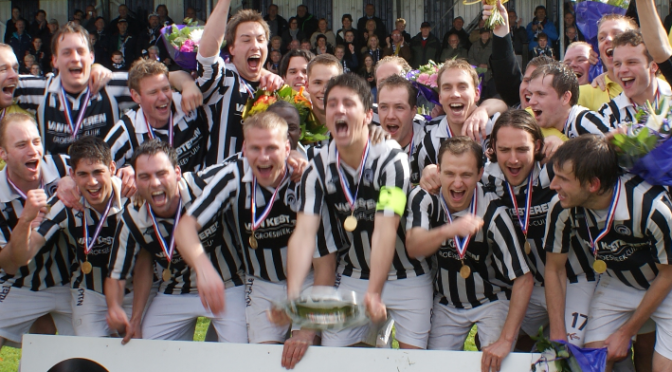
Achilles´29 are one of the most successful amateur clubs of the Netherlands, since they were founded on 1st June 1929. There recent success has been remarkable, just last season, the Whiteblacks won the Topklasse Zondag for the second time in a row. Besides that they have won the KNVB Amateur Beker in 2011 and the Supercup for Amateurs twice in 2011 and 2012. They have also won some titles in the lower leagues and in the Districts. With last season’s title win in the Topklasse Zondag, Achilles was asked to join the Eerste Divisie by the KNVB and the team accepted the invitation.
Their stadium, the Sportpark De Heikant has been used since their inception and has a capacity of 4,500 seats.
Last season, the club won 22 games, lost 6 and drew twice with the best goal difference in the league (+47) only conceding 23 goals. The highest win was a 6-0 thrashing of SWZ from Sneek.
After the promotion, their successful coach Jan van Deinen announced that he would not lead them into professional football and quit. So Achilles has hired François Gesthuizen, from hoofklasser (4th Division) Blaauw Geel´38 from Veghel, to guide them this upcoming campaign.
Their only well known player is Thijs Hendriks, who played 4 games in the Eredivisie for NEC. No other player in their squad, as time of writing, has ever played higher than in the Topklasse.
Achilles´29 have had several great players in the past on their books like Arno Arts, midfielder who played top flight football for FC Twente, FC Utrecht and NEC or Barry Ditewig former goalkeeper for the now defunct SC Veendam and ADO Den Haag.
Apart from the first team Achilles´29 has 11 other senior teams, 1 womens team and 13 youth teams. Their archrivals are De Treffers, also a team from Groesbeek.
Jong Ajax
Jong Ajax, the reserve side of Eredivisie champions Ajax Amsterdam, are also on the way to their first season in professional football. The eight-time winner of the Beloften Eredivisie (1994, 1996, 1998, 2001, 2002, 2004, 2005, 2009) finished 4th last season in the league and was invited to take part as one of the four new teams in the newest implementation of the Eerste Divisie.
The team, likes the first team, plays 4-3-3, like every other team from the Ajax set-up. Just like a reserve side, they will consist of players who graduate from the Ajax youth academy or are unable to play in the first team due to injuries or players who cannot gain selection for the first team. Alfons Groenendijk, who played 22 times for Ajax himself, is in charge of the squad.
They will play their home games at Ajax’s sporting complex near to the Amsterdam Arena. De Toekomst, opened at the 14th August 1996, and will have a capacity to house 2,250 supporters. Only the home game against Jong PSV, will be played at the Amsterdam Arena due to the interest in that game.
Jong PSV
The Beloftenteam from PSV, Jong PSV, are four-time champions of the Beloften Eredivisie (1997, 2000, 2010, 2011) and they ended last season in 9th position.
Jong PSV will be the squad to introduce the talents from the youth to the senior football and give the talents from the first team some game practice. The team will be managed by former RKC Waalwijk player Darije Kalezic, whgo was last seen coaching De Graafschap.
The home games will be played at De Herdgang, the training complex of PSV. In an announcement before the new season, PSV announced that no fans from Willem II, FC Den Bosch, Jong Ajax, Jong FC Twente, MVV Maastricht, Fortuna Sittard, FC Dordrecht, FC Oss or De Graafschap will be welcome at De Herdgang for risks of crowd trouble.
Jong FC Twente
The two-time winners of the Beloften Eredivisie (2008, 2012) from Enschede were the last invited team to the Eerste Divisie for the upcoming season. Jong Twente, finished in the 8th last year in the competition for the Beloftenteams, and will try to help players to promote into the first team of FC Twente. Jan Zoutman has the task of leading the team, he managed Haarlem years ago in the Eerste Divisie.
Jong Twente will play their home games in the same stadium like the first team, De Grolsch Veste.
Click on Markus’ name above to follow him on Twitter
The world famous Ajax Academy System, De Toekomst, has recently been reviewed by UEFA and has been voted the number one academy ahead of Barcelona, Borussia Dortmund, Real Madrid and Liverpool. De Toekomst, which translates to ‘The Future’, has produced some of the finest talents in world football down the years. It have produced some of the biggest names in Dutch football such as Johan Cruyff, Patrick Kluivert, Marco van Basten, Edgar Davids and Dennis Bergkamp but what makes the youth academy so good and produce so much home grown talent that goes on to great success?
The Ajax academy – De Toekomst
Originally founded on 18th March 1900, De Toekomst’s facilities and are situated down the road from the Amsterdam Arena. There are around 14 hectares of various grass and artificial grass pitches, a stadium for reserve and youth games and a full sized, covered artificial grass pitch. The indoor dome, which was built in 2011, is another addition to De Toekomst and has a pitch and a variety of instruments designed to take the Ajax method to the cutting-edge of scientific development. There is a two-storey building which has locker rooms, class rooms, workout facilities and offices for coaches and sport scientists. Within the workout facilities, there is a weights room, a gym and a swimming pool for recuperation and a café where players are served meals. Visitors are also allowed to visit De Toekomst at free will to watch training sessions and games and can also visit the café where they can enjoy a glass of beer or a cappuccino while overlooking the training grounds. The only off-limits areas are the indoor pitch and the first team training area.
The main goal for Ajax is to have three players make it to the first team from the academy every two seasons, if they don’t achieve this it is seen as a failure. To achieve their aim, they have to get the right type of player in from the start and they do this through their extensive scouting network. Ajax’s preferred zone of recruitment is 50km around Amsterdam but they sometimes stretch their recruitment area across the Netherlands with fifty scouts and occasionally across Europe where five scouts are positioned. An example of this occurring is the signing of Christian Eriksen from Odense BK in 2008. At the time Eriksen, who was 16, joined Ajax’s youth academy after trials with Barcelona, Chelsea and Real Madrid. After his move to Ajax, Eriksen said, “My first step should not be too big. I knew that playing in the Netherlands would be very good for my development. Then Ajax arrived and that was a fantastic option.”
Christian Eriksen signing as a 16 year-old
After finding the latest talent for the academy, the players have to go through a test stage called ‘talentdagen’, a stage where the coaches find out if they are good enough to be signed on a youth contract. In this stage the coaches look for a certain set of skills which would allow them to fit into the Ajax style of play. The desired skills for the young players include ball control, position play, movement habits, mind-set and T.I.P.S (Technique, Intelligence, Rapidity and Personality). If they pass this test stage, they are deemed to have the technical ability to progress into the academy.
The academy has over 200 players and has a variety of age groups which range from 5 year olds up to the Under 19s and Ajax 2, the reserve team. All these players are supervised by 13 coaches and the ideal coach for Ajax is an ex-player who had lots of experience at high levels of the game. An example of this is back in 2008 when former Ajax player Dennis Bergkamp was appointed as the U12 coach before moving onto the U19s in 2010 and now he is the assistant manager of the senior side. All the coaches at De Toekomst have a massive influence on each player’s development and are trusted in keeping with the Ajax philosophy at all times in preparation for the first team, if they make it that far.
The system that Ajax use throughout the club is 4-3-3 system named Total Football, which was first created by Rinus Michels in the 1970s. During that era, Ajax played some of the finest football ever and had a 100% home record over two seasons and won the European Cup three times in a row. They also celebrated five title wins in 1972 (Eredivisie, KNVB Cup, European Cup, European Super Cup and the Intercontinental Cup). It was also further used by the Netherlands national football team at the 1974 World Cup where they achieved a second place finish.
The tactic’s success depends largely on the adaptability of each individual in the team and the ability to quickly switch positions depending on the on-field situation. It also requires the players to be comfortable in numerous positions and relies on the technical ability of the players, reinforcing the idea of training the academy players using this formation from an early age.
As previously mentioned, when they players come into the academy they are immediately exposed to the Total Football tactic. A report by the ECA on youth academies in Europe showed that children as young as eight are exposed to the 4-3-3 system. Under 8’s training sessions are mainly focused on passing, movement and finesse but confidence on the ball is the priority.
One of the great things are De Toekomst which English academies could learn from is that they believe that the children shouldn’t be over trained, the players evaluations only start at the age of 13. They believe that it is very beneficial for young players to not be over trained and 12 year old boys only train three times a week and then play a match on weekends.
“The coaches believe that children have their own lives and families and they should not be taken away from their daily lives, families and social environment for too long. When they are not training, young academy prospects should play on the street with their friends; this can be crucial to a player’s development both as a person and a football player.”
At this age the number of focuses in training increases up to seven which includes team spirit building. The other focuses at this age level include passing, technical training, positional play and finishing on goal.
Once the players reach the age of 15, the training level is upped and they train five times a week. Their training consists of short games and running exercises or sometimes in may be passing the ball over a short distance. The main focus for this age level is positional game play and games with many variations, as well as player evaluation.
Once the players at De Toekomst reach the age of 16 and 17, they are deemed to have ‘made it’ and are almost guaranteed a first team place in the near future, something that is extremely rare in the modern game. From this age during training, they are required to do 30m sprints with sensors to register times over five metres. The De Toekomst staff believes this is the distance over which acceleration occurs most often in real games.
De Toekomst has had many famous graduates over the years, perhaps too many to go into detail. I’ll go into detail of my four favourite graduates but there is plenty more graduates that could be talked about. Marco Van Basten, Marc Overmars, Frank and Ronald de Boer, Clarence Seedorf, Frank Rijkaard and Wesley Sneijder are just some of the names that have been produced by the famous academy.
Johan Cruyff
Probably the most famous player to come through De Toekomst, Cruyff became synonymous with the playing style of Total Football. He joined De Toekomst on his 10th birthday and made his first team debut, aged 17, against GVAV in 1964. Cruyff won a total of 20 honours during his time with Ajax which included eight Eredivisie titles, three back to back titles between 1965 and 1968. He also won the KNVB Cup five times and was part of the Ajax side that won three consecutive European Cups in the 1970s. Cruyff had numerous individual honours to go along with the team efforts for Ajax, he won the Ballon d’Or three times (1971, 1973, 1974), the European Golden Shoe (1968) and Dutch Footballer of the Year five times (1967, 1969, 1971, 1972, 1984). He ended his nine year affiliation with Ajax in 1973 when he moved to Barcelona and also played for Los Angeles Aztecs, Washington Diplomats, Levante, Feyenoord. Cruyff also returned for a two year spell with Ajax in 1981. He had massive success with the national side as well having made 48 appearances and scoring 33 goals. When Cruyff scored in a match for Netherlands, they never went onto lost the game. Cruyff led them to a runners-up medal in the 1974 World Cup and received the World Cup Golden Ball award for his efforts during the tournament.
Edgar Davids
Edgar Davids is perhaps the most recognisable footballer of all time due to his appearance of dreadlocks and protective goggles, which he wore due to glaucoma. He began his career at De Toekomst as a 12 year old and spent five years in the academy before making his debut in 1991 in a home win against RKC Waalwijk. During his five year original spell with the club, he helped Ajax win three Eredivisie titles and achieved success in Europe with a 1992 UEFA Cup win and the 1995 UEFA Champions League. In 1996, Ajax got to the final of the Champions League again but lost on penalties and Davids missed the first penalty in the shootout. He left Ajax in the summer of 1996 for the bright lights of Milan but only lasted a year before being transferred to Juventus. During his career he also enjoyed a loan spell to Barcelona and deals at Inter, Spurs, another spell at Ajax, Crystal Palace before ending up at current club Barnet in 2012 – where he now manages. He was capped 74 times by the Netherlands, during which he represented his country once at the World Cup and three times at the European Championships, and scored six goals.
Dennis Bergkamp
Bergkamp was born in Amsterdam in 1969 and joined the famous academy in 1981 as an 11 year old. He was brought through the system and handed his debut against Roda JC in 1986 by Johan Cruyff. Bergkamp scored his first goal for the club in 1987 against HFC Haarlem before establishing himself as a first team player in the late 80s. In the 1990-91 season, he was the Eredivisie’s joint top goalscorer with Romario after he scoring 29 goals in 36 games. During his time with Ajax, he made 239 appearances, scoring 122 goals and he was voted Dutch Footballer of the Year in 1992 and 1993. He moved to Inter Milan in February 1993 for £7.1m before moving onto the club where he achieved most success, Arsenal. His international career saw him make 79 appearances with 37 goals, a record which was taken over by the next graduate I will be talking about, Patrick Kluivert. During his career, he achieved 22 individual honours which included Dutch Football Talent of the Year (1990), Ballon d’Or (1992, 1993) and PFA Team of the Year (1997-98).
Patrick Kluivert
Kluivert joined De Toekomst at the age of seven after learning to play football on the streets. During his time at the academy he played in a variety of positions including defender but he was too strong in technique, football intelligence and speed and was made a striker. He made his Ajax debut as an 18 year old in the Dutch Super Cup victory against Feyenoord and opened the scoring in the game. He was part of Ajax’s Golden Generation in the early 1990s which featured the likes of Edwin van der Sar, Marc Overmars and Clarence Seedorf. Kluivert came off the bench in the 1995 Champions League final to score an 85th minute winner against one of his future clubs, AC Milan. During his career he also played for Barcelona, Newcastle, Valencia, PSV and Lille. He also had huge success with the national side making 79 appearances and is the all-time leading Netherlands goalscorer with 40 goals.
However all these graduates are in the past now and Ajax have suffered in recent times due to other top domestic leagues going global. Other domestic leagues have lucrative TV revenues coming in yearly whereas the Eredvisie has little income compared to them forcing Ajax to become a player factory and selling their star talents when they reach a certain market value. Over recent years they have been forced to sell players but Ajax have made huge profits from them. Examples of this include Thomas Vermaelen (£12m), John Heitinga (£12m), Wesley Sniejder (£27m), Rafael van der Vaart (£5.5m) and Gregory van der Wiel (£6m).
From the profits they make, Ajax re-invest most of the money in young stars of the future and, as previously mentioned, they sometimes look abroad for the best young players to bring to De Toekomst to transform into stars and sell on for profit. Two of the best examples of recent times are Danish midfielders Christian Eriksen and Viktor Fischer.
Eriksen signed for Ajax from Odense BK in 2008. At the time Eriksen, who was 16, joined Ajax’s youth academy after trials with Barcelona, Chelsea and Real Madrid. He worked his way through the the youth teams and was promoted to the first team in January 2010 before making his debut within a month against NAC Breda. Eriksen was compared to the Ajax youth products Wesley Sneijder and Rafael van der Vaart by Martin Jol. He also said that he was a good reader of the game in the number 10 role, a role which he commonly features in for both club and country. Eriksen’s breakthrough season came in 2010-11, during which he was named as Danish Talent of the Year, Ajax’s Talent of the Year and Dutch Football Talent of the Year. Since then he has had a rising influence in the squad and has recently been linked with big money moves to Liverpool and Borussia Dortmund.
Viktor Fischer impressed visiting Ajax scouts in the U17 World Cup in Mexico and signed for them after trials with Manchester City, Chelsea and Inter Milan. Similar to Eriksen, Fischer joined Ajax for the chances to develop as a player in the famed De Toekomst academy. During his time with Denmark U17’s, he scored 20 goals in 30 appearances – an impressive feat. Fischer made his first team debut in a friendly at the start of last season against SV Huizen and then made his Eredivisie debut in October 2012. In his debut season, he emerged as Frank de Boer’s first choice left winger and scored in the game that secured Ajax’s 32nd Eredivisie title. He was also named Ajax’s Talent of the Year for his outstanding debut season which saw him score ten goals in the league, twelve in all competitions. Fischer made his senior international debut in November 2012 and has so far made 2 appearances for Denmark and looks set to have a very good future in the game.
As well as having non-Dutch players coming through the ranks and impressing the coaches, Ajax also have a number of Dutch players that have a big future at the Amsterdam Arena. One of these is Stefano Denswil, who played a big part for Ajax in the 2011-12 NextGen Series as they reached the final before being beaten on penalties. Denswil was announced as a member of the first team squad at the start of last season after impressing for Jong Ajax. He only made three appearances for the first team but had a scoring debut in the KNVB Cup against ONS Sneek as he scored a free kick in the 88th minute.
Let’s just hope that all these players, that have the potential to do big things, will live up to their expectations and perform at the highest level. Without De Toekomst and the development of their youngsters, we may not have seen some of the greatest footballing talents to ever grace the footballing world. Hopefully one day Ajax will be able to compete with the biggest team’s in football and keep hold of their high quality players instead of being a player factory and selling them on for profit.
Click on Michael’s name above to follow him on Twitter.
In October 2012, Edgar Davids shocked the footballing world joining English League Two side Barnet FC as player-manager, here’s Bees fan Josh Ilan’s account of the Dutch legend’s impression he has left on the club.
Under the tutelage of Mark Robson, we were absolutely dire. Twelve games into the season, and we were bottom of the table, having only garnered three points – and no wins. The football we played was dire, and our chances of survival almost non-existent. It was like we started on a points deduction, and paid faith to the adage men against boys.
There was a feeling of negativity and doom amongst the club. And then Edgar Davids joined.
It had been mooted previously, but this was cast-off as a ridiculous rumour. His arrival saw the club gain notoriety from all over the world. We were incredulous at how a former Holland captain – a man who had represent clubs at the highest levels of the game – would now be gracing the famous Underhill slope.
Davids’ reasons for joining the club were to help his local team, and to gain invaluable experience as a coach. His first official game in charge resulted in our first win of the season: this was the 4-0 win over Northampton Town, in which we played absolutely phenomenally.
We improved dramatically upon his arrival. Wins and draws went from once in a blue moon to a regular occasion. The defence tightened, the midfield became more coherent and the strike force more deadly. Feelings of excitement and cautious optimism became present, with Davids doing the impossible in turning us from relegation certainties to candidates; a scenario we could have only hoped for at the start of the season.
While we could not achieve the ‘Great Escape’, Davids’ reputation remains as strongly. A poll on the Barnet Forum saw 97% of people say how they wanted him to stay at the club, despite our relegation. If it was not for him, we would have been relegated months before, potentially as the worst ever League Two side.
And his decision to stay at the club means we have a bright future, and cause for optimism ahead of next season.
Under Davids, our style of play became more expansive. His style revolves around the cultures of the different countries he has played in. It can be seen as slightly defensive, with it being based around possession and playing out from the back. This is a style and philosophy to be admired.
He is also having an impact on the younger players, with him bringing academy players into the side to great effect. Elliott Johnson has become a regular under him, while Luke Gambin burst into the side towards the end of the season. In fact, the latter has been surprisingly linked with a move to Ajax, Davids’ stomping ground.
His managerial style sees him want to get the best out of his player. Davids may be strict, but this makes the players want to perform, both for themselves and their manager.
And this is a style which saw us improve so quickly. In fact, in the 36 games Davids was in charge, we picked up 48 points. This would have seen us finish 9th, had the season started upon his arrival. We would have been far closer to the play-offs than the relegation zone we ended up in.
Any other season and we would have survived. Our points tally of 51 was the highest from any side in League Two history to be relegated on. We were not relegated by a matter of points, but five goals.
As with any young manager learning his trade, Davids did make a few tactical errors before the end of the season. We became slightly more defensive, with a fear of losing becoming prevalent.
At times, we lacked a Plan B when our pretty passing style failed. This is something we will need to work on for the more physical and long-ball systems employed in the Conference.
He also played himself at times on the wing, to the detriment of the team. I feel that he was not good enough for League Two, a far cry of the player he once was, and that his best place would be managing the team from the side. However, he does add a sense of leadership on the pitch, which gives us renewed vigour – which does justify his selection in the team at centre-midfield.
One of the things I commend Davids for most is the way he has embraced the club, and its culture. He does not see himself as any better to the rest of the players, and respects us fans.
Davids made the news after he rescued 38 Barnet fans – including myself – after our coach collapsed when going home from a 3-2 loss to Accrington Stanley. At the service station we met him at, he was approachable, friendly and very down-to-earth.
After we lost 2-0 to Northampton Town, he issued a quote which could become an epithet for the season to come: “If you have to go to the Conference, you go to the Conference.” This indicates his humble nature, and how he is not fazed about the level he is playing at – with his love for the club being genuine.
I was lucky enough to be in one of his press conferences this season. The aura he gives off his extraordinary. His passion and vision for the club represents that of the fans and our chairman. He wants the best for us, and he is not using us for personal motives.
In an age where football is dominated by money, there are the odd exception who play for love – and not money. One is Edgar Davids.
As our chairman Tony Kleanthous said: “Once a Bee. Always a Bee!”
Click on Josh’s name above to follow him on Twitter.
With another season over and yet another season without trophies, PSV have gotten a lot of criticism lately. They spent loads of money on new players (mostly midfielders and attackers) over the last few seasons, which made them big favourites at the start of the season. Having scored an astonishing 103 goals in 34 matches, the attacking strikeforce seems very good, but due to 43 goals conceded, they eventually lost the title to Ajax, who claimed their third consecutive title. Fans have voiced their concerns about the transfer policy of the club. PSV should invest more in their leaky defense and give youth more chance in their opinion.
So, after head coach Advocaat announced that he would leave the club at the end of the season, PSV promoted assistant manager Phillip Cocu to the head coach role. In the presentation of their long-term plans, Cocu and Brands mentioned both investing in defense and youth as the new priorities for next season.
Over the last weeks, many articles about possible transfer targets for PSV popped up in Dutch media, with most of them confirmed by PSV staff. We made a list of potential signings and also included a list of players that will or might leave the club during the next transfer window.
Leaving – Mark van Bommel retired this weekend
Outgoing
Boy Waterman: Has been PSV’s first choice goalkeeper for most of the season, but was criticised by many fans. Contract expires this summer and according to VI, Cocu wants to let him go in order to give youth goalkeepers Jeroen Zoet and Nigel Bertrams a chance to compete with Tyton.
Wilfred Bouma: Senior defender in his second term for PSV. Played a few matches last year but was considered to slow for PSV’s defence. Today, new head coach Cocu has told Bouma that there will be no space for him in next year’s squad, so Bouma will have to make place when his contract expires this summer.
Marcelo: If anything has been made clear this season once more, it is the fact that PSV’s defence was once more incapable of making a strong impression. Among fans, Marcelo is the main victim of criticism. Made some fatal mistakes. Thijs Slegers, Voetbal International’s PSV watcher, announced a few days ago that Bundesliga side Werder Bremen appear to be interested in buying the 25-year old Brazilian defender. No formal approach has come in though, according to PSV technical director Marcel Brands.
Stanislav Manolev: Was loaned out to Fulham in January, and has told Dutch media that he is hoping for Fulham to activate the buyout clause in his contract.
Atiba Hutchinson: Player with the most appearances for PSV this season. Naturally a central midfielder, but switched to right back after Stanislav Manolev went on loan to Fulham in January. Earlier (in December 2012), 30-year old Hutchinson announced that he would not renew his expiring contract in order to be able to have one last adventure.
Orlando Engelaar: PSV already tried to get rid of him at the beginning of this season. Very expensive player wage-wise and mostly benched or in the reserves. His contract expires this seasons and PSV have announced not to renew his deal.
Mark van Bommel: Played a key role in PSV’s season. The 36-year old legend returned at the beginning of the season to play for PSV one last time. Despite recent attempts by PSV fans to get him to stay he announced his retirement at the end of the season.
Kevin Strootman: This 23-year old midfielder has once more had a very strong season alongside Van Bommel. With his performance, loads of clubs, including Manchester United, are interested in aquiring the services of the Dutchman.
Jeremain Lens: Had a good season as he scored 15 and gave 10 assists, but has been very open about his ambitions. He has already expressed his desire to play in the Bundesliga or Premier League several times.
Incoming
Jeroen Zoet (RKC Waalwijk): This young goalkeeper will return from two seasons on loan at RKC and is looking to compete for first goalkeeper with Tyton, after having had a good season in Waalwijk.
Mike van der Hoorn (FC Utrecht): 20-year old defender who has impressed this season for his current club FC Utrecht, with his team conceding 41 goals (less than PSV!). According to Dutch newspaper De Telegraaf, PSV technical director Marcel Brands has already approached Mike informally if he would be interested in joining PSV.
Virgil van Dijk (FC Groningen): Another defender who has played a very solid season for his club, leading to interest from clubs in- and outside of the Netherlands. Marcel Brands was spotted in Groningen on the last day of the season as Groningen lost 0-2 to Ajax to check out the young defender.
Santiago Arias (Sporting Lisbon): Highly-rated young right-back from Sporting Lisbon. Has been a transfer target this whole season, but with both Manolev and Hutchinson expected to leave, a right back is now top priority.
Karim Rekik (Manchester City, loan): Dutch central defender currently playing for Manchester City. Played only one match for City this season, and isn’t expected to play much next season either. As reported by Thijs Slegers (Voetbal International), PSV might try to bring him to Eindhoven on a temporary deal.
Luis Felipe Ramos (Ituano): This young (16-year old!) Brazilian defender is currently on trial with PSV. If he turns out to be good enough for PSV, he can be brought in instantly as he appears to be able to get a European passport.
———–
Click on Joost’s name above to follow him on Twitter and also visit his blog at FM Holland.




















 totaldutchfootball.com