All posts by Will Burns

UEFA CHAMPIONS LEAGUE PREVIEW: Ajax vs. PAOK Salonika

This article is produced in association with HeaderBlue

Ajax have barely got themselves back into training and they have the challenge of Greek Superleague runners-up PAOK Salonika in the third qualification stage of the Champions League. Looking for real value in the betting markets, Will Burns thinks the Amsterdammers will win, but with a struggle.

AjaxPAOK

Tuesday 26th July 2016 – 19:45BST

AJAX vs. PAOK SALONIKA

UEFA CHAMPIONS LEAGUE – THIRD ROUND QUALIFYING FIRST LEG

Tuesday night sees Peter Bosz first competitive match as Ajax manager as he control the reins that Frank de Boer left behind at the end of the season. A season which the Amsterdam giants saw PSV pip them to the title on the last day of the season, as Ajax failed to overcome De Graafschap while PSV dispatched PEC Zwolle. A result which placed the final nail in De Boer’s coffin as he resigned immediately.

It’s a new beginning in Amsterdam and although the players are virtually the same with only two summer additions, it’s a fresh start for Bosz, who we last saw in Holland managing Vitesse Arnhem. He will have get his players to adapt to his high pressure style of football as soon as possible. In regards to player changes: right-back Ricardo van Rhijn has departed for Club Brugge and fellow defender Mike van der Hoorn joined Swansea City, in return Bosz has added experienced German defender Heiko Westermann to the ranks from Real Betis and Mateo Cassierra, a 19-year-old Colombian striker from Deportivo Cali signed on the dotted line for €5.5m.

For PAOK FC themselves are experiencing the effects of change in management as Vladimir Ivić only took over from Igor Tudor back in March. They head into Tuesday’s game like Ajax, with this being their first competitive game since the end of last season. These two sides have met only twice before, again a two-legged affair in the UEFA Champions League qualifying back in 2010/11 which produced two draws and saw the Greeks prevail on the away goal rule. Coach Ivić, a former player of the club, scored twice in the legs versus the Amsterdammers.

While looking at the betting, Ajax are very short at 1.65 (with Ladbrokes) so I am avoiding this even though I think they are the most likely winners of this match. PAOK will set-up in a tight 4-3-3 formation which Ajax may find tough to break down so they may look to the counter as a weapon. I see this being a cautious game for Bosz’s side with a high defensive line, Ajax will be looking to hold off the Greeks and keep a clean sheet for the return leg next week. However, this is Ajax’s home leg and they need at least a goal, this may open then up at the back and concede as the young and old pairing of Jairo Riedewald (19) and Westermann (32) may need time to gel with each other.

I envisage Ajax scoring with ease as Anwar El Ghazi, Davy Klaassen, Amin Younes and Lasse Schone, all vying to start, are all capable of filling the opponents goal. Ajax to win with Both Teams to Score is our most value tip priced up at 333/100 at William Hill and if this is land then Over 2.5 Goals is worth a bet at 5/4 with BetBright. I would advise to go small on a Ajax 2-1 win also, best priced with Bet365 at 9/1.

TIPS

Ajax to win with Both Teams to Score (4.33 at William Hill)

Over 2.5 Goals (2.25 at BetBright)

Correct Score: Ajax 2-1 PAOK Salonika (10.00 at Bet365)

Name-WillBurns

Click the name above to follow Will on Twitter.

TotalDutchFootball.com    WorldFootballWeekly.com

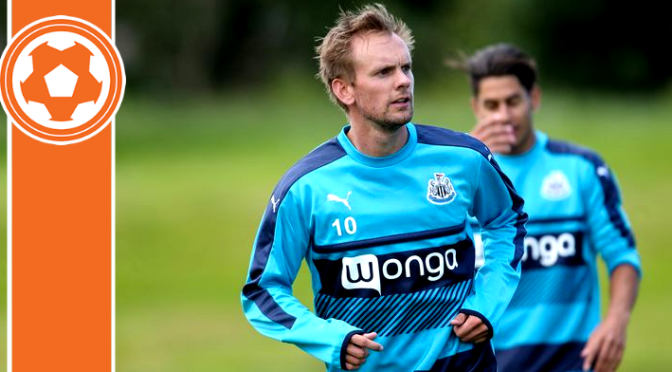
Newcastle’s Siem de Jong – The forgotten man of Dutch football

He is the forgotten man in Dutch football and hasn’t even been mentioned when people discuss the future of Oranje. Siem de Jong was once thought to be one of the best players coming through in the Eredivisie, but a move to Newcastle United has sent his career backwards significantly. Before the move, he was Ajax captain and he was certainly an option to captain the national side in the future. The move to England was meant to enhance his Oranje hopes and give him the platform to become a big name across Europe. However, his two years at the club have only brought four league starts, while he has featured as a substitute a further 18 times tells Jake Jackman.

Newcastle signed De Jong to play the number ten role, behind Papiss Cisse and provide the creative spark that the club had missed since selling Yohan Cabaye. Many thought he would do well at the club, as he is a great passer of the ball, and has an intelligence in the final third that can’t be trained. The former Ajax man isn’t afraid of the physical side of the game, and should have been able to adapt to the style of the English game. He started well, and had a good start to pre-season before disaster struck.

The Dutchman injured his calf during the pre-season of 2014 and was perhaps rushed back by Alan Pardew, who had planned to build around De Jong.  That proved a huge error as he suffered a thigh injury during a match against Crystal Palace. The attacker hasn’t had much luck with injuries and these have prevented him from getting a regular place in the Newcastle first team. Another collapsed lung and a freak eye injury have also kept him out of action. He has certainly had more than his fair share of bad luck during his spell in England.

Last season, there were hopes that De Jong would be able to play a big role for Newcastle under Steve McClaren, a man who knew him well from his time as FC Twente manager. The club opted to sign Georginio Wijnaldum from PSV, and this is when alarm bells started to ring for De Jong. His compatriot wasn’t signed as a back-up considering the fee paid for him and his best position was the number ten role, the same as De Jong. McClaren said often that the two could play in the same side, but that never looked likely. De Jong looked to have broken into the first team starting in the wins against Liverpool and Tottenham. His leadership appeared to help the side in terms of game management, and it isn’t surprising they gave two of their best performances of the season with De Jong on the pitch. However, he quickly resorted to playing a squad role.

His club are going through a resurgence under Rafael Benitez and it is unknown whether De Jong will be a part of his plans this season in the Championship. It isn’t the level that he will want to be playing at, but it would give him the opportunity to increase his confidence and gain a first team place at a club hoping to be back in the Premier League next season. There will be players that benefit from the relegation and emerge as key players in the second tier, who wouldn’t have been as involved if they had remained in the Premier League. De Jong can certainly be one of those, as he has the talent and leadership required to secure a starting berth at Newcastle.

This year is hugely important for De Jong. At the age of 27, he still has time to have a good career and his national team prospects aren’t entirely gone. A link to Fenerbahce is interesting, and could appeal to De Jong, who has already said he isn’t ready to return to Holland, although he isn’t ruling it out. His younger brother, Luuk, also had a disappointing time at Newcastle, but opted to join PSV and rebuild his reputation. Two championships later and an Oranje recall later and his decision appears inspired. He could learn a lot from his younger sibling and the Eredivisie could be the best destination for him. He could yet stay at Newcastle, and there is no doubting his leadership qualities could be an asset. The side lacked it last year and played better when the Dutchman was on the pitch. His future is unclear, but he needs to make the right decision. He has had two years out of the limelight, he can’t afford a third.

Name-JacobJakeman

Click on Jacob’s name above to follow him on Twitter.

TotalDutchFootball.com    WorldFootballWeekly.com

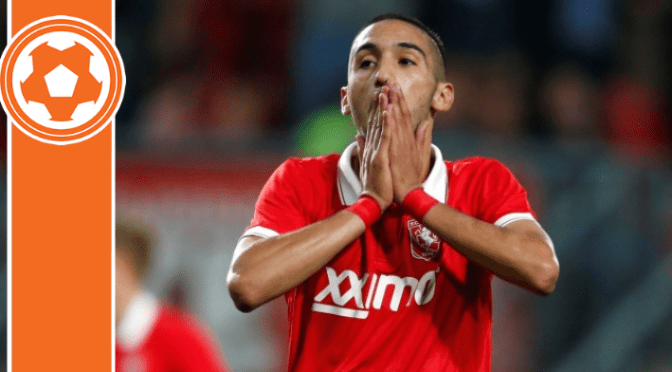
Hakim Ziyech would thrive at Swansea City or Middlesbrough

Following the demotion of FC Twente, the future of Hakim Ziyech has become an interesting one to follow amidst Premier League interest. Swansea City and Middlesbrough have both been linked in recent days, which should excited fans of both clubs, as Ziyech has the potential to become a Champions League calibre number ten. In my opinion, he is one of the most exciting players to have come through the Eredivisie in recent years and given his club’s demotion and financial strife, he will be available at a very good price. If one of the clubs above manage to get the deal done for Ziyech, it would be a huge coup says Jake Jackman.

The Moroccan international was the standout player in the Eredivisie this season, not only for his goals and assists, but also for the manner in which he managed to get them. He was playing for a side that had to sell a lot of key players last summer, and a lot of pressure was put on him to carry the side. He was 22 at the beginning of the season and that is a heavy weight of expectation to carry on his shoulders, especially at a club with the esteemed history of FC Twente. Although the club won’t be playing in the Dutch top flight next season, that isn’t for footballing reasons, as Ziyech dragged them to a safe mid-table finish almost single-handedly.

Ziyech scored 17 times and gained 10 assists from the FC Twente midfield, in what was a hugely impressive individual season as a part of a struggling side. He was given the captaincy and led by example, showing that there is more to Ziyech than technical ability, but he is also a leader and revels in such a role. He has had opportunities to leave FC Twente in the last 12 months, but opted to stay put, and that decision has proven to be a great one from Ziyech. He has developed a lot over the last season and will be in a much better position to adapt to a new league when his inevitable move happens in the coming weeks.

In terms of his style, Ziyech is a risk taker in the final third, as he can play some sumptuous passes, which sometimes leads to a low completion rate. He is exciting to watch when he is dribbling with the ball as he is quick, nimble and uses skills effectively. His vision is that of a mature player, as he can see things other less talented attacking midfielders do not. He is good with both feet, and has an eye for goal. The most encouraging thing about his style is his intelligence in the final third as he knows when to shoot and when to pass to a team-mate. His set pieces are also devastating at times, and would be an asset to any side.

If he does come to England, comparisons will be drawn with Memphis Depay, who has struggled to adapt in the Premier League after a great season in Holland. Although there are similarities in that they were both involved in 27 goals, they are different players, with Ziyech preferring to play more centrally and is less direct than the Manchester United man. Depay wasn’t deployed correctly and has failed to make an impact as a result. Ziyech will need patience if he comes to England, as he will need to adapt to the more physical style of play that the English game is famed for.

He has adapted to every new challenge in his career to date. The midfielder adjusted quickly after his move to FC Twente, upped his game when his club put the attacking responsibility on his shoulders. He has also made his mark on the international scene quickly, already having two goals to his name for Morocco. It was a controversial decision to play for the African country after being part of a Dutch squad in the past and he could turn out to be a player the KNVB wish they would have made a bigger effort to keep.

The coming weeks will be interesting and Ziyech is a player who will no doubt continue to progress. He has overcome so many challenges already and his impressive ability to lead and perform to a higher level than he had before last season would have caught the eye of many European clubs. His mentality should mean he will get to the top of the game in the coming years, while his potential can’t be questioned. Whichever club gets him, will be getting a very talented dynamic number ten, capable of producing many goals and assists. He remains young and for the price that he will be available for, Ziyech offers little risk. Every club across Europe should be enquiring about him. The Premier League looks a likely destination, and after he adjusts to the physicality of the league, I expect Ziyech to thrive in England.

Name-JacobJakeman

Click on Jacob’s name above to follow him on Twitter.

TotalDutchFootball.com    WorldFootballWeekly.com

Vincent Janssen – A good signing for Spurs?

Vincent Janssen is closing in on a move to join Tottenham, after AZ Alkmaar agreed to let him travel to London for talks with the North London club. They are desperate to bring in cover for Harry Kane, and add a different attacking option to the squad. They have been linked with higher profile forwards, but a move for Janssen represents value for money, while the Dutchman is unlikely to demand a starting berth to begin with. The fee wanted by his current club is believed to be around £12m, which could turn out to be a bargain says Jake Jackman.

The striker has had a meteoric rise to the very top of the Dutch game. He was the top scorer in the Eredivisie during his first season in the Dutch top flight. This led to his first Dutch call up and he has continued to perform at that level, scoring three times in five caps. It is his form for Holland that will have led to this transfer, as he has showed he can compete with the very best. He was arguably the best player on the pitch at Wembley as the Netherlands managed to beat England, scoring a penalty and assisting the winning goal.

Janssen is a unique centre forward in that he is strong and well built, allowing him to play the target man role well. His hold up play is excellent, but he also possesses an impressive passing range, an attribute we come to expect of any Dutch player. He is also quick, with his movement able to stretch defences. The striker is obviously a good finisher, as shown by his tally of 27 league goals in the Eredivisie this season.

He is lethal around the 18-yard box, and manages to find a way to get a shot away even in the most improbable situations. Spurs fans can also expect to see Janssen’s impressive link up play in the final third. He often plays intricate flicks and backheels to get his team-mates on the ball. Although he is born to score goals, he also has good vision in the final third and does look to gain assists as well as goals.

The Dutch forward is mentally strong and has stepped up every time a question is asked of him. He was signed as a back-up forward for AZ at the beginning of the season, but the departure of Aron Jóhannsson thrust him into the starting eleven. He initially struggled and didn’t score for several weeks. His confidence remained though and his self-belief carried him through a rough period as he adjusted to the Dutch top flight. That will be key again as he moves to England.

In terms of his primary tactical plan, Janssen is the perfect fit for Mauricio Pochettino. He is as similar to Harry Kane as they come, although Janssen is more of a number nine, while Kane does play a withdrawn role at times. The AZ Alkmaar forward will be able to come into the team and not alter the tactics hugely and I think that is a major reason he is joining Tottenham. It is a risk to buy a player off the back of just one top flight season, but his international performances show he can compete at a higher level.

This is a great signing for Spurs, and he perfectly fits the criteria that Pochettino will have wanted for a second choice striker. He is young, fits in well to his tactical plan and he won’t complain about being used mainly as a rotational option. However, he is hungry and the Dutch international has been successful at every level he has played at. He will believe in his own abilities and will try to break into the first team. You wouldn’t back against him either given how quickly he has emerged as the long term striking option for Oranje.

For Janssen personally, I think that another season in the Eredivisie would have been beneficial to develop further away from a pressured environment. However, it is difficult to turn down a move to the Premier League and Tottenham is a good club to join at the moment. They are on the up and have an exciting manager, who gives young players a chance. Eric Dier, Dele Alli and Harry Kane have all showed that if you perform when given a chance, it is possible to break into the first team at White Hart Lane. Janssen will believe he can do that too and he could force Pochettino to devise an alternative tactic that could facilitate two strikers. The most important thing is for the Tottenham staff and fans to be patient with him as he settles in England. Memphis Depay wasn’t afforded that luxury and has been labelled a flop as a result. If he gets time, Janssen will thrive in England.

Name-JacobJakeman

Click on Jacob’s name above to follow him on Twitter.

TotalDutchFootball.com    WorldFootballWeekly.com

Why Leicester City target Arek Milik could star at Euros?

Unfortunately the Netherlands will not be at the European Championships this summer, but that doesn’t mean there is no interest for Dutch fans. A player I expect to breakthrough in France is Arkadiusz Milik, who regular watchers of the Eredivisie will know is a huge talent. He will be leading the line for Poland, alongside the world class striker that is Robert Lewandowski. Although many will see the Bayern striker as the key man for the Poles, it could be Milik’s goals that propel them to have a good tournament. Opposition teams will be so focused on preventing Lewandowski from getting clear cut chances leading to space being left for Milik and that will allow the Ajax striker to thrive says Jake Jackman.

Ajax lost the league title on the final day in unfortunate fashion, but there is a core of youngsters with huge potential. Milik is one of those and he is approaching a crossroads in his career, as a move to a bigger league looks to be on the horizon. In recent days, the English press have linked the striker to Premier League champions Leicester City. It is a move that makes sense for both parties, but Milik’s camp may be keen to weigh up their options after the European Championships, as there is a chance that he could attract interest from bigger clubs.

For those that haven’t seen the Pole in action, he is an exciting forward, with anticipation and the ability to get shots away, even when tightly marked being two of his most impressive attributes. He has scored all sorts of goals in the Eredivisie, from headers, close range finishes, long range goals and direct free kicks. There is more to his game than just goals though, as he looks to bring the midfield into the game, as displayed by his seven assists in the league. Since joining Ajax, his technical ability has risen significantly, as you would expect given the reputation of the club’s coaching staff.

His goal record for the national team is excellent, as he has found the net ten times in 24 caps, continuing his form from the Polish youth sides. He scored the opening goal in his country’s first ever win over Germany, showing that he can compete with the best players in the world. The fact that Milik partners arguably the best striker in the world for the national team is a huge help. He is learning from the best, while the pressure to perform isn’t as high. The stage is set for Poland to have a great Euros, being drawn in Group C alongside Germany, Northern Ireland and Ukraine. They should be confident of qualifying from that group and will be confident in all three matches. If they do have a good tournament, it could be Milik and not Lewandowski who turns out to be the star.

It’s easy to see why Leicester City are trying to get a deal done early for the Polish star, if reports are accurate. He is a young player, with lots of potential, who has a long term future at Champions League level. The 22-year-old would instantly improve their starting eleven and could form a deadly partnership with Jamie Vardy. However, they will also know that if they leave it until after the Euros, they could be beaten to his signature by a bigger outfit. Every single tournament there are a group of young players that breakout, and I expect Arkadiusz Milik to be one of those this summer.

Name-JacobJakeman

Click on Jacob’s name above to follow him on Twitter.

TotalDutchFootball.com    WorldFootballWeekly.com

Could these five Eredivisie players be on the move this summer?

As one of Europe’s second tier leagues, the Eredivisie will always be at risk of losing its best players, as has happened in recent years. Last season it was Memphis Depay, Gini Wijnaldum, Luc Castaignos, Jordy Clasie and Oussama Tannane who were the big names to leave Holland. This year’s Eredivisie has had an intriguing title race with both PSV and Ajax level on points going into the last two matches. Meanwhile, there have been young players breaking through lower down in the league that will attract big interest this summer. The following are the five players that I feel will attract the most interest and are ready to try their luck in another league tells Jake Jackman.

Hakim Ziyech

The FC Twente attacking midfielder is almost certainly going to be leaving the league this summer, as he has outgrown the Eredivisie and his club are in desperate need of cash. Ziyech is a number ten, who is capable of scoring and creating goals as shown by this season’s tally of 17 goals and 10 assists. He has already tied Memphis Depay’s goal and assists haul from last season, and with two matches to play, he is set to beat it. Ziyech is a dead ball specialist, while his vision is also incredible as he often plays key passes that open up opposition defences. He has also showed his leadership ability as he has captained FC Twente this season after opting to remain at the club last summer.

I’d expect Ziyech to be available for a reasonable fee all factors considered, which could make him the bargain of the summer. He has been linked to Barcelona, Leicester City and Fenerbahce in recent months and it is impossible to predict where he will end up. The 23-year-old will be known to a lot of scouts across Europe and with the potential of making a huge profit, there will be lots of clubs asking about the midfielder.

Vincent Janssen

This year was Janssen’s first in the Eredivisie, but he is en route to being the league’s top scorer and he has also made his Oranje debut in recent months. He made an impact against England, getting a goal and an assist as the Dutch recorded a famous victory at Wembley. This match may have brought him to the world’s attention, but the AZ striker was already well known to regular watchers of the Dutch top flight. Janssen is a complete forward who is very capable of leading the line on his own. His strengths lie around the penalty box as he is a strong finisher, while he is good at anticipating potential chances. Janssen is a capable dribbler, while he also brings midfielders into the game in the final third.

He has an incredible 25 goals in his first Eredivisie season, which surpasses his tally from last season with Almere City. His rise to the top has been staggering and at the age of 21, he is likely to improve a lot more, which is exciting for Oranje fans, especially after the disappointment of missing the European Championships this summer. Janssen would suit Premier League football, and has been linked to both Liverpool and Manchester United. If he does move to a new league in the summer, fans will have to be patient and give him time to adapt as he is still very young. Janssen has adjusted quickly to every challenge he has been set in his career and I think he would be a huge hit wherever he goes.

Jetro Willems

Jetro Willems would have probably departed the league last summer if it wasn’t for his injury problems. He returned in the second half of the season and has performed well for the most part, but he has yet to find his form from last season. He has one goal and three assists to his name from just 13 league games, which shows that he is still a very effective player going forwards. Meanwhile he showed his defensive qualities in both legs against Atletico Madrid, playing a key part in two clean sheets. Willems is a modern day full back, who loves rampaging forwards. He is a good crosser of the ball and his ability to make the decision when on the ball in the final third shows intelligence beyond his years.

He has been linked with several clubs including Manchester United, Liverpool and Arsenal in recent months. It is got to the point when he should consider moving to another league to test himself and to continue progressing. He would risk stagnation if he remains in the Eredivisie as he is comfortable and established as the best left back in the division. He could cost up to £10m this summer, but he would be a great signing for any of the clubs mentioned as he has the potential to become one of the best full backs in world football. Also, he brings experience of the Champions League and has a winning mentality, both of which will be invaluable when he finally leaves the Eredivisie.

Riechedly Bazoer

The Ajax academy is still bringing through great talents in each generation and Riechedly Bazoer could be the best for a long time. He has already established himself as a starter for both club and country, while he has interested the likes of Napoli in recent months. The central midfielder is a great passer of the ball, while he is capable of carrying the ball, which is often does as he drives Ajax forwards. His reading of the game is superb as he rarely makes mistakes. Moreover, he is able to score goals with his tally standing at five for the season, with his long shots being another strength.

He is only 19-years-old and his potential is enormous. Bazoer is likely to go for a big fee when he does eventually leave Ajax. He has been linked with a move to Arsenal recently, but he may feel another year in the Eredivisie would be beneficial for his development. A move too soon to the wrong club can leave your growth at a standstill as Memphis Depay has learned the hard way. If he does leave this summer, he will be a great pick up for one of Europe’s premier clubs.

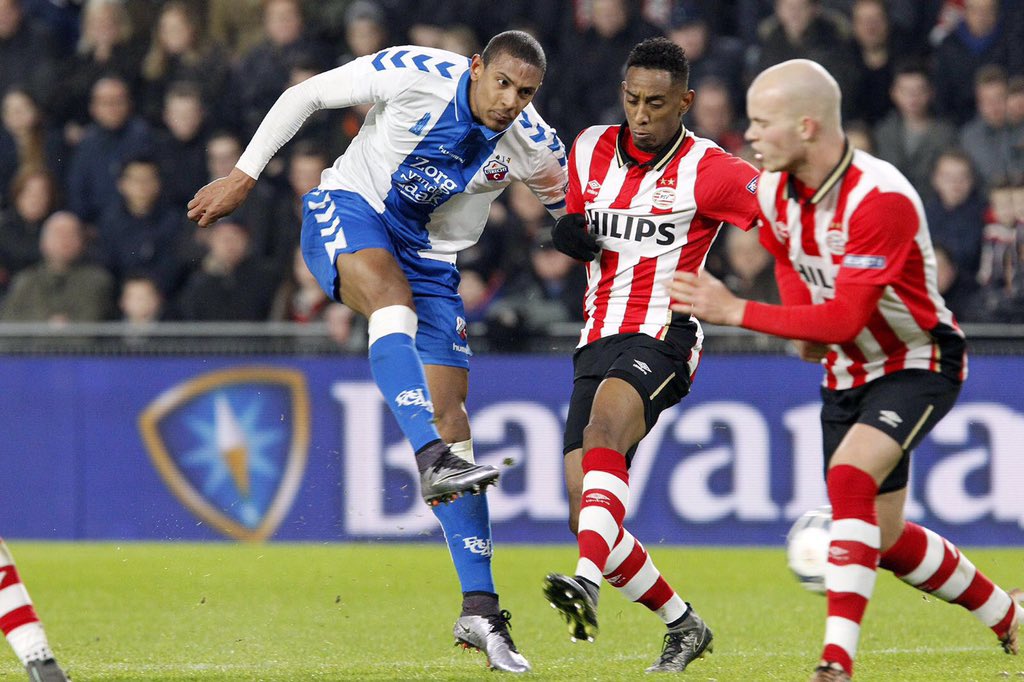
Sebastian Haller

The striker has had a great season in the Eredivisie and at the age of 21, he will develop a lot more in the future. Haller is all the attributes to succeed in a bigger league. He is great in the air, a strong finisher and capable of beating defenders on the dribble. The Frenchman is also contributes defensively, especially when it comes to defending set pieces. He almost joined Norwich City in January for £6.5m and although his value may be more in the summer, he will still be a cheaper option for clubs. He is an exciting prospect and it might be worth taking a risk on him now at a fee around £8m, than waiting and seeing his value rise.

Haller has scored 17 goals and has 4 assists, an impressive return which has helped his club get in contention for a Europa League spot for next season. He remains inconsistent and often scores his goals in streaks, but that is to be expected given his age. Tottenham have been linked with him in recent weeks, but they may be looking for a more proven talent to be a back up to Harry Kane, especially with the Champions League next season. He may opt for one more season in the Eredivisie, there will be interest in him this summer though.

Name-JacobJakeman

Click on Jacob’s name above to follow him on Twitter.

TotalDutchFootball.com    WorldFootballWeekly.com

Vincent Janssen – The future firepower for Oranje?

AZ Alkmaar striker Vincent Janssen is currently one of the brightest talents in the Eredivisie and his rise to the top of the league will have caught the attentions of a lot of people in football. He has been compared to Ruud van Nistelrooy and many have talked about him as being a big part of the future for the National side. Although it is important to not get carried away, Janssen’s start to 2016 has been incredible and he has scored as many league goals as Lionel Messi with ten says Jake Jackman.

His battle to get where he is has faced its setbacks, as he was released from the Feyenoord academy in 2013 and could have disappeared off the scene. However, the forward joined Almere City in the Jupiler League and scored 29 goals in 69 matches for the club. It isn’t an incredible goal return, but he grew with experience and started to stand out in terms of his overall contribution. Fred Grim, who worked with the forward at Almere City, had no doubts about Janssen’s ability to step up to the Dutch top flight and he has been proved correct. The forward is now second in the goal chart, only to the experienced Luuk de Jong, and could surpass the PSV forward if he continues this rich vein of form.

It was a match just a few weeks ago where Janssen really put his name on the map and went from a good striker, to one who could push on for better things. He returned to former club Feyenoord and ran riot, with one of the best striking displays seen in Holland this season. Feyenoord still had an outside chance of joining the title race, but the movement and clinical finishing of Janssen heaped misery on the club who released him as a youth player. He scored a hat-trick and was ‘Man of the Match’ on the day. AZ have showed themselves as a team on the rise, and Janssen is at the apex of that.

The Dutch national side is going through a period of upheaval and there will be temptations to get rid a lot of the older players and build a team of younger players, like both Spain and Germany have done in recent times. If they do opt to do that, Janssen is the prime candidate to be the forward, as he has all the characteristics to be a top forward.

Although he is not the tallest (5ft 11), he is capable in the air, but he is strongest with the ball at his feet. His nimble footwork allows him to beat defenders, while his coolness in front of goal has played a huge part in his good run. He has emerged as one of the best finishers in the league. Furthermore his movement and awareness in the final third are those of a player who can continue his goalscoring form and can grow in the sport.

Holland have a lot of good young players coming through. Memphis Depay, Anwar El Ghazi, Riechedly Bazoer and Jetro Willems are already well known, but you can know add Vincent Janssen to that list and it will be intriguing to follow his career over the next 18 months.

Name-JacobJakeman

Click on Jacob’s name above to follow him on Twitter.

TotalDutchFootball.com    WorldFootballWeekly.com

The last great Dutch side

It’s no secret that these days, money has a huge influence in football, with the strongest clubs in the world mainly being the richest too. The financial situation has also created a huge gap between European leagues, with top sides from less wealthy league’s struggling to compete with those from England, Spain and Germany in particular writes Fin Crebolder.

In the Dutch Eredivisie, clubs have never been big spenders, but have instead created great sides mainly through either developing players in their own youth system, or buying players from abroad at a young age. In both cases, the players would usually reach their peak at the club, allowing the team to compete with the best, before moving on to a major European league. However, since the billionaire owners and the huge TV licensing deals have come into play, this has rarely happened, as the Eredivisie top talents are signed by the rich European clubs before they reach their peak. Gone are the days of great Dutch European sides such as the Ajax team of 1998, with mid-table clubs in major leagues such as Southampton and Newcastle now being more appealing to exciting young talents than the traditional giants of Ajax, PSV and Feyenoord. As these Dutch clubs all suffer the same fate, teams can be built that look excellent domestically, but simply are not good enough to compete with the bigger and richer teams in Europe. However, this was of course not always the case. There was a time, not so long ago, where a Dutch team went toe to toe with the best in Europe. And what a team it was.

It was 2004, and PSV Eindhoven were not in the best state. They had just lost out on the Eredivisie title to rivals Ajax, and Chelsea, recently bought out by a rather wealthy Russian man, had signed two of their key players, Arjen Robben and Mateja Kezman. To make matters worse, the chairman Rob Westerhof and the board had constantly clashed with manager Guus Hiddink regarding financial matters. Whilst off the pitch the situation may not have been good, as soon as the season started it became apparent that these problems had not affected the on pitch performance of the club, with them still possessing one of the strongest squads in Europe, not just the league.

THE LINEUP

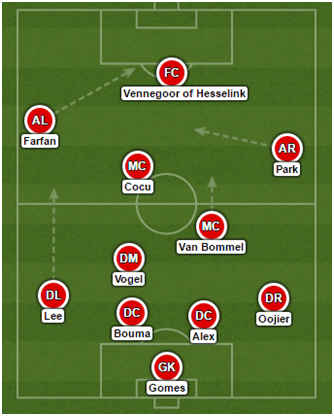
In goal was the new signing Heurelho Gomes, who after initial struggles and question marks, became a fan favourite, often bailing the team out with his reflexes and acrobatic, if somewhat erratic style. However, he was not called upon all that often due to the defence in front of him. Starting at right back was club legend Andre Ooijer, who had been at the club since 1997. Whilst he was not a marauding and exciting full back, he more than made up for it with his defensive solidity. Wilfred Bouma led the defence from the centre, being partnered by the 21 year old Brazilian Alex, who was on loan from Chelsea, and would remain so for three years. Completing the defence was the more adventurous and attacking of the two full backs, Lee Young-pyo, who Hiddink brought to PSV after the two worked together at the 2002 World Cup. His incredible speed and stamina allowed him to constantly run up and down the left side, becoming a key player for PSV in both defence and attack.

Whilst the defence was very impressive, it was the midfield of PSV that truly made them one of the European elite. In the holding role of the three was Johann Vogel, whose work often went unnoticed. With an excellent tackle and intelligent positioning, Vogel would sit in front of and protect the defence, allowing his two midfield partners to make an impact further forward, and they did just that. Phillip Cocu had just been brought back to PSV after an extremely successful six year spell at Barcelona, and became a key player, playing as the most attacking of the three midfielders, often getting forward and posing a goalscoring threat, shown by the ten goals he scored, but also tracking back and putting in excellent defensive work in tougher games. What Cocu lacked in technical ability he more than made up for with his work rate and off the ball movement. The third and arguably most important cog in the PSV midfield was club captain Mark Van Bommel, who was simply the complete midfielder. Often starting in a deeper position, Van Bommel would relentlessly press the opposition and more often than not win the ball. However, contrary to popular believe, there was far more to his game than just brute force, as he was often the creative hub of the team with his excellent range of passing and set piece abilities. This midfield three was wonderfully balanced, with all three players possessing excellent technical, mental and physical abilities between them, making them an efficient and at times unbreakable machine.

As said, the midfield was the key to this team, providing stability and balance, but that’s not to say the attack wasn’t equally as impressive. Usually on the right was Park Ji-Sung, arguably the side’s player of the season behind Van Bommel. He had struggled for first team opportunities after joining with Lee following the 2002 World Cup, but after the departure of Arjen Robben, he was given a chance in the starting lineup, and took it. He may not has possessed the unbelievable attacking abilities of Robben, but more than made up for it with his work rate in both pressing the opposition in their own half and man marking players into his own. This is not to say he lacked attacking ability. At the time Park was extremely quick and possessed impressive passing and crossing ability, shown by the ten goals and six assists he got. On the opposite side of the attack, Farfan and Beasley, the two players brought in to replace Arjen Robben, competed for the starting spot, with Farfan usually taking it. As they were brought in to replace Robben, both of these players were far more attacking and direct than Park, often running directly at the opposition defence with their pace and dribbling, making them key to PSV counter attacks, whilst off the ball they would make runs behind the defences. Leading the line for PSV was Jan Vennegoor of Hesselink. After signing in 2001, Vennegoor of Hesselink struggled, and before the start of the 2004/05 season looked set to leave. However, after Kezman left for Chelsea, he too was given a chance in the first team and became an important player, with his physicality key to the side. He often held the ball up before laying it off to one of the onrushing Cocu, Park or Farfan, and was also a threat inside the box both in the air and on the ground, finishing the season as the side’s top scorer with 19 goals.

STYLE OF PLAY

This side was very different to the traditional great Dutch sides. Rather than focusing on possession and freedom of movement, Hiddink set up this team to be fast, direct and efficient. They were defensively sound, not only due to the individual quality of the defenders, but the structure of the midfield in front of it.

Off the ball, Vogel and Van Bommel would form a double pivot in front of the defence with Cocu pushing slightly further forward to press the opposition, forming a stable 4-2-3-1 formation, with Park tracking back on the right to protect the solid but aging Andre Oojier, who would then tuck in and sit narrower and deeper to his fellow full back. The protection provided by the midfield meant that the central defenders would rarely have to press the opposition midfield, allowing them to sit deeper and mark the attackers, making it extremely difficult for the opposition to find space near the PSV box.

psv

On the ball the team was still a largely structured unit, but were certainly more fluid than off the ball. Van Bommel would push higher up, leaving Vogel as the lone holding midfielder and changing the formation to a more attacking 4-3-3, where Cocu would push even further forward most of the time, although he sometimes swapped roles with Van Bommel. On the left side of the pitch, Farfan would often drift into the position of left striker, leaving space for Lee to bombard forward and provide a cross for one of Vennegoor of Hesselink, Farfan, Park or Cocu to get on the end of, with Van Bommel lurking outside the area ready to recover the ball or release a long shot. On the right was Park, who was given the most free role in the team, often drifting central behind the striker, and this, coupled with Farfan’s movement created a diamond shape in the team. This was also beneficial defensively at times, as it allowed Park to mark and harass the opposition defensive midfielder (I’m sure you’ve all heard those Pirlo quotes).

The team’s main philosophy was quick transitions, aiming to get the ball from one of the pitch to the other as quickly as possible. This does not mean that they were a long ball side who simply punted it forward to Vennegoor of Hesselink, but instead moved up the pitch quickly through either the individual pace of Park, Lee or Farfan, or through the excellent passing ability of the midfield, and Van Bommel in particular. The creative ability of the midfield along with the pace and movement of the wingers made this strategy extremely successful, with Vennegoor of Hesselink also key to it, holding up the ball with his back to goal before setting up one of the onrushing players.

THE SEASON

In their first three matches of the league season, they managed to score 15 goals, and this was reflective of their domestic season, as they stormed to the league title, finishing ten points ahead of Ajax, who they beat 4-0 in the ArenA in one of their many scintillating displays. They finished the season with 87 points, 89 goals and just one defeat, a quite incredible record. They managed to complete the domestic double when they won the KNVB Beker, breezing past Willem II 4-0 in the final, after defeating Feyenoord on penalties in the semi-final. Whilst their domestic achievements were undeniably impressive, there have been many great Eredivisie title winning sides over the years. These teams achievement among the European elite is what set them apart from other Dutch sides of recent times.

After breezing through the play off, PSV were drawn in a group with Rosenborg, Panathinaikos and Arsenal. In the group stages, their first game was their toughest, as they faced arsenal at the Emirates. Despite a strong defensive performance, they lost 1-0 due to an Alex own goal just before half time. They followed this with a 1-0 win over Panathinaikos, a 2-1 win away at Rosenborg and a 1-0 win over them in the return leg. They entered the home game against Arsenal two points clear at the top of the group, and managed a creditable 1-1 draw to maintain this advantage going into the final game. However, they played their worst performance of the season in the final group game, losing 4-1 to Panathinaikos, and finishing 2nd.

In the first knockout round they were drawn against Monaco, who had topped their group above Liverpool. Like in the group stages, PSV were excellent defensively, scoring early on through a Alex set piece in the first leg before holding a 1-0 lead to take to Monaco, where they put in an excellent performance, scoring a goal in each half through attackers Vennegoor of Hesselink and Beasley to win 3-0 on aggregate against a largely fancied side.

In the quarter-finals they were drawn against an even stronger French side, Lyon, the team who had won three consecutive league titles and were storming the French league yet again, and also finished above Manchester United in their Champions League group. Lyon’s class was clear straight away, as they came racing out of the blocks and were 1-0 up after twelve minutes. They continued to dominate PSV and Heurelho Gomes was inspired in the PSV goal, single handedly keeping it at 1-0 going into halftime. However, in the second half PSV looked like a different side, starting to take control of the game and equalising through Cocu in the 80th minute, giving them a crucial away goal to take back home. In the second leg, it was clear that both sides were nervous, as both failed to play to the best of their ability. However, like in the first leg, Lyon managed to score early again, this time after a mistake from Bouma, and things were looking bleak for PSV, as the rest of the half was poor. After half time, PSV got that all important goal through a superb Alex volley, but it did not provide the spark to their performance, and the scrappy game continued through the rainy night, until penalties loomed. The Dutch side held their nerve, with Gomes the hero again, saving two penalties, and sending PSV to the last four of the Champions League. Their opponents? AC Milan.

This was an AC Milan team of incredible quality, boasting the likes of Cafu, Maldini, Pirlo, Kaka, Seedorf and Shevchenko in their illustrious squad. They topped Barcelona in the group stages, and beat Manchester United and fierce rivals Inter Milan in the knockout stages, and were unsurprisingly heavy favourites against this PSV side. The following matches would define this PSV team, and ensure they went down in history as one of the great Dutch sides.

The first leg was played at the San Siro, and Hiddink set the side up in a diamond formation in an attempt to match AC Milan man for man, whilst also giving Park a more central role to both mark Pirlo off the ball and drive at the heart of the AC Milan defence of it. Vennegoor of Hesselink was left on the bench as Hiddink went for pace in attack, hoping to counter attack Milan with Beasley and Farfan. For the first fifteen minutes of the match, PSV were under siege from AC Milan, barely surviving the constant attacks thrown at them. However, the defence (just about) held on and by the twenty minute mark the Dutch side began to gain a foothold on the game, largely due to the performances of midfield duo Van Bommel and Cocu. Park’s direct running was also causing AC Milan all sorts of problems, with Farfan missing a golden chances after springing the offside trap. This warning woke Milan up who began to press forward again, forcing Gomez into two excellent stops from Kaka. However, just before half time, Shevchenko got the goal to send Milan into half-time with a deserved 1-0 lead. I don’t know what Hiddink said during the break to his players, but it must have been some speech, because a different side came out in the second half. PSV dominated and created chance after chance, with Park, Lee and Farfan all guilty of failing to finish. Vennegoor of Hesselink was brought on with half an hour left, allowing PSV to go more “route one”, with Van Bommel being the next to miss a chance, narrowly hitting over the bar from close range. Ultimately though, the effort had worn the PSV players out, and AC Milan finished the game strongly, pushing forward and getting a crucial (and very avoidable on PSV’s part) second goal from Tomasson. A lapse in concentration had left them with it all to do.

Going into the second leg, PSV had to score at least two unanswered goals against a side who had only conceded two goals all season in the Champions League. Ooijer was suspended whilst Beasley was injured, meaning Theo Lucius and Vennegoor of Hesselink were given the nod, with the team playing their usual 4-3-3 formation. They startled AC Milan with their high paced start, constantly pressing to win the ball and running directly forward with it. This intense start paid off when Park put PSV ahead after just nine minutes when he drifted inside from the right and finished off an excellent move. This put a real spring in the Dutch side’s step, with them maintaining their high intensity for the rest of the half, although they couldn’t find that second goal. The second half was more of the same, with the home crowd louder than ever before, and they would only get louder after Cocu equalised with a header following excellent wing play by the marauding Lee. Farfan, who had arguably been the star of the show, continued to tear apart the Milan defence and force multiple saves from Dida. With ten minutes left, PSV were pressing for the winner whilst Milan, who had no shots on target, seemed content to survive to extra time. However, in the 90th minute, PSV hearts were broken, when captain Van Bommel lost Ambrosini, the man he was marking, who headed home an excellent Kaka cross. Although Cocu managed to score a simply stunning volley only a minute later to make it 3-1, it was too late, and PSV were cruelly knocked out on away goals against a team they had well and truly outplayed and outclassed over two legs. In true Dutch fashion, they had a team capable of winning it, but fell at the (semi) final hurdle, Football, ay? It’s a cruel mistress.

THE AFTERMATH

Unsurprisingly, the financial superpowers in football took notice of the excellent talent at PSV and sadly the best Dutch club side since 1998 was largely ripped apart. In defence, both Bouma and Lee couldn’t resist the temptation of the English top flight, moving to Aston Villa and Tottenham respectively. However, the real losses came in midfield where Vogel went to AC Milan, Park joined Manchester United in a big money move, and Van Bommel left on a free transfer to Barcelona. They all left Eindhoven as club icons, beloved by the fans, and Park, Van Bommel and Bouma would all return to the club in the swansong of their careers, receiving a heroes welcome. PSV still managed to win the Eredivisie the following season, but didn’t have the quality to replicate their incredible Champions League run, falling to Lyon in the first knockout round.

As I said at the start of this article, these days it is very rare for a Eredivisie side to be able to hold on to key players and build a side capable of competing on the European front like they used to. However, this wonderfully talented side showed just what can happen when it does happen, when everything just clicks, and we can only hope that, in this game dominated by money, another Eredivisie side manages to build and maintain a team even half as good. With billionaire owners and TV licensing deals hurtling more and more money into the major leagues, it may take a while for this to happen, but I assure you, if it’s anything like this PSV side, it’ll be worth the wait.


Name-FinCrebolder

Click on Fin’s name above to follow him on Twitter.

Ajax – Continuity or Revolution?

Speaking to the BBC’s World Service in October 2015, Ajax Head Coach, Frank De Boer highlighted his intention to leave Ajax in the near future, targeting a move to the Premier League writes Steven Davies.

“Yes I think every year [the prospect of leaving Ajax] comes closer of course. I’m looking maybe for another adventure. If there is an interesting club that I think with my quality I can make that team better – if I can, then I will take that chance.”

An Impressive Coaching C.V.

De Boer’s coaching credentials, in addition to his illustrious playing career at: Ajax, Barcelona and Glasgow Rangers, make him a strong candidate whenever a vacancy arises across Europe.

Taking the helm at the Amsterdam ArenA on 6th December 2010, following the resignation of Martin Jol, initially only as caretaker manager until the winter break, his first game in charge was a UEFA Champions League match against A.C. Milan at the San Siro, where Ajax upset the Italian giants 2–0 through goals from Demy de Zeeuw and Toby Alderweireld.

Having been given the job full-time, De Boer then went on to lead the club to the 2010-11 Eredivisie title following a 3–1 home victory over FC Twente (the reigning champions) on the final day of the season.

Three more titles followed in as many years with the last of these being secured on 27th April 2014, following which, De Boer became the first coach ever to achieve this feat in the Dutch league. Ajax’s 33rd league title also marked the first time the Amsterdam giants had ever won four successive titles. On a personal level, the 2013-14 title triumph was De Boer’s ninth championship with Ajax – another record, while he also bagged the Rinus Michels Award for the second successive year.

Time to Go?

Despite losing out in the Eredivisie title race to a dominant PSV Eindhoven last season, De Boer’s Ajax have fought their way back into contention this term and, should a fifth title in six years be secured in 2015-16, it would mark a fitting end to a glorious reign in Amsterdam for the 45-year-old.

Along with being linked to the Liverpool job prior to the appointment of Jurgen Klopp, De Boer has also been linked with a move to take over from under-fire Newcastle United boss Steve McClaren, and the Dutchman praised both clubs in his interview with the BBC’s World Service.

“They are fantastic clubs. Liverpool and Newcastle, with supporters behind them, is a fantastic environment to coach – but this year it is important for me to do well at Ajax and then we will see.”

De Boer’s suggestive comments would indicate that his time at the helm in Amsterdam may finally be coming to an end, being noticeably more non-committal  than when previously approached by Liverpool’s owners, Fenway Sports Group, in 2012, prior to Brendan Rodgers’ appointment – saying he was “very honoured” to be considered for the role. However, he had deemed it “too early” at the time.

Now, having seemingly come to a point in his career—with four Eredivisie titles in five seasons—where he needs a change of direction, De Boer appears to be casting his net in readiness for a summer departure.

Most recently, De Boer admitted he was interested in holding talks regarding the vacancy at Swansea despite having more than a year to run on his contract in Amsterdam and is expected to make a decision on his future in March.

When quizzed by the Dutch media about his next move, De Boer said: ‘First you have to see what the plan is at a club and what I and the people I would take with me could add to it. The last club I was linked with was Swansea City. I have had no contact with them at this time. But what if these people paint me a pretty picture that they are in that category of clubs with which I could do something beautiful? Like clubs such as Tottenham and Liverpool. Those are the sort of clubs with which you would want to work. But the most important thing would be the feeling I get (But) I will (finish) the season with Ajax.”

So, with the Frank De Boer era in Amsterdam seemingly coming to a close, where now for Ajax?

Continuity – Promotion from within

Football is a philosophy in the Netherlands and nowhere more so than at AFC Ajax where the club have long clung doggedly to the principals of developing talent from within.

These principles, or abandonment thereof, have more recently, of course, come under fire from none other than the man whose name is most synonymous with the club – Johan Cruijff.

In November 2015, Cruijff announced that he was leaving his role as an adviser to the club sighting the fact that his vision to improve Ajax’s youth structure is no longer being implemented and insisting that his name and any connection be removed from a playing and development philosophy he had led for years.

Cruijff’s announcement came hot on the heels of the departure of former Dutch international, Wim Jonk as head of youth development at De Toekomst – Ajax’s famed academy.

Renovating the club’s academy had been at the heart of plans Cruijff laid out for the former European champions with the Dutchman using his weekly newspaper column in De Telegraaf to announce his decision to step down and criticise the club’s directors.

Cruijff,68, who is being treated for cancer, won eight league titles and three European Cups with Ajax from 1964-73 before returning to manage the Amsterdam giants from 1985-88 – during which time the club lifted the European Cup Winners’ Cup in 1987, had bemoaned the state of the club in a typically outspoken manner in De Telegraaf after watching Martin Jol’s Ajax wilt in the Estadio Santiago Bernabéu against Real Madrid in the group stages of the UEFA Champions League in 2010.

This isn’t Ajax anymore. Let me get to the point: this Ajax is even worse than the team from before Rinus Michels’s arrival in 1965.

The score might have only been 2-0 on the night but the gulf in class and the ease in which the Spanish giants cruised to victory over the four time European Champions led Cruijff to act.

A so-called ‘Velvet Revolution’ was set in motion with Cruijff calling for the replacement of the Ajax Board of Directors including general director, Rik van den Boog and chairman, Uri Coronel, saying that in their place should stand former Ajax players and enlisting the likes of Wim Jonk and Dennis Bergkamp to be his hands-on advocates on the training fields in Amsterdam.

Cruijff believed a club like Ajax could not hope to compete with the biggest clubs in Europe for players; paying exorbitant transfer fees, wages and dealing with unscrupulous agents for players in their mid to late twenties and early thirties was a fool’s errand. Instead, the road back to the summit of European football for Ajax was to stop signing overrated foreign players and build a team around youth that was developed from within.

In Cruijff’s vision, Wim Jonk, Dennis Bergkamp, Marc Overmars and coach, Frank De Boer would be afforded complete control in terms of both personnel and implementation.

Yet, the Ajax Board of Directors were not about to go down without a fight, and, by appointing Louis van Gaal as general director behind Cruijff’s back in November 2011, they ensured a public and bloody battle through the courts ensued; the acrimonious war of words eventually being resolved in February 2012 with a judge ruling that van Gaal’s appointment had been illegitimate.

In the wake of this monumental ruling, the old order was replaced by the new; Cruijff had won.

Coach, Frank De Boer and Director of Football, Marc Overmars, now no longer allowed to purchase players for large sums of money, had to identify replacements from within when key players were sold.

In an era of domestic dominance for de Godenzonen, European club success became the barometer of progress, but, four years on from that monumental court ruling, Cruijff’s blueprint has ultimately failed to deliver on European club football’s biggest stage.

The 2010/11 UEFA Champions League campaign included not only that much maligned 2-0 defeat to Real Madrid in the Bernabéu but also a comprehensive 4-0 thrashing in the reverse fixture at the ArenA in addition to a poor 2-1 loss to Auxerre in France. However, the club did prove to be competitive elsewhere, holding the mighty AC Milan 1-1 in the ArenA, where they also beat Auxerre 2-1, before, now under the guidance of Frank de Boer, they upset Milan 2-0 at the San Siro.

All in all, three defeats, two wins and one draw meant that Ajax finished just a point behind Milan who qualified for the latter stages of the competition in second place in Group G behind Real who posted an unbeaten group campaign; winning five and drawing just one.

A short run in the UEFA Europa League followed in the New Year, with the Amsterdam giants dispatching Belgian side, Anderlecht 5-0 on aggregate in the round of 32 before being dumped out by Spartak Moscow 4-0 on aggregate in the round of 16.

A frustrating campaign in 2011/12 culminated in another third place finish; this time on goal difference with Lyon progressing to the latter stages from Group D.

Drawn in a far more favourable group than in 2010/11, Ajax could only manage two wins, both coming at the expense of Croatian side, Dinamo Zagreb and two goalless draws with Lyon. In the remaining fixtures, the Dutch champions endured two more thrashings at the hands of eventual group winners, Real Madrid for the second season in succession.

Another foray into the UEFA Europa League followed, where, despite exiting the competition in the round of 32 at the hands of Manchester United, Frank de Boer’s men posted a memorable 2-1 victory in the second leg at Old Trafford.

The draw did Ajax few favours in 2012/13 as the Dutch champions were placed in a true ‘group of death’ which included: Borussia Dortmund, Manchester City and, for the third season in succession, Real Madrid.

Ajax struggled to gain any traction in the group, managing only a single victory, a 3-1 home success against Manchester City and a draw in the reverse fixture in Manchester. Four defeats home and away to both Dortmund and Real rounded out a dismal campaign and left the Amsterdam club lagging behind in a distant third place.

The club found little solace in the UEFA Europa League where they were eliminated in the round of 32 on penalties after their tie with Steaua București ended all square on aggregate.

Ajax were again drawn into another ‘group of death’ in 2013/14, or a group more appropriately dubbed the ‘group of champions’ with: Barcelona, AC Milan and Celtic, like Ajax, all boasting UEFA Champions League success in their respective illustrious histories.

A close campaign ensued with qualification coming down to the wire between Ajax and Milan once more. This time just a single point separated the two European giants; Ajax’s record of two wins, two draws and two defeats just losing out to Milan’s record of two wins, three draws and one loss.

The 2013/14 UEFA Champions League campaign proved to be Ajax’s strongest thus far in the De Boer reign, with the Dutch champions holding the Italian’s both home and away in addition to posting victories over Celtic and humbling the mighty Barcelona at the ArenA.

In the end though, a disappointing 2-1 reverse in Glasgow and an inability inflict the killing blow in either match against the Rossoneri left the Amsterdam giants once more facing a UEFA Europa League campaign in the New Year.

But their interest in the competition would be short-lived – Red Bull Salzburg inflicting a resounding 6-1 aggregate defeat over two legs in the round of 32.

Another tough draw followed in 2014/15, with Ajax drawn in Group F alongside: PSG, APOEL and, for the second season in succession, Spanish giants, Barcelona.

The club could only muster a single victory; a 4-0 success at the ArenA against APOEL on 10 December 2014, the Cypriotes having surprisingly held the Dutch champions 1-1 in Cyprus at the end of September. Ajax also posted a creditable home draw with PSG but fell apart in the other three games, losing home and away to Barcelona as well as in Paris; ending up a massive eight points behind second placed PSG in the group.

The club progressed beyond the round of 32 in the UEFA Europa League for the first time since 2010/11, overcoming Legia Warsaw 4-0 on aggregate before being eliminated by eventual finalists Dnipro on the away goals rule despite beating the Ukrainians 2-1 in the ArenA following a 1-0 loss in the first leg in Kiev.

In 2015-16, Ajax’s interest in European club competition ended prior to Christmas, having failed to progress from their UEFA Europa League group – finishing a disappointing third behind Molde and Fenerbahce in a group that also contained Scottish champions, Celtic. This, after dropping into the competition following elimination at the hands of Rapid Vienna (5-4 on aggregate) in the Third qualifying round of the UEFA Champions League in early August, left a sour taste in the mouth of many associated with the club – not least Cruijff himself.

Although not consistently able to hold its own against the elite of European club football season in and season out, De Boer’s charges have, on occasion, been able to bridge the gulf in finances and personnel to give these clubs a run for their money – most notably in: 2010/11, 2011/12 and 2013/14.

Similarly though, the club failed to progress out of the group stages of the UEFA Champions League in five of the last six seasons while also fizzling out in the UEFA Europa League in each of the last six.

Even prior to this seasons’ debacle on the European stage, Cruijff’s disgust was perhaps rooted in the fact that in 2014/15, the Amsterdam giants actually found themselves in a far worse position compared to the much lamented 2010/11 UEFA Champions League campaign. In 2014/15 Ajax posted a record of just one win, two draws and three defeats, scoring 8 goals whilst conceding 10 and amassing just five points. In 2010/11 they posted a more competitive record of two wins, one draw and three defeats, scoring 6 goals and conceding 10; amassing seven points in a group that, it could be argued, was far more difficult to qualify out of than its 2014/15 equivalent.

In fact, it could be argued that Cruijff’s ‘Velvet Revolution’ has actually made little difference in terms of the personnel on the field – a point not lost on the Dutch footballing icon.

If we compare the Ajax match day squad named by Martin Jol that was dispatched 2-0 on 15th September 2010 at the Bernabéu in the UEFA Champions League to the one selected to face PSG at the ArenA by Frank de Boer on 17th September 2014 in the same competition, it is interesting to note how many players were actually products of the Amsterdam clubs’ academy and how many were brought in from outside the club.

Ajax team (vs Real Madrid 15/09/10): Stekelenburg (Zandvoort ‘75/ Schoten/ Ajax) , Van der Wiel (HFC Haarlem/ Ajax), Alderweireld (Germinal Beerschot/ Ajax), Ooijer (SDW/ SDZ/ Ajax), Anita ( CVV Willemstad/ VV Maarssen/ Ajax), Enoh (Little Foot FC), Sulejmani (Partizan), El Hamdaoui (Excelsior) , de Jong ( DeGraafschap/ Ajax) , Emanuelson (Voorland/ Ajax), de Zeeuw (AGOVV). Subs: Verhoeven (BFC/ Ajax), Eriksen (Middlefart G&BK/ OB/ Ajax), Blind (AFC/ Ajax), Lindgren (Landskrona BoIS/ Ajax), Tainio (TP-47), Oleguer (Gramenet), Jozefzoon (Ajax).

Ajax team (vs PSG 17/09/14): Cillessen (NEC/ De Treffers), van Rhijn (RKSV DoCoS/Ajax), Veltman ( VV Ijmuiden/Ajax), Moisander (TPS/ Ajax), Boilesen (Skovlunde/ Brondby/ Ajax), Sigþórsson (Vikingur/ HK/ AZ Alkmaar), Klaassen (HVV de Zebra’s/HSV Wasmeer/ Ajax), Andersen (Aalborg Freja/ AaB), Schone (Lyngby/ sc Heerenveen), Serero (Senaoane Gunners/ Ajax Cape Town), Viergever (Sparta Rotterdam). Subs: Boer (Flevo Boys), van der Hoorn (SC Buitenboys/ FC Omniworld/ FC Utrecht), Duarte (Sparta Rotterdam), Milik (Rozwój Katowice), El Ghazi (BVV Barendrecht/ Feyenoord/ Spartaan ‘20/ Sparta Rotterdam/ Ajax), Denswil ( Hellas Sport/ Ajax), Zimling (AB 70/ Tarnby/ Fremad Amager/ KB).

Twelve players selected in the match day squad to face Real Madrid on 15th September 2010 were products of the Ajax youth system, while only eight (seven if you discount Ajax’s association with Ajax Cape Town) who came through the Amsterdam clubs’ famed academy were selected to face PSG on 17th September 2014.

If anything, in terms of the promotion of young talent from within, Ajax appears to be going backwards – a point confirmed when, in 2014/15, Cruijff’s blueprint apparently discarded, the club fell back into old habits in terms of transfer policy, shelling out substantial sums of money to revitalise a squad ravaged by the annual selling of key players. This lack of faith shown by key decision makers in those coming through De Toekomst was ultimately the straw that broke the camel’s back in Cruijff’s eyes.

During the turbulent and ultimately disappointing 2014-15 campaign, Frank De Boer regularly bemoaned his players’ performances and took the opportunity to recruit, when and where he could, players from outside the club. In came: Arkadiusz Milik (Bayer 04 Leverkusen – loan), Niki Zimling (1. FSV Mainz 04 – loan), Richairo Zivkovic (FC Groningen – 2.5 million euros), Nick Viergever (AZ Alkmaar – 2 million euros), Diederik Boer (PEC Zwolle – 750,000 euros), James Fofana (PSV) and Robert Muric (Dinamo Zagreb) in the summer transfer window while the club added: Daley Sinkgraven (sc Heerenveen – 7 million euros) and Andre Onana (FC Barcelona – 200,000 euros) when the window reopened in January 2015.

With Arkadiusz Milik’s season-long loan proving to be a success (netting 11 times in 21 appearances) the Polish international was signed permanently for a reported 2.5 million euros at the start of April 2015, taking the former champions’ overall spending for 2014/15 to around 12.45 million euros; which, for a Dutch club, whose television and sponsorship revenue is limited when compared to their counterparts in Spain, England and Germany, is akin to a fortune. This exorbitant expenditure was mitigated only by the fact that the club recouped around 29.72 million euros during the 2014 summer transfer window which included the big money sales of de Jong (Newcastle United – 7.5 million euros) and Blind (Manchester United 17.5 million euros) as well as the frustrating loss of the highly rated 16-year-old forward, Mink Peeters to Spanish giants, Real Madrid for a paltry 110,000 euros.

The 2015 summer transfer window was also a busy time in Amsterdam with the club repurchasing left back,  Mitchell Dijks for around 1 million euros from Willem II – just a year after ushering the gangly defender out of the door, while also welcoming a slew of other new (and old) faces: Nemanja Gudelj (AZ Alkmaar – 6 million euros), Francesco Antonucci (RSC Anderlecht – 500,000 euros), John Heitinga (Hertha BSC – Free transfer), Dragisa Gudelj (NAC Breda – Free transfer) and Kaspar Dolberg (Silkeborg IF – Free transfer); spending 7.5 million euros in total and recouping over half of this outlay by selling Icelandic marksman, Kolbeinn Sigþórsson to FC Nantes for a fee of 3.5 million euros.

Despite not being the hundreds of millions of euros that some of the continent’s elite turn over year-upon-year, this sort of frivolous spending in a perilous economic climate, in the full knowledge that qualification to the group stages of the UEFA Champions League was (as it turned out) anything but guaranteed and with limited other means of income in comparison to Europe’s top clubs, appeared nothing short of foolhardy – little wonder that Cruijff demanded that his name be removed from any association with such a strategy.

In light of this, it can be said that continuity is impossible in Cruijff’s absence and could only be loosely termed as such if a member of either De Boer’s current technical staff or another, currently employed lower down working with the younger age groups at De Toekomst were to step up and take the reins.

Of those, only two names stand out as real contenders for the role.

Dennis Bergkamp

Upon retiring, the ‘non-flying Dutchman’ initially insisted he would not move into coaching and turned down an offer to scout for Arsenal to concentrate on travelling and spending time with his family.

However, in April 2008, Bergkamp began a fast-track coaching diploma for former Dutch international footballers and undertook a trainee role at Ajax. Having completed the Coach Betaald Voetbal course, Bergkamp was appointed assistant to Johan Neeskens for the newly formed Netherlands B team on 26 October 2008.

For the 2008–09 season, Bergkamp returned to Ajax in a formal coaching position with responsibility for the D2 (U12) youth team. Following the promotion of Frank De Boer as manager of Ajax in December 2010, Bergkamp was appointed assistant manager to Fred Grim, dealing with Ajax’ flagship A1 (U19) youth team before becoming De Boer’s assistant in August 2011.

With such a distinguished playing career and having been an integral part of the successful De Boer era at Ajax, one would therefore assume that Bergkamp’s name wouldn’t be far from the top of any list compiled when De Boer’ successor is eventually required.

Despite this, Bergkamp’s lack of managerial experience at first team level leaves him at a disadvantage, while his much publicised aviophobia would present its own issues when it comes to continental competition.

Jaap Stam

Following an illustrious playing career, former Dutch international defender Jaap Stam returned to Manchester United in October 2008 as a scout for the club, responsible for most of South America.

In 2011, Stam became an assistant coach for PEC Zwolle; a position he held for two seasons after Kieron Hogendoorn vacated the role before taking a three-year contract with AFC Ajax as an assistant coach and defensive trainer in 2013.

Stam and Andries Ulderink currently share the head coaching responsibilities for Jong Ajax in the Jupiler League – a side as typically inconsistent as any reserve outfit, who have managed unremarkable mid-table finishes in each of the two seasons since the introduction of a trio of Eredivisie reserve teams into Dutch football’s second tier.

While Stam’s C.V. possesses more experience of coaching and decision making in a first team environment (albeit in a joint capacity), the fact that this has come in the second tier of Dutch football, with what, to all intents and purposes is a reserve team, serves to add little weight to his application for the most high profile job in Dutch football.

Revolution

With suitable candidates seemingly thin on the ground within the current coaching set-up in Amsterdam, could AFC Ajax instead look to make a complete break in the wake of the departures of not only Frank De Boer, but the omnipotent, Johan Cruijff as well?

De Boer’s reign, while littered with silverware, has become a tad tedious as much to the impartial onlooker as to the ardent Ajax fan, with an all too often ponderous, uninspiring, low scoring and all round dull style of play being favoured as the club attempt to bludgeon their way to a fifth Eredivisie crown in six years.

As such, could the time be ripe for a change and, if so, who would the key decision makers in Amsterdam charge with meeting the sizeable expectations demanded year-upon-year at the ArenA?

The Frontrunners

If a list of likely candidates to succeed Frank De Boer were to be drawn up today, a number of names would surely be very near the top whose credentials will shortly be profiled in detail. However, some omissions deserve at least a little justification.

For instance, had Peter Bosz not opted to accept an offer to coach Maccabi Tel Aviv in January 2016, his application would surely have been given some consideration by the Ajax hierarchy. Similarly, despite an impressive C.V. that includes stints at: FC Twente (with whom he was awarded the Rinus Michels Award in 2008), PSV and Schalke 04, it would appear unlikely, given a disappointing 2014-15 at the helm of Feyenoord and lack of any tangible success in terms of silverware, that Fred Rutten, would be considered for the top job in Amsterdam either – his star firmly on the wane. Likewise, it would appear unlikely that veteran coaches like: Guus Hiddink, Bert van Marwijk or Dick Advocaat would be considered as none could be viewed as a viable, long term successor to De Boer, while Wim Jonk, despite (until recently) having occupied a position similar to that of De Boer when he was elevated to the top job in 2010, would also be unlikely to throw his metaphorical hat into the ring.

John van den Brom

A former Ajax player; AZ Alkmaar head coach, John van den Brom initially became head scout of De Graafschap and head coach of amateur side Bennekom following retirement as a player, before becoming coach of the second team at Ajax, on 29 April 2004.

From 2007 to 2010 he served as head coach of unfashionable, AGOVV Apeldoorn with impressive results, winning a place in the promotion playoffs in his last season in charge before, in May 2010, being unveiled as new head coach of ADO Den Haag, with whom he qualified for the 2011–12 UEFA Europa League. The following year, van den Brom repeated the feat, this time while at the helm of Vitesse Arnhem.

Van den Brom’s ability to conjure impressive results from meagre resources brought many admirers, but it was Belgian heavyweights, Anderlecht who took a chance by appointing van den Brom as head coach on 29 May 2012.

More success followed as van den Brom’s Anderlecht were crowned Jupiler Pro League Champions in 2013 whilst also lifting the Belgian Supercup in successive seasons in 2012 and 2013.

However, a disappointing first portion of the 2013-14 campaign saw van den Brom’s tenure brought to a premature end with the club sacking the Dutchman on 10 March 2014 prior to his succeeding of Marco van Basten as the new manager of AZ Alkmaar on 27 September 2014.

A surprise third place finish that ensured a place in the third qualifying round of the UEFA Europa League at the expense of Feyenoord in the last few weeks of the 2014-15 season saw van den Brom’s star once more in the ascendancy.

Thus far in 2015-16, despite a poor showing in the UEFA Europa League, where, after reaching the group stages, AZ could only manage one win and one draw while suffering four losses to finish bottom of Group L with just 4 points and having made a slow start in the Eredivisie, van den Brom remains held in high regard and, with both a proven track record and experience of coaching in continental competition, will most likely find his name on any list of potential successors to Frank De Boer.

Ron Jans

PEC Zwolle head coach, Ron Jans initially started his coaching career as far back as 1991 – the former striker cutting his teeth with SJS Stadskanaal, ACV and Achilles 1894 before assuming the role of assistant coach at BVO Emmen in 2000.

His big break came in 2002 when he was appointed head coach at  FC Groningen in 2002, and went on to become the Eredivisie’s longest-serving head coach while also delivering two consecutive UEFA Cup qualifications in 2005 and 2006 before eventually moving on in 2010.

Surprisingly, in February 2010, Jans opted to join Groningen’s great rivals SC Heerenveen – signing an agreement to take charge at Abe Lenstra Stadium for the 2010-11 season.

Jans’ first season in charge of Heerenveen was mostly considered a disappointment, as he only managed to achieve an unimpressive twelfth place in the league table. However, his second season turned out to be much better; thanks to his ability to get the most out of forwards Bas Dost, Luciano Narsingh, and Oussama Assaidi, Jans guided the club to a fifth place finish in 2011-12 that was enough to ensure the club’s entry into the third qualifying round of the UEFA Europa League for the following season.

Like John van den Brom, Jans too headed over the border to Belgium where he signed with Standard Liège on 29 May 2012, but, following a torrid start to the season, Jans agreed with the club to end his contract on 22 October with Standard 12th in the Belgian Pro League.

The following season Jans returned to coaching, this time at unfashionable PEC Zwolle and in his first season he won the KNVB Cup (the club’s first major silverware) after beating Ajax 5-1 in the final, which in turn brought qualification to the UEFA Europa League. After which he led PEC to the cup final once again in 2014-15 where they were beaten by his old club FC Groningen. PEC also beat Ajax once again in the 2014 edition of the Johan Cruijff Schaal.

Jans possess an impressive C.V. but perhaps lacks the experience of meeting the demands of a large club – with all his success having come while at the helm of unfashionable teams.

Frank Rijkaard

Boasting an impressive C.V. as both a player and a coach, Frank Rijkaard could also come into the reckoning for the Ajax job.

Rijkaard’s coaching career began when he was appointed bondscoach in 1998 having previously served as an assistant coach, alongside Johan Neeskens and Ronald Koeman under Guus Hiddink. At the time, he was not taken seriously as a manager because of his inexperience, but he was able to guide the Oranje to the Euro 2000 semi-final where they lost to Italy on penalties, after which Rijkaard resigned immediately.

During 2001–02, Rijkaard was appointed coach of Sparta Rotterdam but was unable to avert relegation to the Eerste Divisie for the first time in the club’s history and was fired as a consequence.

But Rijkaard was not out of a coaching role for long, and less than a year after leaving Sparta Rotterdam, he was appointed manager of Barcelona for the 2003–04 season – arriving at the club as it entered a new phase, with the election of a new President in Joan Laporta and a new managerial board.

Rijkaard endured a disappointing start in the Catalan capital that saw some sections of the club’s fans call for his resignation. However, Rijkaard persevered and, from 2004 onwards, the team went from strength to strength. Barcelona finished runners-up in La Liga in 2003–04 as Rijkaard built a new-look side around Ronaldinho, complementing the Brazilian talisman with the talents of: Deco, Samuel Eto’o, Rafael Márquez, Ludovic Giuly, Víctor Valdés and Andrés Iniesta before securing back-to-back La Liga titles in 2004–05 and in 2005–06.

Rijkaard also achieved success on the European stage – winning the 2005–06 UEFA Champions League with a 2–1 win against Arsenal in the final. With Barcelona 1–0 down for much of the match, Rijkaard’s late tactical substitutions proved decisive, as the introduction of Henrik Larsson and Juliano Belletti contributed directly to Barcelona’s two goals. The success made him the fifth individual to have won the European Cup both as a player and as a manager, alongside Miguel Muñoz, Giovanni Trapattoni, Johan Cruijff, and Carlo Ancelotti – a feat also later achieved by his eventual successor, Pep Guardiola.

After his departure from Barcelona in 2008, Rijkaard endured largely uneventful reigns in charge of Turkish giants, Galatasaray and the Saudi Arabian national team before stepping away from the professional game.

In March 2014, in an interview with Voetbal International, Rijkaard announced that he had no plans to return to the game in a coaching capacity and it appears unlikely that, given the opportunity, the 53-year-old would opt to take up the reigns in Amsterdam.      

The Outsiders

When discussing the future coaching direction of a club of the stature of AFC Ajax, you will always find that big names of the past will be linked by the press whenever a coaching vacancy becomes available. Often, those linked with the job have little more than name value or past glories as a player for said club to qualify them for what is, arguably, the most important role at any professional football club. As such, with Frank De Boer having himself been a distinguished former player, the temptation may be to look once again in this direction.

Indeed, there are a number of former Ajax players currently making their way at various levels and locales across the globe.

  • Patrick Kluivert, who recently helped Curacao to their best performance yet in FIFA World Cup qualifying before stepping down on 10 September 2015, has amassed extensive experience as an assistant at a host of top Dutch clubs as well as a short stint at Brisbane Roar in Australia’s A League under Ange Postecoglou.
  • Clarence Seedorf spent four turbulent months at the helm of AC Milan between 16 January 2014 and 9 June 2014 before being replaced by Filippo Inzaghi.
  • Aron Winter, who spent a number of years working within the youth system at Ajax before embarking on an unsuccessful stint in charge of Toronto FC in MLS, has, since 2014, been the head coach of the Dutch U-19 national team.
  • Edgar Davids accepted the role of player manager on 11 October 2012 at English League Twoside Barnet, initially alongside Mark Robson, who subsequently left the club on 28 December 2012- leaving Davids in sole charge. However, the former Dutch international could not stop Barnet from being relegated from the Football League on the final day of the 2012-13 season. Davids remained in charge the following year until resigning on 18 January 2014 with the club struggling in the top tier of non-league football.
  • John van’t Schip began his coaching career in 2001 at FC Twente before returning to Amsterdam to work with Jong Ajax. From August 2004 he assisted Marco van Bastenin coaching the Dutch national team, until Van Basten left the position of head coach following Euro 2008. Van ‘t Schip followed Van Basten back to Ajax, becoming assistant coach alongside Rob Witschge, for the 2008–09 season and, on 6 May 2009, after  van Basten’s resignation, was appointed interim head coach until the end of the season. He has since embarked on somewhat of a coaching odyssey, plying his trade in Australia’s A league for Melbourne Heart between 2009 and 2012 – a spell punctuated by a short stint in Mexico with Club Deportivo Guadalajara before the Dutchman returned to Melbourne in 2013 to coach the rebranded Heart – now known as Melbourne City.

But, with all due respect, none of these former greats appear a likely successor to De Boer and, looking beyond the big names and obvious choices, there are a number of coaches who have made waves in the Netherlands in recent seasons that could, in theory at least, be factored into the coaching equation as someone who, while not being afforded the sort of sway Frank De Boer is currently given in Amsterdam, could perhaps work in tandem with a Director of Football. Names such as Willem II’s Jurgen Streppel, Heracles’ John Stegeman, Sparta Rotterdam’s Alex Pastoor and NEC Nijmegen’s Ernest Faber all fit this sort of mould, but it is a relative unknown who may prove to be the most likely candidate to truly bring about a revolution at AFC Ajax.

Erik ten Hag

FC Utrecht’s Erik ten Hag may appear, at first glance, to be a surprising name on a list of candidates for what is arguably the biggest job in Dutch football, but the 45-year-old’s place on the list is, in my opinion, very much warranted.

The former centre back cut his coaching teeth serving as an assistant, first between 2006 and 2009 at FC Twente and then from 2009 to 2012 at PSV Eindhoven before landing the top job at Go Ahead Eagles who he promptly led to the unlikeliest of promotions to the Eredivisie for the first time since 1996 – via the promotion playoffs.

But, instead of savouring the moment and guiding the club in the Eredivisie, ten Hag was snapped up by Pep Guardiola at Bayern Munich where he served as head coach of the Bavarian giants’ second team, Bayern Munich II for two seasons before being appointed as head coach of an FC Utrecht that had previously underachieved for a number of seasons on 23rd May 2015.

Having implemented an attacking brand of football reminiscent of Guardiola’s Bayern, ten Hag’s Utrecht have surprised many in 2015-16 – not least Ajax themselves who came unstuck at Stadion Galgenwaard on 13 December 2015 and, with the club currently in the thick of the European playoff scramble on the back of seven wins in their last eleven games in all competitions which included progression into the semi-finals of the KNVB Beker at the expense of PSV on 4 February 2016, the previously unknown ten Hag is rapidly gaining a reputation as one of the best young coaches in the Netherlands and could well prove to be an inspired, if unusual choice of successor to De Boer given the right set of circumstances and a strong finish to the season.

The Winds of Change

It appears that change could well be afoot at AFC Ajax, both on the touchline and in the director’s box.

Following the departure of Johan Cruijff and his ‘vision’, there is now a role that needs to be filled – a role that requires someone larger than life who possess both the vision and the sheer bloody mindedness to reinvent and remodel the club and its world renowned academy in their own image.

It can be argued that the reason that Cruijff’s vision failed to endure was due to the fact that the Dutch footballing icon had little appetite for the day to day working of a football club, preferring instead to paint his visions from afar and lambast those on the ground when these visions did not play out in reality the way they had in his thoughts. Thus, the person who fills this void must be a visible presence at the club on a day to day basis, holding regular meetings with not only the head coach, but also the entire technical staff at not only first team but all levels of De Toekomst to ensure that their vision is implemented effectively at all levels on a consistent basis.

It is here that appointing an experienced coach may hit a potential roadblock as it would become a question of who was really in charge with a potential for resentment at being undermined by such a figure as the new coach attempts to meet the expectancy of the supporters and match the success of the De Boer era domestically while also looking to take the club to the next level in continental competition.  It is also here that the notion of appointing a younger manager with progressive ideas that fall in line with that of a potential Director of Football at AFC Ajax appear more and more palatable.

Of course, there is only really one man who could hope to fill the vacuum left in the wake of Cruijff’s departure – the man whose appointment as general director at the club behind Cruijff’s back in November 2011 led to a public and bloody battle through the courts which was eventually resolved in February 2012 – Louis van Gaal.

Currently enduring a torrid time at the helm at Old Trafford, van Gaal could well cut his losses in the summer and head into a well-earned retirement following a decorated coaching career that has seen spells at not only Ajax – who he most notably guided to UEFA Champions League glory in 1995, the UEFA Cup in 1992, the Intercontinental Cup in 1995, the UEFA Super Cup in 1995, three successive Eredivisie titles between 1994 and 1996, the KNVB Beker in 1993 as well as three consecutive Johan Cruijff Schaal’s (93,94 and 95) – but also Bayern Munich (one Bundesliga title, a DFB Pokal and a DFB Super Cup), two spells at Barcelona (two La Liga tiles, one Copa del Rey and a UEFA Super Cup), AZ Alkmaar (one Eredivisie title in 2008-09) and two spells as bondscoach.

However appealing retirement may appear to the 64-year-old, van Gaal would surely relish such a project given the opportunity.

The Future?

Whatever the future holds for AFC Ajax one thing is clear, there must be a carefully thought out plan of succession put in place sooner rather than later – be it from within the current coaching structure or beyond the confines of De Toekomst. Or else the most decorated club in the Netherlands could well be heading for another considerable period in transition in the wake of Frank De Boer’s departure.


Name-StevenDavies

Click on Steven’s name above to follow him on Twitter

Depay or Wijnaldum? Did Manchester United buy the wrong player from PSV?

PSV had perhaps their best team for years last season and clinched the Eredivisie with relative comfort, with Memphis Depay and Gini Wijnaldum taking most of the plaudits. Both managed to secure a move to the Premier League, but they have had differing fortunes in England. The former has struggled and has lost his place in the side to the homegrown Jesse Lingard, which shows how Depay has under-performed this season. Meanwhile, Wijnaldum has been a revelation for Newcastle, despite their struggles as a side. He has stood out as a complete midfielder capable of taking his Eredivisie form into the Premier League, which begs the question, why weren’t there bigger clubs in for him last summer? And did Manchester United buy the wrong player from PSV last summer asks Jake Jackman.

20160130 - Depay vs Wijnaldum

Manchester United wanted to add some attacking talent to their squad over the summer and opted for Depay, who was excellent last season for PSV, scoring 22 goals and getting 5 assists. However, Manchester United don’t play out and out wingers, which has prevented Depay from settling in. Also he is only 21 years old and perhaps Manchester United underestimated how much time the Dutchman needed to reach his best form. He has scored just two goals in 17 league appearances and has looked like a weak link at times, especially against Stoke when the first goal was down to his poor touch.

The one time dominant force of English football haven’t managed to get a balanced partnership in central midfield, with Bastian Schweinsteiger, Michael Carrick and Morgan Schneiderlin being very similar, and none of them offer that attacking impetus from deep, which makes the team one dimensional in attack. This is why I feel Georginio Wijnaldum would have been a better fit for Louis van Gaal’s side this summer, as he can play in central midfield, and he is a forward-thinking player, who would have given their midfield another dimension. It’s odd that the club didn’t at least try to sign Wijnaldum, considering that the manager knows him well from his time as manager of the national side.

Another reason why Wijnaldum would have been a better fit is that he has been involved in transferring clubs before, and he is far more experienced than Depay. This has allowed him to be better prepared for moving to a new league, which is evident in his immediate impact. He has nine goals and three assists for Newcastle, and he still has 16 games to play. The Dutchman has a great chance of securing a big goal tally for the season, which is rare for a midfielder in his debut Premier League season. He has the potential to be one of the most complete midfielders produced in the Netherlands since Wesley Sneijder. Although he would have had less freedom at Manchester United, he would have been a better fit than Memphis Depay and would have been a big improvement on their current midfield options.

It is concerning to see the failures of Depay this season and Manchester United doesn’t look a good fit for him. Hopefully he manages to make an impact in the second half of the season as he has a lot of talent and it would be a shame for his confidence to be hit so soon after his big money move. If he doesn’t do any better before the summer, he should try and look for a move away from Old Trafford, unless van Gaal departs as it doesn’t look like he will ever have sustained success under his former national team manager. In hindsight, Depay should have moved to a smaller club, in order to bridge from PSV to a huge Champions League club, like Wijnaldum has.


Name-JacobJakeman

Click on Jacob’s name above to follow him on Twitter.

TotalDutchFootball.com    WorldFootballWeekly.com

Maikel Kieftenbeld turning out to be a bargain buy for Blues

When 25 year old Dutch midfielder Maikel Kieftenbeld joined Blues from Groningen for a mere £160,000 I don’t think anyone would’ve predicted how crucial he would become to Gary Rowett’s team writes Luke Turner.


To be fair, I had never heard of Maikel prior to him joining the Blues and his early season performances left me thinking. His endeavour was there for all to see but he couldn’t seem to string a pass together. As time has gone on, I have seen more of him and now it can be seen clearly what his strengths and weaknesses are. Kieftenbeld is excellent at committing himself for tackles, breaking the play up and covering ground. However, his weaknesses are that he can needlessly give possession away as well as fouls. Up until Saturday he had also barely been a threat in front of goal.

With Maikel Kieftenbeld in you team, you know what you’re going to get. You can’t expect a pin point 40-yard long pass but what he does give you a fully committed performance and 110% effort right up until the last kick of the game. Only Jonathan Grounds makes more tackles and interceptions on average per game than Kieftenbeld which shows how important he is to the team.

I can’t quite believe that we signed him for such a small transfer fee. Talk about value for money! A midfielder of his ability would cost at least a couple of million pounds if signed from the Premier League or a fellow Championship club. It just shows that there are players out there that can be sought for such little money.

I think the game on Saturday against Brentford was the game where Blues fans really discovered their love for Kieftenbeld. As the game approached 90 minutes, Maikel intercepted a pass in his own half before making a 60-yard lung busting run in support of James Vaughan and then tapped home from a couple of yards to clinch the winner. His first goal for Blues, his first goal in England and in front of the Tilton as well. You could see in his celebration that he was delighted. That goal epitomised Maikel’s style of play and he certainly fits the bill for the type of player Rowett dreams of having.

What a signing he has proved to be so far by Gary Rowett. If he continues to produce performances at the level he has so consistently so far this season then I think we could be seeing a new Blues cult hero in the making. Dutch Maik, I salute you!

Name-LukeTurner

Click on Luke’s name above to follow him on Twitter.

TotalDutchFootball.com    WorldFootballWeekly.com

Could Tonny Vilhena be ready to call Sunderland, Bournemouth or Southampton home?

Although the Dutch are not going to be at the European championships this summer, there is still a lot of very talented players coming through and several of them will be targets for European clubs this window. The three big names that I expect to be attracting interest are Anwar El Ghazi, Jetro Willems and Tonny Vilhena. In this article, I’ll be concentrating on Vilhena, who could leave this window, due to his contract wrangle with Feyenoord at the moment. He looks set to leave the club with Giovanni van Bronckhurst admitting that much recently writes Jake Jackman.

The types of clubs that have been linked with Tonny Vilhena aren’t the biggest, despite his undoubted potential. Sunderland, AFC Bournemouth and Southampton have been credited with an interest in the attacking midfielder, but none of these sides are in the greatest health at the moment, which might lead to Vilhena leaving it until the summer to move. Ronald Koeman has spoken out about his interest in the player he managed for a period at Feyenoord and that could be the best fit for him, as it’s unlikely that either Eddie Howe or Sam Allardyce know the midfielder’s game as well as Koeman does. Although the English media believe that Sunderland are the favourites to sign him, Allardyce’s treatment of Jeremain Lens could leave Vilhena with doubts about moving to the North East, especially considering the club’s perilous league position.

Vilhena has hardly had a great contribution to Feyenoord’s season to date, only starting in three Eredivisie matches, but he did manage to score in the club’s last two fixtures before the winter break. The midfielder has two goals and two assists this season, with a goal involvement every 107.8 minutes, which is a very good return and begs the question why he hasn’t been used more. He is best served as a number ten, which is a possible that Feyenoord haven’t always used this season and this may be part of his reason for leaving.

The Feyenoord midfielder is attacking minded, which is why he has struggled to break into the side this season as he can be lazy defensively when used as part of a midfield three. His best position is as a number ten, with his movement being one of the major strengths to his game. He knows when to stay deep and when to make surging runs into the box. He is also an excellent finisher with both his feet and his head. As expected from a Dutch youth international, Vilhena is very good when passing the football, with the ability to play defence-splitting passes.

In a period of precariousness for Dutch football, Vilhena will have a great belief in his ability to be a big part of the future. There remain doubts about his attitude after he was involved in a bust up with team-mate Miquel Nelom in recent times. Feyenoord may be even keener to do a deal for the midfielder this month as he is obviously looking for a move, and that won’t have a good impact on the overall morale of the squad. Feyenoord have a very good chance of achieving something this season as they are only two points off PSV in second and five off Ajax, after a good first half of the season.

I think Vilhena is a very talented individual, who is struggling to push on, which is why he is trying to move to another club. He has the ability to play in the Premier League and he will take a lot of confidence from the way Gini Wijnaldum has settled into the league. Although he is nowhere near as complete as Wijnaldum, they are similar players and that will be the level Vilhena is trying to hit in the next few years. Southampton would be the best fit for him, if that deal can be salvaged. If he goes to Sunderland as is being rumoured by some media outlets, that move could do more damage than good for his career long term as Allardyce isn’t known for being a fan of players like Vilhena.


Name-JacobJakeman

Click on Jacob’s name above to follow him on Twitter.

TotalDutchFootball.com    WorldFootballWeekly.com

Hakim Ziyech now deserving of his big break

In a summer transfer window where the mind boggled at the amount spent – a record £870m in the Premier League – Hakim Ziyech surprisingly remained in the Eredivisie with FC Twente. His stellar performances from last term have only carried through to this term and the decision to pass up on the 22-year-old is proving to be a foolish one writes Alex Blinston.

When Jesus Corona departed Twente for pastures new this summer – The Mexican wide man joined FC Porto for £7 million – Hakim Ziyech may have expected to see bids come in for his services, and rightly so.

His performances for The Tukkers last season were sensational, particularly in a side that largely underwhelmed with financial issues at the heart of their struggles. In the 2014/15 campaign the Moroccan born playmaker recorded 11 goals and 16 assists – Ziyech was the only player in the Eredivisie to register both 11 goals and assists. No player played more key passes last term than Ziyech (83) and only Jetro Willems (75) and Yassin Ayoub (63) played more accurate crosses (60), eye-catching figures by any measure.

Twente are sat in 16th place with only nine points to their name, however, this isn’t due to a lack of effort from their captain. His seven goals and four assists this season is a sterling return and Ziyech is leading the Eredivisie in terms of key passes (43), attempted dribbles (68)  and only Edouard Duplan has completed more accurate crosses than Ziyech.

The 22-year-old fits the bill of a traditional no.10. His technique and vision is first-rate and he combines this with a great ability to carry the ball at a defence with an incredible presence. Predominantly left-footed, Ziyech is equally apt with both feet and he is a menace from set-pieces – nobody completed more assists from corners last term (5).

So why did nobody make a serious bid? While there are niggling issues with his strength: although he is 5’11” he still has a very slender frame, as well as his occasional carelessness with the ball, highlighted by his pass completion this season (73.3%), neither should detract from his undoubted talent.

The Netherlands-Morocco tug-of-war took an interesting step in October as Ziyech opted to represent his country of birth, after pulling out of a Netherlands side due to injury back in June. With Wesley Sneijder’s talents undoubtedly waning, Danny Blind’s side are yearning for the architect to lead their side forward post-Sneijder; Hakim Ziyech would have been the perfect fit. After representing the Oranje at U21 level, it will be a bitter pill to swallow. With the 22-year-old yet to represent Morocco in an international fixture, nothing is concrete but all the signs are leading to North Africa with Ziyech saying, “As it looks now, I go to Morocco. I just want to play.”

A player with seemingly unbounded potential, Ziyech needs to continue his progression and inevitably a move will materialise. Great credit needs to be given to the player who didn’t ‘throw his toys out of the pram’ and attempt to force his way out of Twente. While hyperbole can often surround young players, it certainly isn’t the case for Hakim Ziyech for whom the sky is the limit.

  • All stats via Opta Sports

Name-AlexBlinston